What Is Cluster Protocol (CP)? Inside the AI Stack Built for Autonomous Agents
AI agents are moving from simple chat interfaces toward systems that can call models, access data, rent compute and execute transactions on their own. The problem is that these resources still sit across fragmented platforms with different APIs, payment systems and access rules.
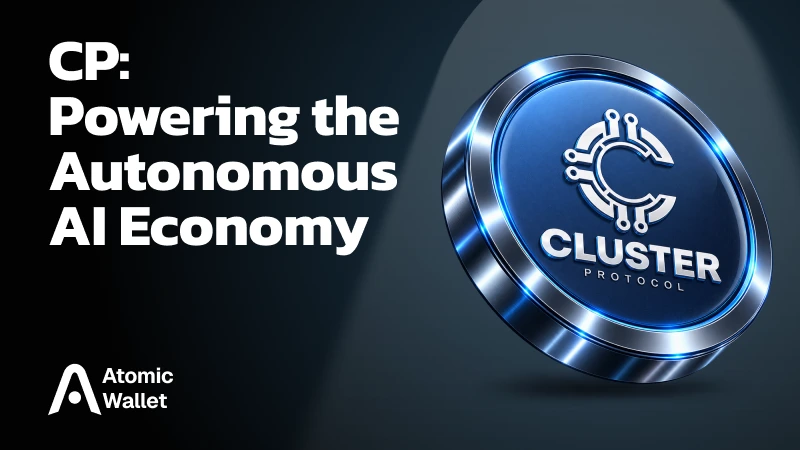
Cluster Protocol is trying to collapse that stack into one environment. It combines AI inference, GPU compute and tokenized datasets with settlement on Base, giving developers and autonomous agents a single layer for accessing and paying for AI infrastructure.
The $CP token sits inside that model as the network’s coordination and settlement asset, linking usage across inference, compute, data and ecosystem incentives.
What Is Cluster Protocol (CP)?
Cluster Protocol is an orchestration layer that connects AI models, compute and tokenized data through one infrastructure stack.
Its inference gateway provides access to more than 500 AI models across text, image, audio, embeddings and reranking. The same platform also connects GPU resources for custom workloads and a data marketplace where datasets can be stored through IPFS and represented onchain.
Instead of forcing developers to integrate each service separately, Cluster brings them behind one API and one settlement layer on Base. That makes the protocol less like a standalone AI marketplace and more like infrastructure for building autonomous workflows that need multiple AI resources at once.
How Cluster Protocol Connects Models, Data and Compute
Cluster Protocol brings three core AI resources into one orchestration layer:
- AI inference: developers can access 500+ models across text, image, audio, embeddings and reranking through a unified gateway.
- Tokenized data: datasets can be stored through IPFS, represented onchain and monetized with automated revenue distribution.
- GPU compute: the network connects compute resources for custom model hosting, fine-tuning and heavier AI workloads.
The important part is how these pieces interact. Cluster is designed to route applications and agents across models, data and compute without forcing developers to manage separate infrastructure for every task.
Why x402 Matters for Autonomous AI Agents
x402 gives AI agents a way to pay for digital services directly as they use them.
Instead of relying on subscriptions, pre-funded accounts or traditional API billing, an agent can pay per request through an HTTP-native payment flow. Cluster uses that model across its infrastructure stack, with settlement taking place on Base.
A typical interaction can be reduced to four steps:
- An agent requests a model, dataset or compute resource.
- The service returns the price for that request.
- The agent authorizes the payment.
- Access is delivered and the transaction settles onchain.
That matters because autonomous software needs more than intelligence. It also needs an economic layer that lets it purchase resources without a human approving every action. x402 gives Cluster a native payment rail for that machine-to-machine activity.
What Is the CP Token Used For?
$CP is the utility and settlement asset that connects activity across the Cluster ecosystem.
One distinction matters: CP staking does not secure blockchain consensus or validate transactions. It functions more like an access and incentive layer inside the protocol. $CP also does not currently provide governance rights.
As utility tokens become more tightly connected to onchain services, direct asset control becomes part of the experience as well.
Atomic Wallet gives users a self-custody environment for managing crypto assets while keeping control of their private keys.
CP Tokenomics and Unlock Schedule
Cluster Protocol has a fixed maximum supply of 5 billion CP, with around 1.369 billion tokens, or 27.38% of supply, circulating at launch.
The launch structure keeps insider supply heavily locked:
- Team & Advisors: 18-month cliff, followed by 24 months of linear vesting.
- Series A & Strategic: 12-month cliff, followed by 24 months of vesting.
- Seed: 12-month cliff, followed by 24 months of vesting.
- Liquidity allocation: fully available at launch to support market depth and exchange requirements.
- Community allocation: partly liquid at launch, with the remainder distributed over time through rewards and incentives.
That means no team or investor tokens entered circulation on day one. The trade-off is that large scheduled unlocks still sit further out, making vesting dates an important part of the long-term CP supply picture.
Why the CP Launch Structure Stands Out
CP launched without team or private-investor tokens entering circulation on day one.
That reduces immediate insider sell pressure compared with launches where early backers receive liquid allocations at TGE. Instead, initial circulating supply comes from community, liquidity and foundation allocations, while seed and Series A investors remain locked for 12 months and the team for 18 months.
The structure gives Cluster more time to build usage before major insider unlocks begin. But it does not remove dilution risk. Once those cliffs expire, a meaningful share of the 5 billion CP supply starts entering circulation, making future unlock schedules important for holders to track.
CodeXero Brings Cluster Infrastructure to dApp Builders
CodeXero turns Cluster’s infrastructure into a browser-based environment for building onchain applications with natural language.
Instead of manually wiring together models, datasets, compute providers and blockchain components, developers can describe an application and use Cluster’s stack underneath it.
Project-reported usage already includes:
- 300K+ connected wallets
- 25K+ deployed dApps
- 4B+ AI tokens processed
The bigger role of CodeXero is distribution. It gives builders a direct application layer on top of Cluster’s inference, data and compute products, creating another path for infrastructure usage to translate into activity across the broader CP ecosystem.
The CP Bull Case: AI Agents Need Their Own Economic Rails
Cluster is betting that autonomous agents will need infrastructure they can access, pay for and coordinate without human intervention.
The bull case rests on four drivers:
- Agent growth: more autonomous applications increase demand for models, data and compute.
- x402 payments: machine-native settlement makes pay-per-use infrastructure easier for agents to consume.
- Unified infrastructure: inference, datasets and GPU resources sit behind one orchestration layer instead of separate integrations.
- Base distribution: Cluster can tap into an established EVM ecosystem while keeping payments and token activity onchain.
If agent-driven software becomes a larger part of the crypto and AI stack, Cluster has a chance to sit underneath that activity as infrastructure rather than compete as another consumer-facing AI app.
What Could Hold Cluster Protocol Back?
Several risks could weaken the CP thesis:
- Crowded AI infrastructure market: Cluster competes with centralized AI providers and a growing number of decentralized compute, inference and data networks.
- Usage may not translate into token demand: strong product activity only matters for CP if enough of that activity creates sustained token utility.
- Future unlock pressure: team and investor allocations are locked at launch, but significant supply begins vesting after the initial cliffs expire.
- Dependence on ecosystem adoption: x402, tokenized datasets and agent payments still need broader developer adoption to reach meaningful scale.
- Execution risk: combining models, compute, data and payments into one reliable stack is more difficult than operating any one of those services alone.
Cluster has a broad infrastructure thesis, but the market will ultimately judge it on recurring usage rather than the number of components inside the stack.
Can Cluster Protocol Turn AI Usage Into CP Demand?
Cluster Protocol has built a broad stack around one core idea: autonomous agents should be able to access models, data and compute through the same infrastructure they use to settle payments.
The key question is whether that usage creates durable demand for $CP. Product traction, integrations and agent activity can grow independently of token value, so the long-term thesis depends on how tightly CP remains connected to payments, access and incentives across the network.