What Is Cap? The Stablecoin Protocol Built on Verifiable Credit
Stablecoins have become one of the most important sectors in crypto, but generating sustainable yield on digital dollars remains a difficult challenge.
Many protocols rely on complex strategies, centralized decision-making, or opaque lending practices that force users to trust intermediaries they cannot fully verify.
Cap is taking a different approach.
Built on Ethereum and supported by the MegaETH ecosystem, Cap is creating a credit marketplace where yield is backed by onchain financial guarantees rather than blind trust. By combining stablecoins, transparent collateral, and market-driven underwriting, the protocol aims to bring a more verifiable model to DeFi credit.
At the center of this system are cUSD, stcUSD, and a network of underwriters who put their own capital at risk to secure lending activity.
Why Cap Is Getting Attention
Cap has quickly emerged as one of the most closely watched projects in the intersection of stablecoins, credit markets, and DeFi yield.
The protocol’s approach stands out because it focuses on solving a long-standing problem in both traditional finance and crypto lending: how to create sustainable yield without relying on opaque risk management.
Several factors are driving interest in the project:
- the growth of stablecoin markets
- increasing demand for verifiable yield
- MegaETH ecosystem support
- innovative credit infrastructure
- the CAP token launch
Unlike many yield protocols that depend on trust in a centralized team or institution, Cap is attempting to make guarantees visible and enforceable onchain.
This “verification over trust” philosophy has helped the project attract attention from users looking for a more transparent approach to credit and stablecoin-based yield generation.
What Is Cap?
Cap is a credit protocol built on Ethereum that uses onchain financial guarantees to support lending, borrowing, and stablecoin yield generation.
Rather than relying on a single institution to evaluate and manage risk, Cap distributes underwriting decisions across a marketplace of independent participants.
The protocol consists of several core components:
- cUSD — a stable digital dollar
- stcUSD — a yield-bearing version of cUSD
- Underwriters — participants who provide financial guarantees
- Borrowers — entities seeking access to capital
- Lenders — users providing liquidity to earn yield
The key innovation is that every loan is backed by dedicated collateral supplied by an underwriter.
If a borrower defaults, the underwriter’s collateral is designed to absorb losses according to protocol rules enforced by smart contracts.
By aligning incentives between all participants and making guarantees transparent onchain, Cap aims to create a credit market that is safer, more scalable, and easier to verify than many existing alternatives.
The Problem With Traditional Credit Markets
Cap was created to address one of the biggest structural weaknesses in lending markets: the misalignment between those managing risk and those providing capital.
This issue is often described as the principal-agent problem.
In both traditional finance and DeFi, the people making lending decisions are not always the same people bearing the consequences when those decisions go wrong.
This can create several challenges:
- prioritizing growth over credit quality
- opaque underwriting processes
- limited visibility into collateral
- concentration of decision-making power
- delayed discovery of losses
Crypto investors have seen these problems repeatedly through lending failures, hidden leverage, and risk management breakdowns.
Cap argues that the root problem is not simply bad underwriting—it is a system where incentives are not fully aligned.
Its solution is to make those evaluating risk put their own capital behind every decision.
How Cap Works
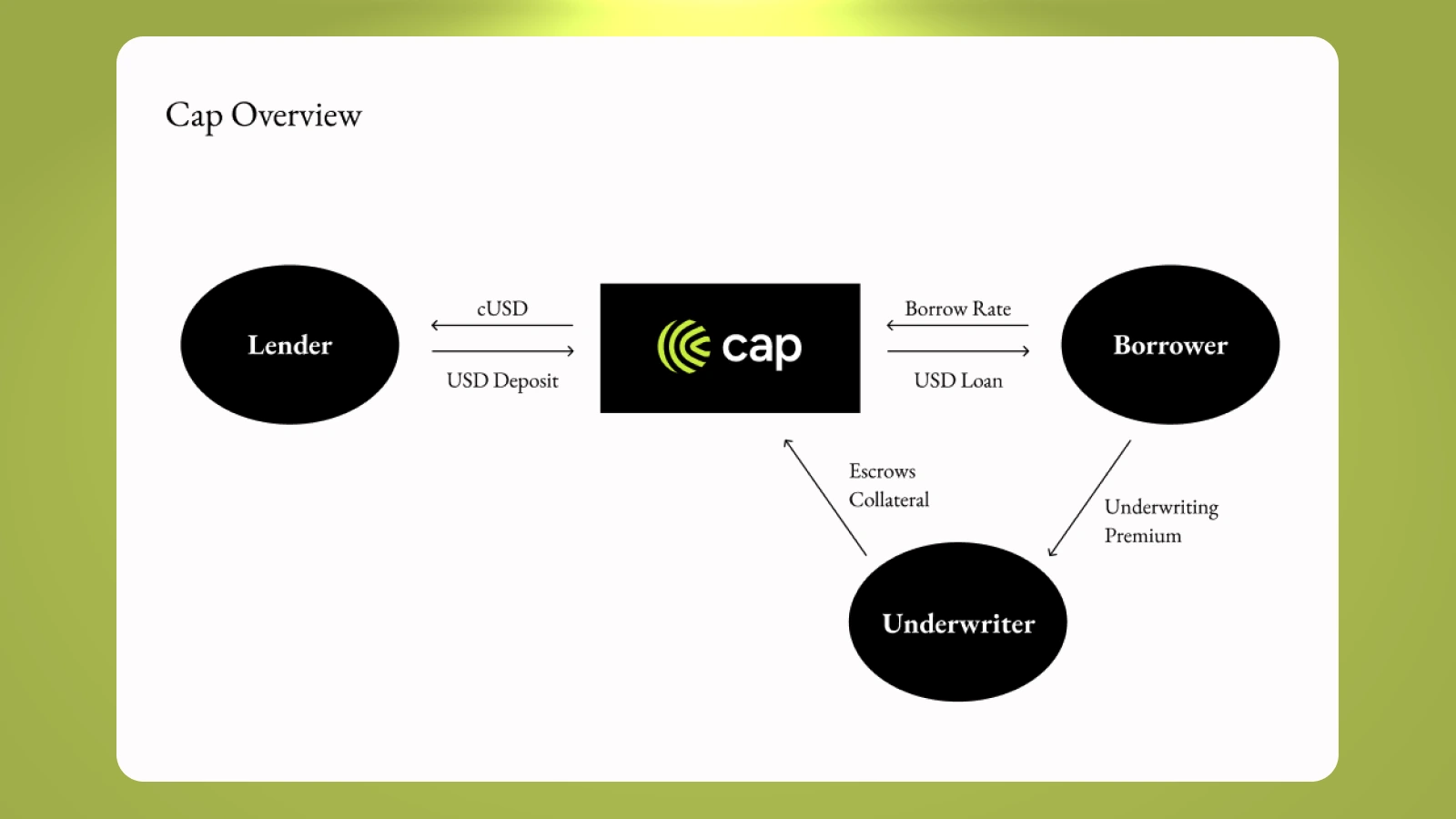
Cap introduces a decentralized credit marketplace where lenders, borrowers, and underwriters interact through smart contract-enforced financial guarantees.
Instead of relying on a central credit manager, the protocol distributes responsibility across independent market participants.
The system operates through several roles:
- Lenders provide capital to earn yield
- Borrowers access funding through the marketplace
- Underwriters back loans with their own collateral
- Smart contracts enforce guarantees automatically
- Collateral vaults secure risk coverage onchain
When a borrower receives funding, an underwriter must commit collateral to support that position.
Because the underwriter’s capital is directly exposed to potential losses, they are incentivized to evaluate credit quality carefully before providing coverage.
This structure is designed to align incentives across the marketplace while making risk exposure visible and verifiable onchain rather than hidden behind institutional reporting or trust-based assumptions.
cUSD vs stcUSD Explained
Cap separates stability and yield into two different assets designed for different purposes within the ecosystem.
This structure allows users to choose between holding a stable dollar asset or participating in yield generation.
cUSD is designed to function as the protocol’s stable unit of account, maintaining exposure to the U.S. dollar.
stcUSD is designed for users seeking yield generated through the protocol’s credit marketplace.
By separating these functions, Cap aims to create a more flexible stablecoin ecosystem where users can select the level of risk and return that best matches their objectives.
This dual-asset model has become increasingly common across DeFi as protocols seek to balance stability, liquidity, and yield generation.
What Makes Cap Different?
Cap’s core philosophy is simple: verify guarantees instead of trusting intermediaries.
Many lending platforms rely on centralized risk managers, private reporting, or opaque portfolio structures.
Cap attempts to replace those assumptions with transparent, onchain guarantees that anyone can inspect.
Several characteristics distinguish the protocol:
- verification over trust
- transparent collateral backing
- isolated risk exposure
- market-driven underwriting
- smart contract enforcement
The protocol also isolates underwriting relationships, meaning a problem in one position is not automatically designed to spread throughout the broader system.
By making collateral visible and guarantees enforceable onchain, Cap aims to create a lending environment where users can independently verify risk protections rather than relying solely on institutional credibility.
The CAP Token Explained
CAP is the governance and utility token that helps align participants with the long-term success of the protocol.
Unlike many DeFi projects that rely heavily on token incentives to attract liquidity, Cap has emphasized a more conservative approach to token distribution and ecosystem growth.
The token is designed to support several functions:
- governance participation
- protocol parameter voting
- ecosystem coordination
- discretionary buyback mechanisms
- future platform integrations
CAP holders can vote on important protocol decisions, including changes related to collateral requirements, approved reserve assets, borrower eligibility, and other core risk-management parameters.
As the protocol evolves, the team has indicated that CAP may become more deeply integrated into future versions of the platform, expanding its role beyond governance alone.
Cap and MegaETH
Cap has become one of the most closely followed projects emerging from the MegaETH ecosystem.
MegaETH is focused on building high-performance blockchain infrastructure capable of supporting real-time applications and more demanding onchain experiences.
Within that vision, Cap represents a financial use case centered on credit markets and stablecoin yield.
Several factors connect the project to the broader MegaETH narrative:
- ecosystem acceleration support
- real-time finance infrastructure
- next-generation DeFi applications
- growing developer attention
- expanding ecosystem visibility
As MegaETH continues attracting builders and users, projects such as Cap could benefit from increased exposure and network effects.
This relationship has contributed to growing interest in Cap among investors looking for emerging opportunities at the intersection of stablecoins, credit markets, and new blockchain infrastructure.
Risks Investors Should Know
Although Cap aims to improve transparency in credit markets, it still faces many of the risks common to emerging DeFi protocols.
No lending system can completely eliminate risk, even when collateral and guarantees are visible onchain.
Users should consider several factors before participating:
- smart contract vulnerabilities
- borrower default risk
- stablecoin-related risks
- liquidity constraints
- regulatory uncertainty
- adoption and execution challenges
Cap’s model depends on the quality of underwriting decisions and the effectiveness of its guarantee structure during periods of market stress.
While onchain transparency can improve visibility, it does not guarantee that every credit event will be resolved without losses.
As with any DeFi protocol, users should carefully evaluate risk tolerance before committing capital.
Managing CAP and Stablecoins Safely
Secure asset management remains essential when participating in stablecoin and DeFi ecosystems.
Whether holding CAP, cUSD, stcUSD, or other digital assets, maintaining control over funds should be a priority.
Good security practices include:
- storing recovery phrases offline
- verifying wallet addresses before transactions
- avoiding phishing websites and fake applications
- reviewing token approvals regularly
- using trusted self-custody solutions
Many DeFi participants prefer self-custody because it removes reliance on centralized custodians and gives users direct control over their assets.
Atomic Wallet provides a self-custodial environment for managing cryptocurrencies and stablecoins while allowing users to retain ownership of their private keys and funds.
Risks Investors Should Know
Although Cap aims to improve transparency in credit markets, it still faces many of the risks common to emerging DeFi protocols.
No lending system can completely eliminate risk, even when collateral and guarantees are visible onchain.
Users should consider several factors before participating:
- smart contract vulnerabilities
- borrower default risk
- stablecoin-related risks
- liquidity constraints
- regulatory uncertainty
- adoption and execution challenges
Cap’s model depends on the quality of underwriting decisions and the effectiveness of its guarantee structure during periods of market stress.
While onchain transparency can improve visibility, it does not guarantee that every credit event will be resolved without losses.
As with any DeFi protocol, users should carefully evaluate risk tolerance before committing capital.
Managing CAP and Stablecoins Safely
Secure asset management remains essential when participating in stablecoin and DeFi ecosystems.
Whether holding CAP, cUSD, stcUSD, or other digital assets, maintaining control over funds should be a priority.
Good security practices include:
- storing recovery phrases offline
- verifying wallet addresses before transactions
- avoiding phishing websites and fake applications
- reviewing token approvals regularly
- using trusted self-custody solutions
Many DeFi participants prefer self-custody because it removes reliance on centralized custodians and gives users direct control over their assets.
Atomic Wallet provides a self-custodial environment for managing cryptocurrencies and stablecoins while allowing users to retain ownership of their private keys and funds.
Conclusion: Can Cap Build a Safer Credit Market?
Cap is attempting to redesign credit markets around transparency, verifiability, and aligned incentives.
Rather than asking users to trust centralized managers or opaque lending structures, the protocol seeks to make risk visible through onchain guarantees backed by collateral and enforced by smart contracts.
Its long-term vision combines several powerful trends:
- the growth of stablecoins
- rising demand for onchain yield
- expansion of private credit markets
- increased transparency in finance
- the evolution of DeFi infrastructure
If successful, Cap could help demonstrate that credit markets do not need to rely on hidden risks and trust-based assumptions to function at scale.
Whether the protocol can achieve widespread adoption remains to be seen, but its focus on verifiable credit makes it one of the more distinctive experiments emerging in the next generation of DeFi.