What Is Gno.land? A Go-Powered Smart Contract Platform
The blockchain industry has spent years competing over speed, scalability, and lower transaction costs. Gno.land takes a different starting point. Instead of asking how to build a faster blockchain, it asks how smart contracts can become easier to write, understand, and maintain for millions of developers who already know Go.
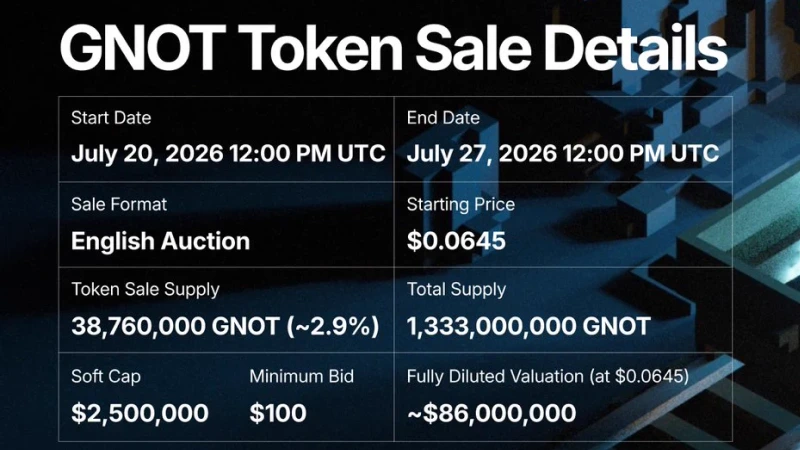
That vision has gained renewed attention as GNOT entered its public sale on Sonar, ahead of the network’s expected mainnet launch in Q3 2026. While the token sale introduces Gno.land to a broader audience, the project’s long-term ambition is far bigger: creating a smart contract platform where developers can build decentralized applications using a language that feels almost identical to standard Go.
What Is Gno.land?
Gno.land reimagines smart contract development with the Go programming language.
Created by Jae Kwon, the co-founder of Cosmos and Tendermint, Gno.land is a Layer 1 smart contract platform powered by Gno—a blockchain-native interpretation of Go (Golang). Rather than introducing yet another domain-specific language, the project adapts one of the world’s most widely used programming languages for deterministic, onchain execution.
At the heart of the platform is the idea that blockchain development shouldn’t require developers to start from scratch. Because Gno remains nearly identical to Go, developers can quickly build decentralized applications, reusable packages, and onchain applications known as Realms, while benefiting from a familiar syntax and development experience tailored for blockchain.
Why Did Gno.land Choose Go Instead of Solidity?
Millions of Go developers can start building without learning an entirely new language.
Most smart contract platforms ask developers to adopt a blockchain-specific language before they can build their first application. Gno.land reverses that approach by bringing blockchain capabilities to a language that already powers cloud infrastructure, networking software, and many of the tools behind modern internet services.
Because Gno is approximately 99% compatible with Go, developers can reuse familiar syntax, workflows, and much of the existing standard library. The result is a dramatically lower learning curve, allowing Go programmers to focus on application logic instead of spending weeks mastering a new smart contract language.
Inside Gno: A Smart Contract Language Built for Go Developers
Gno feels like Go because it was designed to preserve the developer experience, not replace it.
Rather than inventing new syntax, Gno removes only the features that conflict with deterministic blockchain execution—such as direct operating system or network access—while introducing blockchain-aware libraries for smart contract development. This design allows developers to write code that feels familiar without sacrificing the security and predictability required by decentralized applications.
How Does GnoVM Work?
GnoVM executes source code directly instead of relying on traditional bytecode.
Unlike the virtual machines used by Ethereum and many WebAssembly-based blockchains, GnoVM interprets a program’s Abstract Syntax Tree (AST)—the structured representation of the original source code. This keeps execution closely aligned with what developers actually write, making applications easier to understand, debug, and maintain.
Key characteristics of GnoVM include:
- Direct execution of source code through its AST rather than compiled bytecode.
- Automatic state persistence, eliminating the need to manually serialize application data.
- Built-in Merkleization, allowing blockchain state to be stored securely and efficiently.
- Deterministic execution, ensuring every node reaches the same result.
- Program suspension and recovery, enabling applications to freeze and later resume execution while preserving their state.
By automating much of the complexity traditionally associated with blockchain development, GnoVM allows developers to focus on application logic instead of storage management and low-level virtual machine behavior.
What Are Realms?
Realms turn smart contracts into interactive onchain applications.
Most blockchain platforms deploy individual smart contracts that expose a set of callable functions. Gno.land introduces Realms—persistent onchain environments that can store logic, state, and even user-facing content within a single application.
A Realm can function as far more than a contract. Developers can build DAOs, games, social applications, marketplaces, knowledge hubs, or other decentralized services where both the application logic and its evolving state live directly onchain. Users can even explore Realm source code through gnoweb, making applications transparent, inspectable, and easy to discover.
Why Gno.land Is Different
Gno.land focuses on improving how developers build, not just how blockchains perform.
Rather than competing solely on throughput or transaction fees, Gno.land aims to make blockchain development more accessible by reducing complexity for one of the world’s largest developer communities.
What Is GNOT Used For?
GNOT powers both network operations and ecosystem governance.
As the native token of Gno.land, GNOT plays a central role in keeping the network operational while giving the community a stake in its future development.
Its primary functions include:
- Paying gas fees for onchain transactions.
- Covering storage deposits, with tokens bonded when data is written to the blockchain.
- Participating in governance as the ecosystem evolves.
- Supporting network security and validator incentives through the broader token economy.
Beyond its technical role, GNOT also underpins the ecosystem’s long-term growth, including developer funding, community initiatives, and treasury programs designed to expand applications built on Gno.land.
Managing GNOT Securely
Self-custody gives you full control over your GNOT.
After the Gno.land mainnet launches and GNOT becomes widely available, storing the token in a non-custodial wallet ensures that you—not a third party—control your private keys.
Atomic Wallet provides a secure way to manage GNOT alongside other digital assets from a single interface while maintaining full ownership of your funds.
The Bigger Picture
Gno.land is trying to lower the barrier to Web3 development, not raise the ceiling on blockchain performance.
Many Layer 1 networks compete by promising higher throughput, lower fees, or new consensus mechanisms. Gno.land takes a different path by focusing on the developer experience. If building decentralized applications becomes as intuitive as writing conventional Go software, blockchain development could become accessible to a much broader community of engineers.
That vision extends beyond a programming language. With Realms, an AST-based virtual machine, and a growing ecosystem backed by developer funding, Gno.land is positioning itself as a platform where developers can build expressive onchain applications without abandoning familiar tools. Whether that approach gains widespread adoption will ultimately depend on the quality of the applications the community creates—not just the technology itself.