What Is KYC in Crypto? How It Works and What You Need
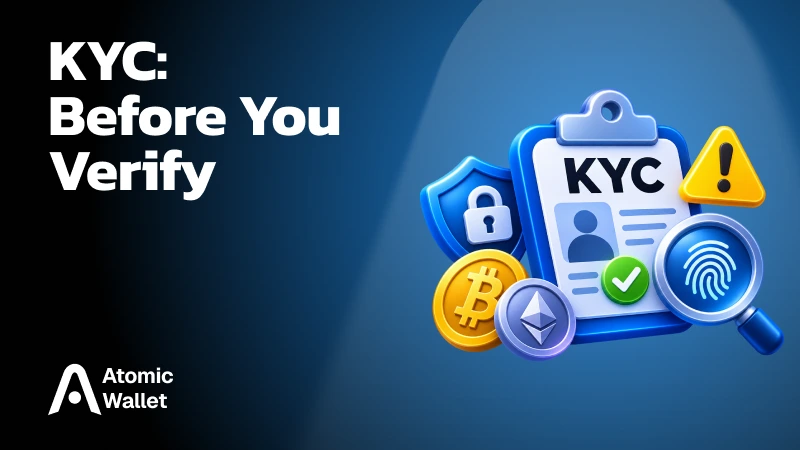
A crypto service asks for your passport, a selfie, or proof of address before you can buy or withdraw funds. These requests usually form part of KYC, an identity verification process used by exchanges and other financial services.
The requirements depend on the service you are using. Creating a self-custody wallet, opening an exchange account, and buying crypto through an integrated payment provider can involve different checks. Understanding who requests your information helps you decide what to share and what to expect.
What Is KYC in Crypto?
KYC stands for Know Your Customer. In crypto, it refers to the checks a service uses to establish a customer’s identity and verify their personal information.
For example, an exchange may ask for your legal name, date of birth, and a government-issued ID when you open an account. It compares the information you provide with supporting documents or other reliable sources before granting access to certain services.
A wallet address alone does not establish someone’s legal identity. KYC connects a customer’s account and activity with a verified person. Depending on the circumstances, the provider may later request updated information or additional evidence.
These checks belong to the service’s customer verification process. When you send Bitcoin, the network validates the transaction against its rules, including the required signatures. Uploading a passport is a separate requirement that an exchange or another provider may impose when you use its services.
Why Do Crypto Platforms Require KYC?
Crypto platforms require KYC to meet applicable financial regulations, identify their customers, and assess the risks associated with providing services to them.
Regulated exchanges and payment providers operate under rules designed to prevent money laundering, terrorist financing, and other financial crimes. The FATF standards for virtual asset services include customer due diligence, record keeping, and reporting suspicious transactions. Countries implement these standards through their own legal frameworks.
Identity checks give a provider information it can use to assess an account and investigate potential misuse. Depending on the service, checks may also help identify stolen identities, duplicate accounts, or customers who are ineligible for particular products.
For users, KYC can determine access to fiat purchases, trading, withdrawals, or higher limits. The exact conditions depend on the platform, its regional entity, and the service being requested.
How Does Crypto KYC Verification Work?
Crypto KYC typically involves submitting personal information, completing the provider’s identity checks, and waiting for approval or a request for additional details. The process may combine automated checks with manual review.
A typical verification flow looks like this:
- Enter your personal details — Provide the information requested, such as your legal name, date of birth, and residential address
- Verify your identity — Submit an accepted ID or use another verification method offered by the provider
- Complete a selfie or liveness check if required — Follow the prompts to help confirm that you are the person associated with the identity document
- Wait for review — The provider checks the information, assesses eligibility and risk, and may ask for clarification
- Check the result — Approval enables the services available to your account; an incomplete submission may require corrected information or another document
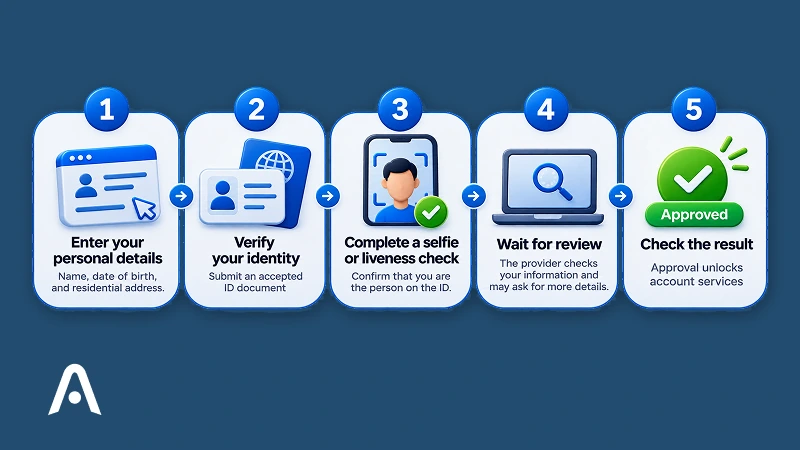
Approval can also be followed by later reviews. Providers may need updated documents or further information when account details, activity, or regulatory requirements change.
What Documents Do You Need for Crypto KYC?
Crypto KYC commonly requires a government-issued ID and may include a selfie, proof of address, or evidence of where your funds came from. The exact requirements depend on the provider, your location, and the review being performed.
Different documents answer different questions:
Check the provider’s accepted documents before uploading anything. Document types, validity periods, and image requirements vary.
Identity verification and financial evidence serve separate purposes. A passport establishes who you are; a source-of-funds request asks how you obtained the assets involved.
Submit clear, complete files that match the requested details. Follow the provider’s instructions on redacting information so essential evidence remains visible.
Some providers support bank-based identity verification. Crypto.com, for example, allows eligible customers in the Netherlands to verify through participating banks using iDIN, without uploading identity documents. The bank authentication provides an alternative way to complete the identity check.
How Long Does Crypto KYC Take?
Crypto KYC may complete almost immediately through automated checks, while manual review can take hours or several business days. Processing depends on the provider, the application, and whether further information is needed.
Your application’s status helps determine the next step:
- Pending: Review is still underway; check for requests for additional information and the provider’s stated processing window
- Incomplete: A required step or document needs attention; open the request and correct the specified issue
- Rejected: Review the explanation and any available resubmission or appeal options, since the outcome may concern documents or account eligibility
If the stated processing window has passed, contact support through the official app or website.
Repeated submissions can complicate an ongoing review. Kraken specifically advises against uploading the same documents again unless it requests replacements.
Is Crypto KYC Safe? Privacy Risks and Fake Requests
KYC can be a legitimate requirement, but sharing identity documents carries privacy risks. Its safety depends on who receives your information, how you submit it, and how the provider protects it.
Documents can be exposed through breaches or misuse of access.
Before submitting documents:
- Open the provider’s official app or website directly and check for the request inside your account
- Confirm which company handles verification, particularly when using an integrated service
- Read its privacy notice for information about data sharing, storage, and retention
- Submit only the information requested through the verified submission process
Your recovery phrase and private keys are never identity documents. A request to disclose them gives someone access to your crypto. Pressure to move funds to a supposed “safe wallet” is another warning sign.
Successful KYC also has a specific purpose: establishing your identity for a service. It does not certify the platform’s solvency, prevent every scam, or guarantee that your personal information will remain secure.
KYC, AML, and the Crypto Travel Rule
KYC establishes who a customer is. AML is the broader framework for preventing money laundering, while the Travel Rule concerns information about the sender and recipient of covered transfers.
These processes address related questions:
The FATF standards include customer due diligence, record keeping, suspicious-transaction reporting, and transfer-information requirements. Local laws determine how these obligations apply.
This explains why an already verified customer may receive further questions. A passport establishes identity; evidence of income can explain the origin of funds; a separate check can assess control over a wallet address.
For example, the EU’s Transfer of Funds Regulation, applicable since December 30, 2024, requires providers to assess whether their customer owns or controls the self-hosted address involved in covered transfers exceeding €1,000. Identity and transfer-information requirements can also apply below that amount.
The regulation does not require those personal details to be published in the blockchain transaction itself. Providers can exchange the required information separately through secure channels.
In July 2026, FATF reported that 83% of surveyed jurisdictions had passed legislation implementing the Travel Rule, up from 73% in 2025. The organization also highlighted continuing gaps in supervision and enforcement, showing that legal adoption and implementation remain separate challenges.
Do Crypto Wallets Require KYC?
Many self-custody wallets let you create a wallet and manage your own keys without KYC. Verification may still be required by an exchange, payment provider, or swap service you use alongside the wallet.
The requirement depends on the activity and the company handling it:
Using several features inside one app can involve several providers. A wallet’s setup requirements therefore do not establish the requirements for every purchase or exchange available through it.
Can You Use Crypto Without KYC?
Yes. Many self-custody wallets support holding, sending, and receiving crypto without identity verification. Buying, selling, or exchanging through another service introduces that provider’s requirements.
“No KYC” describes a particular service or activity. Check what the term covers: creating a wallet, making a purchase, and completing a swap are separate operations. A service that does not request identification at the start may still have conditions allowing additional checks.
The absence of KYC also does not make transactions anonymous. Bitcoin transactions are publicly recorded, and addresses can become associated with people through exchanges, published information, or transaction patterns.
For example, if you withdraw BTC from a verified exchange account to your own wallet, the exchange can associate the destination address with that withdrawal. The receiving wallet does not need to collect your identity for that connection to exist.
When choosing a wallet, consider both identity collection and transaction privacy. Our guide to privacy-focused Bitcoin wallets compares features such as account requirements, network privacy, and control over transaction construction.
Manage Your Crypto With Atomic Wallet
Atomic Wallet lets you create a self-custody wallet and manage supported crypto without opening an exchange account or submitting identity documents for basic wallet use.
You can generate receiving addresses, receive crypto, and authorize transfers from your own wallet. Your keys are stored locally on your device, and you are responsible for protecting your recovery backup.
Purchases and swaps available through our app involve separate service providers. Their verification requirements apply when you use those features, as explained in our AML/KYC policy.