What Is TVL in Crypto? Total Value Locked Explained
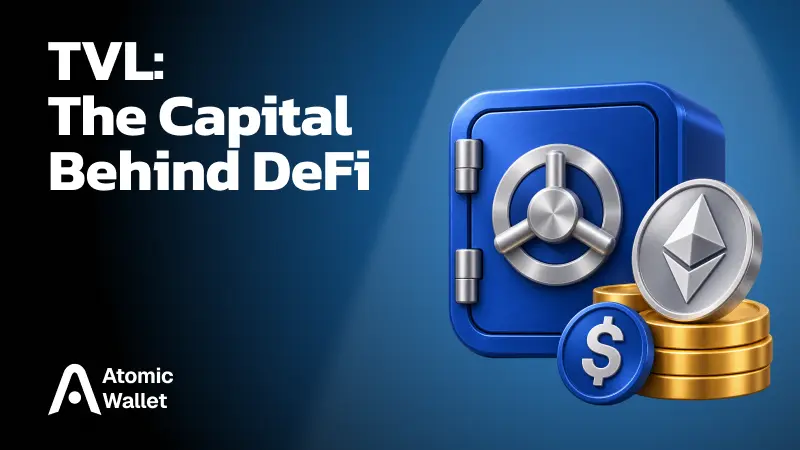
TVL, or total value locked, measures the value of assets deposited in a DeFi protocol. It helps you see where capital is concentrated across lending platforms, decentralized exchanges, and other onchain products.
But a rising TVL doesn’t always mean new money is arriving. Token prices can push the number higher, and generous rewards can attract deposits that leave just as quickly. Understanding what sits behind the figure makes it far more useful than a leaderboard position.
What Is TVL in Crypto?
Total value locked (TVL) is the combined market value of the assets counted as deposits in a DeFi protocol, usually expressed in US dollars.
Those assets serve different purposes depending on the product:
- On a lending platform, users supply assets that support borrowing
- On a decentralized exchange, liquidity providers deposit tokens into trading pools
- In a yield vault, users deposit assets that a strategy puts to work
TVL measures the assets held at a particular moment. It doesn’t show how much money has ever entered the protocol, how much users have traded, or how much revenue the platform earns.
The word “locked” can also be misleading. Deposits don’t always have a fixed lockup period. Some can be withdrawn whenever the protocol’s conditions allow, while others involve withdrawal queues, collateral requirements, or limits on available liquidity.
A protocol’s TVL therefore describes the scale of its deposits. Assessing how safely and effectively it uses that capital takes a closer look.
How Is Total Value Locked Calculated?
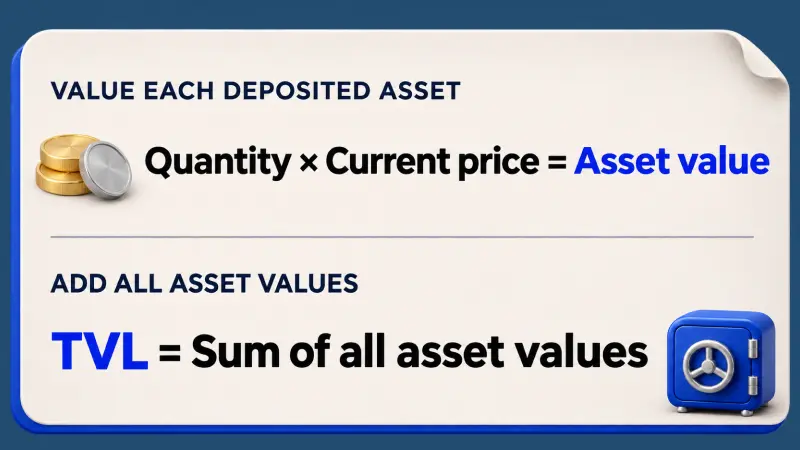
TVL is calculated by multiplying the quantity of each counted asset by its market price, then adding those values together.
Suppose a protocol holds two assets:
- 100 ETH at $2,000 each: $200,000
- 50,000 USDC at an assumed price of $1 each: $50,000
Its total value locked is $250,000.
The calculation includes the assets users deposit, which may be entirely different from the protocol’s own token. A lending platform with a governance token, for example, might hold deposits of ETH, stablecoins, and other supported assets.
Prices matter throughout the calculation. Stablecoins should also be valued at their observed price: if one loses its peg, assuming every token is still worth $1 would overstate its contribution to TVL.
The arithmetic is straightforward. Deciding which assets belong in the calculation depends on the provider’s methodology—a distinction that matters when comparing figures across websites.
Why Does TVL Go Up or Down?
TVL changes when asset prices move, deposits enter or leave, or the assets included in the measurement change.
A rising dollar figure can reflect growing deposits, appreciating tokens, or both. Separating those effects helps you understand what actually happened.
Token Price Changes
Return to our example: the protocol holds 100 ETH and 50,000 USDC, worth $250,000 altogether.
If ETH rises from $2,000 to $3,000 while USDC stays at $1, TVL reaches $350,000—a 40% increase without a single new deposit.
The reverse also applies. Falling token prices can reduce TVL even when users keep their assets in the protocol.
Deposits and Withdrawals
New deposits increase the quantity of assets held. Withdrawals reduce it.
If someone adds 10,000 USDC after the price increase above, TVL rises from $350,000 to $360,000, assuming prices remain unchanged. This time, the increase comes from additional capital.
TVL can even rise while assets leave. Suppose our example protocol starts with 100 ETH at $2,000 and 50,000 USDC at $1: $250,000 in total. Users then withdraw 20 ETH, but ETH’s price rises to $3,000. The remaining 80 ETH and 50,000 USDC are worth $290,000—16% more than before, despite the withdrawal.
Incentives and Temporary Deposits
Token rewards, points campaigns, and promotional yields can attract deposits quickly. Some users move their capital between protocols to capture whichever incentives look most attractive.
Those deposits still represent assets in the protocol, but they may leave when rewards fall or a competing offer appears. A sudden TVL spike deserves context: how much activity accompanies it, who supplies the capital, and whether deposits remain after the campaign ends.
Protocol TVL vs. Chain TVL: What’s the Difference?
Protocol TVL measures deposits in a particular DeFi application, while chain TVL aggregates qualifying deposits across applications on one blockchain.
The same metric appears at several levels. Check which one you’re looking at before comparing figures.
A multichain protocol may have deposits on Ethereum, Arbitrum, and other networks. Its overall TVL can include all those deployments, while its Ethereum TVL covers only that portion.
These levels overlap. Adding a protocol’s Ethereum deposits to Ethereum’s chain TVL would count those deposits again.
Chain TVL also differs from the market cap of the network’s native coin. Ethereum’s DeFi TVL measures qualifying deposits in applications; ETH’s market cap measures the circulating supply of ETH multiplied by its price.
Why Do TVL Figures Differ Between Websites?
TVL figures differ because providers may count different assets, cover different deployments, and use different prices or aggregation rules.
Before treating a discrepancy as an error, check whether both websites are measuring the same thing.
Different Assets and Settings
One dashboard might show a protocol’s combined deposits across every supported chain. Another might display a single network or an older version of the application.
Category settings can also change the result. DefiLlama, for example, treats borrowed assets, staking of a protocol’s own token, and Pool2 deposits as separate categories or settings. Pool2 generally refers to liquidity involving the protocol’s own token.
DefiLlama also excludes native proof-of-stake deposits from chain DeFi TVL. It tracks liquid-staking protocols separately, but excludes their deposits from chain TVL by default.
These are provider-specific rules. Another analytics service may use a different definition, so matching labels don’t guarantee matching calculations.
Finally, compare timestamps and pricing sources. Rapid market movements, a depegged asset, or different update schedules can produce different dollar totals.
Liquid Staking and Double Counting
Suppose someone deposits $1,000 worth of ETH into a liquid-staking protocol and receives stETH representing that position. They then supply the stETH to a lending platform.
Both protocols can report deposits associated with that capital. But adding their figures together doesn’t mean $2,000 of independent capital entered DeFi: the stETH represents a claim linked to the original ETH.
Similar overlap can occur when users deposit liquidity-pool tokens elsewhere or repeatedly borrow and redeposit assets.
Individual protocol figures can still be useful. For chain-wide or market-wide totals, check how the provider handles those overlapping claims and whether its double-counting settings are enabled.
Public blockchain data doesn’t automatically make every TVL figure easy to verify. A 2025 study of 939 Ethereum-based DeFi projects found that 10.5% relied on external servers in their TVL calculations. Understanding a published total can therefore require more than checking token balances onchain.
TVL vs. Market Cap and FDV
TVL measures deposited assets, market cap measures the value of a token’s circulating supply, and fully diluted valuation (FDV) estimates its value using a broader supply figure.
These metrics answer different questions. A protocol can hold substantial deposits while its token has a relatively small market cap—or the reverse.
Check the supply definition behind FDV. Providers may use maximum supply or another full-supply figure, which can produce different results.
What Does the Market Cap-to-TVL Ratio Tell You?
The market cap-to-TVL ratio divides a protocol token’s market cap by the protocol’s TVL.
Consider this example:
- Market cap: $200 million
- FDV: $2 billion
- TVL: $1 billion
- Market cap-to-TVL: 0.2
- FDV-to-TVL: 2
The circulating token valuation is one-fifth of TVL, while the fully diluted valuation is twice TVL. Looking only at the first ratio would miss that difference.
A ratio below 1 doesn’t automatically mean the token is undervalued. Deposited assets belong to users under the protocol’s rules; holding a governance token doesn’t automatically give you ownership of those deposits.
For the ratio to be useful, investigate what the token actually does, whether protocol revenue benefits holders, and how future supply could affect them. Our guide to tokenomics explains how supply, distribution, and incentives fit into that assessment.
Also check the ratio’s direction. TVL divided by market cap is the inverse calculation and produces a different number.
Is a Higher TVL Always Better?
A higher TVL shows more deposited value, but it doesn’t guarantee a safer protocol, better returns, or more usable liquidity.
The composition and use of those deposits matter as much as their size.
A protocol funded mainly by a few large wallets can lose a substantial share of its TVL when one participant withdraws. Deposits attracted by temporary rewards may also leave once those rewards end. Neither situation is obvious from the headline total.
Asset composition adds another layer. Two protocols reporting the same dollar TVL may hold very different combinations of stablecoins, volatile tokens, and assets with limited trading liquidity.
TVL also needs product-specific context:
- Lending: Some supplied assets are already borrowed, so total deposits don’t equal funds immediately available for withdrawal
- Decentralized exchanges: Liquidity may be spread across different pairs and price ranges, so total TVL doesn’t tell you the execution price for a particular trade
- Concentrated liquidity pools: Positions outside the current price range don’t provide active liquidity at that price
Finally, large deposits don’t verify smart-contract security or prove sustainable demand. Review security assessments, borrowing or trading activity, fees, and the source of advertised yields alongside TVL.
The useful question is what that capital supports—and whether its presence is likely to last.
How to Check and Use TVL Before Using a DeFi Protocol
Check TVL alongside deposit flows, asset composition, and actual protocol activity to understand what the headline number represents.
Start with the protocol’s page on DefiLlama, then compare its coverage and methodology with the project’s own dashboard.
- Confirm the scope — Check whether you’re viewing one blockchain, one product version, or the protocol’s combined deployments
- Review the history — Look beyond today’s total to see whether deposits grew steadily, jumped during an incentive campaign, or recently declined
- Inspect the assets — Identify what makes up the deposits and whether a large share depends on one volatile token or another protocol’s receipt token
- Separate flows from prices — Use USD Inflows where available to help distinguish changes in deposited balances from changes in asset prices
- Check activity and access — Compare deposits with how the product is used and review the conditions for withdrawing your assets
That last step depends on the product. For a DEX, examine trading volume and liquidity in the pair you want to trade. For a lending platform, look at borrowing demand, utilization, and available liquidity in the relevant market.
When comparing competitors, use the same data source, settings, and observation period. Compare lending platforms with lending platforms and exchanges with exchanges: a dollar of TVL serves different purposes in each.
A useful comparison explains why capital is there, what it supports, and what could cause it to leave.
Manage Your Crypto With Atomic Wallet
Atomic Wallet lets you hold, swap, and stake supported crypto while keeping control of your private keys.
Researching TVL helps you assess DeFi protocols. Managing your own assets also means deciding where to keep them, which networks to use, and how much exposure to take.
Our wallet brings supported assets together so you can manage your holdings and access available swaps and staking options. Check the terms of each service, including fees and any withdrawal conditions, before committing funds.