What Is Mainnet? How Live Blockchain Networks Work
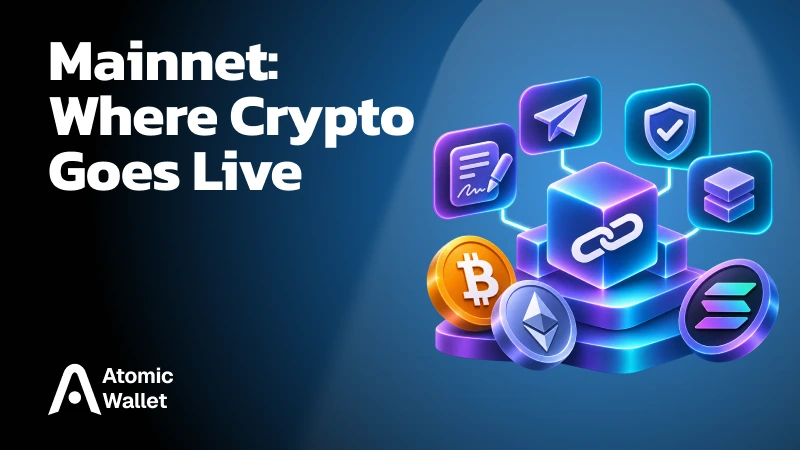
Mainnet is a blockchain’s live network, where transactions involve real crypto assets. When you send coins, swap tokens, or interact with an application on mainnet, your actions affect actual balances and can incur network fees.
You will encounter the term in wallet settings, exchange withdrawal menus, and announcements about new blockchains. The practical questions are straightforward: which network are you using, does your wallet support it, and does a launch require you to move or exchange any tokens?
What Is Mainnet in Crypto?
Mainnet, short for “main network,” is the production blockchain network used to process transactions and maintain records of real assets and activity.
It is where a network operates for everyday use. Depending on its capabilities, that can include payments, token transfers, smart contracts, staking, and decentralized applications.
There is no single universal mainnet. Ethereum Mainnet, Solana Mainnet, and Base Mainnet are separate networks with their own activity and balances. When a service asks you to choose a network, the specific name matters: “mainnet” alone does not identify where your funds should go.
The term describes a network’s operating environment. It does not name a coin or establish that every application running there is trustworthy. A token can also exist on an established mainnet without its project operating a separate blockchain.
How Does a Mainnet Work?
A mainnet processes authorized transactions under its protocol rules and records the resulting changes to balances or other blockchain data.
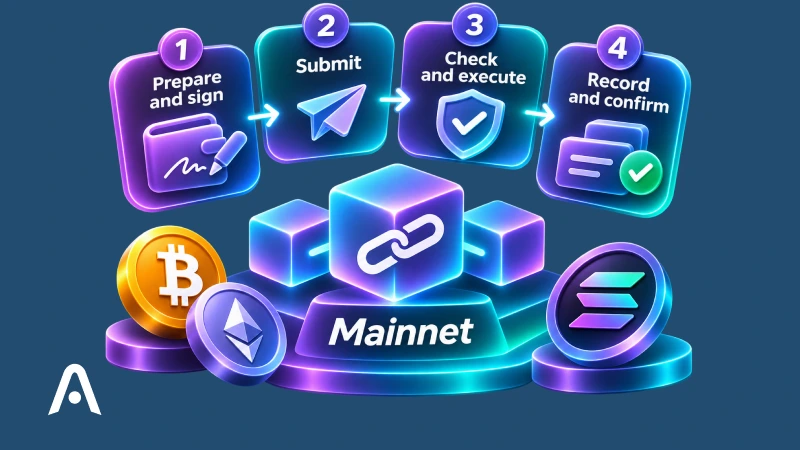
For a typical transfer, the process follows four steps:
- Prepare and sign: Your wallet creates the transaction and uses your signing credentials to authorize it
- Submit: The signed transaction is sent to the network
- Check and execute: The network checks the required signatures, available funds, fees, and other applicable rules before executing the operation
- Record and confirm: The transaction becomes part of the blockchain’s history, with its confirmation status available through wallets and explorers
The exact process depends on the network’s architecture. Proof-of-work networks use miners to produce blocks, while proof-of-stake networks use validators. Layer 2 networks can use sequencers to order transactions and a base blockchain for settlement.
Fees help pay for processing and network resources. They are commonly charged in a network’s native asset, although some applications can sponsor fees or offer other payment arrangements.
An included transaction can still return an execution error. Being recorded on mainnet does not necessarily mean the requested transfer or contract action succeeded, so check both the result and the confirmation status.
Mainnet vs. Testnet: What’s the Difference?
Mainnet is the live environment for real assets and activity, while testnet is a separate environment for testing applications, infrastructure, or protocol changes.
Test coins are commonly available through faucets. Their purpose is to let people experiment without spending mainnet funds. Receiving 10 test ETH does not give you 10 ETH on Ethereum Mainnet, and changing the network selected in your wallet does not convert one balance into the other.
You may also encounter devnet, usually a developer-focused environment, or a local network running on a developer’s computer. The terminology varies: Solana uses Devnet primarily for application development and Testnet for testing validator behavior and network upgrades.
Testnets often continue operating after mainnet launches. They provide an environment for testing later changes before those changes affect production users.
Some testnets are intentionally temporary. Ethereum’s Ephemery testnet resets to its genesis state every 28 days, clearing the accumulated network state so participants can start fresh. This makes it useful for short-term experiments and shows why testnet balances and deployed applications should not be treated as permanent.
What Is a Mainnet Launch?
A mainnet launch marks the start of a blockchain network’s production operation, allowing real assets and transactions to be processed under its rules.
The launch brings together the network software, initial blockchain state, transaction-processing infrastructure, and access through wallets or applications. Some networks open broadly at launch; others introduce users, validators, or features in stages.
Several announcements can happen around the same period, but each describes a different event:
- Token generation: A token is created or distributed
- Exchange listing: A trading platform opens a market for an asset
- Airdrop: Tokens are allocated to eligible recipients
- Protocol upgrade: An existing network changes its rules or capabilities
A project can issue a token on another blockchain before launching its own network. A mainnet can also launch without requiring holders to exchange an existing token.
The launch is a technical milestone, not proof that development is complete. Check what is actually available: who can participate, which applications work, what restrictions remain, and who controls upgrades or emergency actions.
Ethereum’s first live release, Frontier, launched on July 30, 2015, with an initial block gas limit of just 5,000—below the 21,000 gas required for a basic ETH transfer. This temporary “thawing” period gave miners and early users time to connect, illustrating how a mainnet can begin operating with deliberate restrictions.
What Is a Mainnet Swap or Migration?
A mainnet swap exchanges an existing token for its replacement, often when a project moves from a host blockchain to its own mainnet. Migration is the broader process of moving assets or activity to the new network.
A historical example is BNB. In April 2019, Binance supported the conversion of ERC-20 BNB on Ethereum into native BNB on Binance Chain. That migration had its own deposit instructions and address changes; it is not a current guide for transferring BNB.
Each migration needs a separate check:
- Networks: Where the old asset exists and where the replacement will be received
- Conversion ratio: How many new units replace each old unit
- Procedure: Whether a supporting service handles the exchange automatically or holders must act
- Timing: Any migration window, deadline, or temporary withdrawal pause
- Old-token status: Whether the original token remains usable after conversion
A mainnet swap also differs from an ordinary trading swap. Its purpose is to replace or migrate an asset under the project’s rules.
A bridge connects networks and may form part of a migration process. However, bridging between two existing networks does not itself represent a mainnet launch. Simply changing the selected network in your wallet performs neither an exchange nor a cross-chain transfer.
Mainnet Examples: Ethereum, Solana, and Base
Ethereum, Solana, and Base each have a mainnet, but their architecture, fee assets, and network rules differ.
Ethereum Mainnet
Ethereum Mainnet is Ethereum’s production blockchain, where users transfer ETH, interact with smart contracts, and manage tokens and NFTs. ETH pays network transaction fees.
It also provides settlement for Ethereum rollups. Activity on those networks remains distinct from activity recorded directly on Ethereum Mainnet.
Solana Mainnet
Solana Mainnet processes real SOL transfers, token activity, and application transactions. SOL is the network’s fee asset.
On November 16, 2026, Solana retired its “mainnet beta” designation and introduced Solana 1.0 as a shared protocol version. The announcement did not require users to migrate SOL: accounts, assets, applications, and transaction history remained on the same network.
Base Mainnet
Base Mainnet is a production Ethereum Layer 2 network. It uses ETH for gas and has its own network identifier, chain ID 8453.
Base illustrates why mainnet and Layer 1 mean different things. Mainnet describes a live operating environment; Layer 2 describes an architectural relationship with a base blockchain. Base Sepolia is its separate testing environment.
How to Use a Mainnet With Your Wallet
Use a wallet that supports the specific network and asset, verify the receiving details, and check the transaction on the matching blockchain explorer.
For a transfer, follow these steps:
- Confirm the network: Identify the exact blockchain supported by both the sending and receiving services
- Get the receiving details: Copy the address for that asset and network, including any required memo or destination tag
- Verify the token: For token transfers, check the correct contract or mint address on that network
- Check the fees: Confirm which asset pays the network fee and keep enough available if you are responsible for paying it
- Review and send: Check the destination, network, amount, and costs; consider a small initial transfer when using a new destination
- Verify the result: Open the transaction in an explorer for the same network and inspect its status and asset movements
An address’s appearance is not enough to establish compatibility. Ordinary EVM accounts can use the same address across several networks, while each network maintains separate balances.
Switching from Ethereum Mainnet to Base in a wallet changes which network you are viewing. It does not move your ETH between them. Moving value requires a supported bridge, cross-chain service, or withdrawal route.
A small test transfer on mainnet also uses real funds and incurs applicable fees. It checks the transfer route; it does not turn the operation into a testnet transaction.
Is Mainnet Safe?
A mainnet’s safety depends on its technology, network participants, administrative controls, and the applications you use. Its production status alone does not establish that your funds are protected.
Several layers of risk matter:
- Network risk: Software bugs, outages, or attacks can disrupt processing
- Application risk: A smart contract or connected service can contain vulnerabilities or malicious rules
- Control risk: Upgrade keys, emergency powers, or concentrated infrastructure can give a small group substantial influence
- Transfer risk: An incorrect network, recipient, or token address can make funds difficult or impossible to recover
Before using a newly launched network, check its official documentation, operational restrictions, supported wallets, and available security assessments. An audit provides information about a particular scope and version; later changes and components outside that scope need separate consideration.
Migration announcements also deserve verification. Follow the project’s official instructions and confirm whether your wallet or exchange supports the process. A request to submit your recovery phrase to a migration or claim website can expose every account derived from that phrase.
Does a Mainnet Launch Affect Token Price?
A mainnet launch can influence expectations and demand, but it does not guarantee that a token’s price will rise.
The event may introduce practical uses, such as paying network fees, securing the chain through staking, or accessing applications. Its economic significance depends on whether those activities actually require the token and whether people use the network.
Several factors shape the outcome:
- Token utility: What users need the token for after launch
- Adoption: Whether applications attract sustained activity
- Supply: How circulating supply changes through issuance, rewards, or unlocks
- Liquidity: How easily participants can buy and sell
- Expectations: How much anticipated progress was already reflected in the price
Technical progress and token demand do not always move together. A network can become more useful while its token faces additional selling pressure or has a limited role in capturing that activity’s value.
Treat a launch announcement as a starting point for research. Check what became operational, what remains restricted, and how the token fits into the live system before drawing conclusions about its value.
Manage Your Crypto With Atomic Wallet
With Atomic Wallet, you can manage crypto assets on supported blockchain networks while keeping control of your private keys.
Use our wallet to receive, send, swap, and stake supported assets. Before depositing, confirm that the specific asset and network are supported, then copy the corresponding receiving details.
Check the sending platform’s network selection carefully. A matching ticker does not establish that two services support the same version of an asset.
Our wallet handles transaction signing when you authorize an operation. Keep your recovery phrase private and use the relevant blockchain explorer to check the resulting on-chain record.