What Is Ethos (WHUF)? The Token Turning Crypto Reputation Into a Market
Crypto has an identity problem. A wallet can show what someone did onchain, but not whether that person is credible. Reviews live on separate platforms, follower counts are easy to manipulate, and bad actors can rebuild an audience under a new account after a rug pull or failed project.
Ethos is building a reputation layer around that gap. The protocol records reviews, vouches and other credibility signals onchain, while requiring users to put economic weight behind some of their judgments. Its upcoming WHUF token extends that model with a native asset for vouching, rewards and protocol economics.
WHUF launches through a September 1–4 auction. 20% of the fixed 10 million supply will be sold, with bids spanning valuations from $1 million to $99 million. The unusually wide range makes the auction a live test of what the market thinks an onchain reputation network is worth.
What Is Ethos Network?
Ethos is an onchain protocol for building and verifying crypto reputation.
Every user gets a credibility profile built from actions rather than followers. Reviews record positive or negative experiences, vouches put capital behind trust, reputation markets let users take positions on credibility, and slashing can punish bad judgment or behavior.
Ethos then turns those signals into a credibility score with a public history behind it. The goal is not another review website: the reputation layer is designed to be integrated into wallets, dApps and other crypto products, so the same track record can follow a user across the ecosystem.
How Ethos Turns Reputation Into an Onchain Score
Ethos measures credibility through actions that are public, attributable and, in some cases, backed by money.
The protocol combines several mechanisms:
- Reviews — users leave positive, neutral or negative feedback based on their experience with another person or project.
- Vouches — users stake value behind someone they consider credible. The amount and history of that backing become part of the reputation signal.
- Reputation Markets — participants can take positions on whether an account deserves trust, turning collective opinion into a market-based signal.
- Slashing — bad behavior can carry an economic cost, making a vouch more meaningful than a free like or follow.
These signals feed into an Ethos credibility score and, importantly, remain attached to the underlying profile. A strong reputation therefore has to be accumulated over time, while questionable reviews, failed vouches and other negative signals become part of the same public record.
Why Does Ethos Need the WHUF Token?
WHUF gives Ethos a native asset for putting money behind reputation.
Ethos originally built its vouching system around ETH, proving that users were willing to financially back people they trusted without a dedicated token. WHUF takes that model further by bringing vouching, contributor incentives and protocol economics under one asset.
The planned utility centers on three areas:
- Vouching: WHUF can be committed behind users and projects as an economic signal of trust.
- Contributor rewards: users who create useful reputation data and participate in the network can earn WHUF.
- Protocol burns: part of WHUF used through the protocol is intended to be burned, linking network activity to the fixed token supply.
That also creates the key question for the token after launch. WHUF only becomes more than a reputation-themed asset if growing Ethos usage creates recurring demand for it.
WHUF Auction: From $1M to $99M FDV
The WHUF auction lets the market set the token’s launch valuation instead of fixing one sale price.
Ethos will sell 20% of WHUF’s 10 million fixed supply through Sonar from September 1–4. Bids can range from $0.10 to $9.90 per token, creating an unusually wide valuation range.
This is a uniform-price auction. Users choose the maximum price they are willing to pay, but successful bidders do not necessarily pay that amount. Bids are ranked until the 2 million WHUF allocation is filled, and the lowest accepted bid establishes the clearing price for all winners.
So a $9.90 bid does not automatically mean buying WHUF at a $99 million FDV. The final valuation is determined by where demand clears the available supply.
The 85% Price Guarantee Changes the WHUF Sale
Eligible auction buyers can lock in downside protection at 85% of WHUF’s clearing price for 12 months.
The guarantee comes with conditions. Purchased WHUF must be vouched through Ethos within 30 days and remain vouched to preserve eligibility. If a buyer unvouches those tokens, the protection is lost. Redemption also requires KYC/AML and is handled in USDC through the Ethos Foundation.
For example, if WHUF clears at $2, the implied FDV is $20 million. An eligible buyer who follows the vouching requirements would have a guaranteed redemption level of $1.70 per WHUF during the protection period.
If the auction clears at $7.50 or higher, Ethos says the guarantee increases from 85% to 90% of the purchase price.
The mechanism changes the sale economics: buyers get defined downside protection, while Ethos gets an incentive for auction supply to remain committed to the reputation network rather than immediately entering the liquid market.
WHUF Tokenomics: Who Owns the Supply?
WHUF has a fixed 10 million supply with no future token emissions.
The auction accounts for 20% of supply, while the largest individual allocation goes to the Ethos team. Contributor rewards form another major bucket, reflecting the protocol’s plan to incentivize users who help build its reputation data.
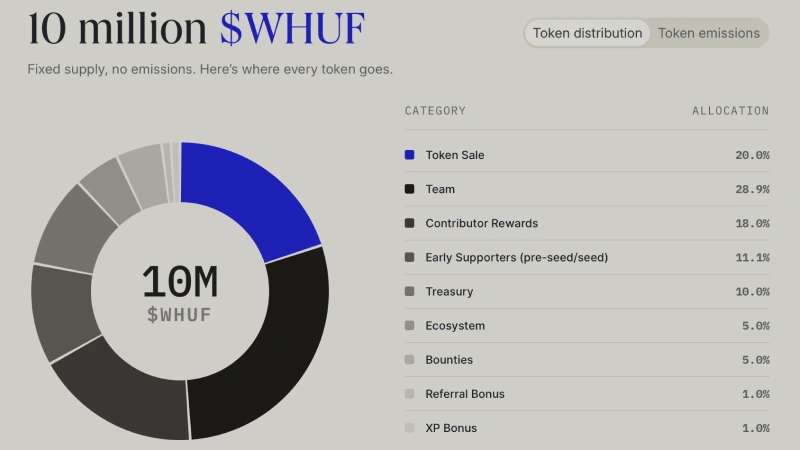
The 28.9% team allocation is the number worth watching. It is larger than the public sale allocation and needs to be viewed alongside vesting and unlock conditions when assessing future sell pressure. On the other side, 20% goes directly through the auction and another 25% is allocated to contributor rewards, ecosystem incentives, bounties and bonuses.
The fixed supply also makes WHUF’s burn mechanism more relevant. With no scheduled emissions replacing burned tokens, sustained protocol usage could gradually reduce supply — but only if WHUF becomes meaningfully used inside Ethos.
What Is WHUF Actually Worth?
The auction clearing price will give WHUF its first real valuation — and the difference between $1 million and $99 million is enormous.
At the bottom of the range, buyers would be valuing Ethos like an early-stage crypto application. At the top, they would be pricing in a much bigger outcome: Ethos becoming a widely integrated reputation layer used across wallets, communities and dApps.
There are reasons the market could pay a premium:
- Ethos already has a live product rather than launching a token around a roadmap alone.
- Reputation solves a persistent crypto problem spanning scams, anonymous teams, influencers and community coordination.
- Economic vouching creates stronger signals than likes, followers or free reviews.
- WHUF has a fixed supply, while protocol burns could make it deflationary if usage scales.
- The price guarantee limits part of the downside for eligible auction buyers who meet its conditions.
But WHUF still has to prove something ETH could not already do for Ethos. The protocol operated its original vouching model with ETH, so adding a native token only creates durable value if contributors want to earn it, users want to vouch with it and integrations expand the network enough to generate recurring WHUF demand.
That makes the clearing price the number to watch on September 4. A low valuation leaves more room for the reputation thesis to develop; a result near the $99 million cap would price much of that future adoption in from day one.
As Ethos expands from ETH-based vouching to its own token economy, users can manage ETH and a broad range of crypto assets in Atomic Wallet, keeping their portfolio under their own control while exploring new onchain protocols.