What Is Linera (LNRA)? Inside the Token Sale Built for Real-Time Markets
Linera is approaching its token launch with a different pitch from the typical Layer 1 sale. Instead of selling LNRA first and finding users later, the project is tying its Community Round directly to activity in its upcoming real-time markets.
The LNRA Community Round runs from September 1–8, with 5% of the token supply allocated to the sale. Participants commit USDC on Base, while every $1 committed also generates $1 of fee-free trading volume for Linera Season 1 — even when part of that commitment is later refunded because of oversubscription.
That mechanic connects the token launch to Linera’s broader bet: blockchain applications should feel instant and interactive rather than waiting on congested shared blockspace. With 65% of LNRA allocated across the Community Reserve and Community Sale, the upcoming TGE will test whether Linera can turn that architecture — and its community — into an active onchain market ecosystem.
What Is Linera?
Linera is a Layer 1 blockchain designed for real-time, interactive onchain applications.
Its architecture is built around microchains: lightweight chains that can operate in parallel instead of forcing every application and user to compete for the same sequence of blocks. When additional capacity is needed, activity can spread across more microchains rather than simply increasing congestion on one shared chain.
The model is particularly suited to applications where latency changes the experience — prediction markets, trading games and other interactive markets where users expect actions and updates to happen almost immediately. This is why Linera increasingly positions itself around real-time and gamified markets, rather than competing only on generic transaction throughput.
Linera was founded by Mathieu Baudet, a former Meta researcher who worked on the Novi digital payments project and low-latency blockchain infrastructure. The project has raised $12 million across two seed rounds, with backing from investors including a16z crypto, Borderless Capital, GSR, Flow Traders and Laser Digital.
What Is LNRA and Why Does Linera Need a Token?
LNRA is the native token being introduced alongside Linera’s move toward Season 1 and its broader network economy.
The token launch gives Linera an asset around which it can build community ownership and incentives as activity moves onto the network. That matters because Linera is not positioning itself as infrastructure alone: Season 1 is designed to put users directly into real-time markets and create activity around the technology.
For now, the clearest LNRA mechanics are tied to its distribution. 65% of the total supply is allocated to the community, split between a 60% Community Reserve and the 5% Community Sale. The reserve is intended to support areas such as ecosystem incentives, liquidity and future community programs rather than entering circulation all at once.
More detailed token utility can develop as Linera moves toward TGE and wider network adoption. The immediate question is simpler: can LNRA help turn an existing community into users who actually participate in Linera’s markets?
LNRA Community Sale: How It Works
The LNRA Community Round combines priority allocations for existing Linera users with an open pool for broader participation.
Participants complete registration and KYC before committing USDC on Base. Badge holders can qualify for reserved allocations based on their badge tier and activity, while registered users can also participate through the Open Pool.
The Reserved Pool gives Linera badge holders priority based on factors such as badge tier and accumulated points. The Open Pool is available to registered participants and uses proportional allocations if demand exceeds the available supply.
That means committing more capital does not necessarily guarantee the same amount of LNRA. Oversubscribed funds can be returned after allocations are calculated — but Linera has added another incentive that makes even the refunded portion relevant.
Commitment Credits: The Twist Behind the LNRA Sale
Every $1 committed to the LNRA sale also becomes $1 of fee-free trading volume for Linera Season 1.
Linera calls these Commitment Credits. They are calculated from the amount a verified participant commits to the sale, up to $100,000, and can later offset trading fees across eligible Season 1 activity.
The unusual part is that credits are based on the original commitment rather than the final LNRA allocation. If a user commits $10,000 but receives only $2,000 worth of LNRA because the Open Pool is oversubscribed, the remaining $8,000 can be refunded while the user still receives $10,000 in Commitment Credits.
This changes the economics of the Community Round. Oversubscription normally ends with unsuccessful capital returning to participants; Linera instead converts that demand into an incentive to come back and use its markets. The sale therefore doubles as a distribution event and a mechanism for bootstrapping Season 1 trading activity.
LNRA Tokenomics: Breaking Down the 65% Community Allocation
65% of LNRA is allocated to the community, but only 5% belongs to the current Community Sale.
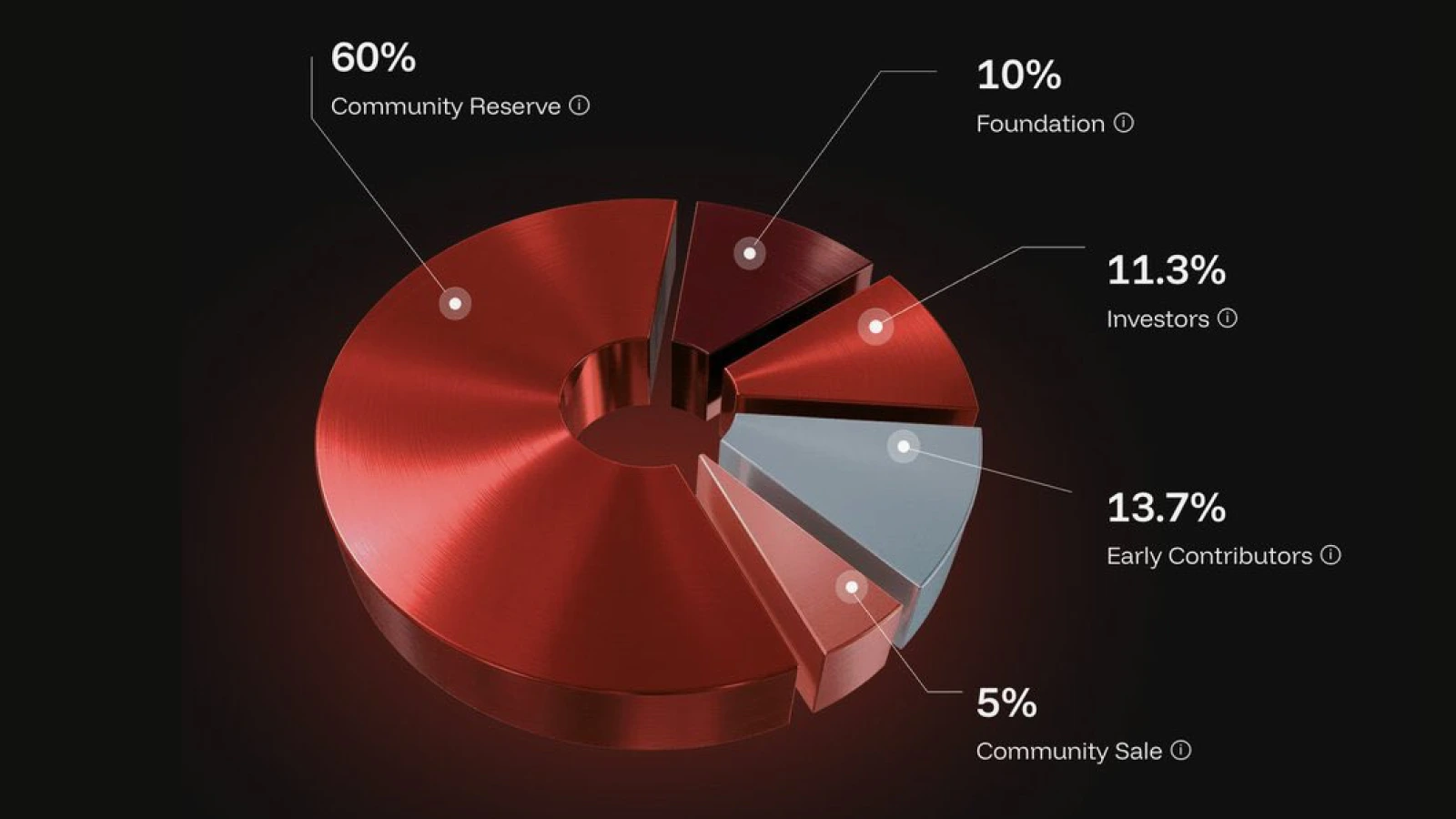
The distinction between the first two allocations matters. The 5% Community Sale is being distributed through the current round and is fully unlocked at TGE for most participants. The much larger 60% Community Reserve is intended for longer-term community incentives, ecosystem development and liquidity rather than entering circulation immediately.
Team and early contributors receive 13.7% of supply, while investors hold 11.3%. Both allocations are locked for one year after LNRA’s first public exchange listing and then unlock monthly over the following 24 months. The Foundation receives 10%, with 5% of its allocation available at TGE and the remainder unlocking linearly over 36 months.
So the headline 65% community allocation should not be confused with 65% circulating supply at launch. What matters after TGE will be how quickly the Community Reserve enters the market, what activities receive those tokens and whether those incentives generate lasting Linera usage rather than temporary reward-driven activity.
Can Linera Turn Its Community Sale Into Real Usage?
The LNRA sale matters only if its participants become active Linera users after TGE.
The structure gives Linera a useful starting point. Badge holders are rewarded for earlier participation, the Open Pool brings in new token holders, and Commitment Credits give both groups a reason to return for Season 1 rather than treating the sale as a one-off allocation event.
The next signals will come from the product itself: how much trading activity Season 1 generates, whether users stay after their fee-free volume is exhausted, and whether developers build markets that genuinely benefit from Linera’s low-latency architecture. Mainnet progress, LNRA liquidity and integrations across the wider crypto ecosystem will matter as well.
For users managing assets across that ecosystem, Atomic Wallet provides a self-custodial way to hold and manage supported crypto while keeping control of their private keys.
Linera has built its token distribution around participation rather than the TGE alone. The harder test begins afterward: proving that real-time blockchain infrastructure can produce markets people continue using when the launch incentives disappear.