What Is Worldcoin? Sam Altman’s Bet on Digital Identity
Artificial intelligence is making it increasingly difficult to distinguish humans from machines online.
As AI agents, bots, and synthetic identities become more sophisticated, a new question is emerging: How do you prove that you’re a real person without giving up your privacy?
Sam Altman believes the answer could be Worldcoin.
The project, now operating under the broader World network, combines biometric verification, cryptography, and blockchain technology to create a global proof-of-personhood system. Supporters see it as essential infrastructure for the AI era. Critics view it as one of the most controversial experiments in modern technology.
At the center of the debate is a simple proposition: scan your eyes to prove you’re human.
Why Worldcoin Is Getting Attention
Worldcoin sits at the intersection of artificial intelligence, digital identity, and crypto, making it one of the industry’s most closely watched projects.
Few crypto initiatives have generated as much excitement—and controversy—as World.
Several factors continue to drive interest:
- Sam Altman’s involvement
- the rise of AI-generated content
- growing demand for proof of personhood
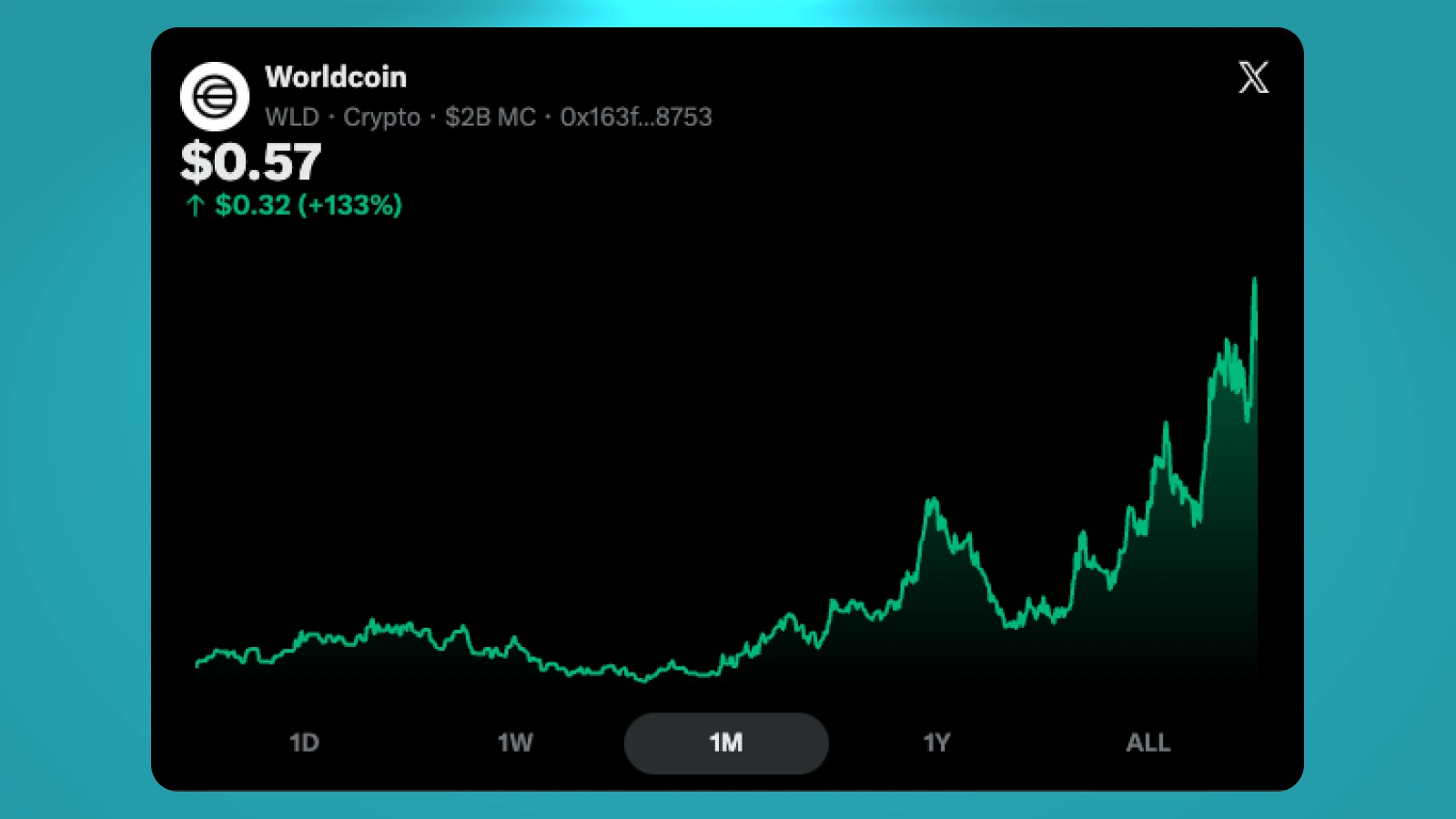
- renewed momentum in the WLD token
- institutional and market attention
The project’s relevance has increased alongside concerns that AI could flood the internet with increasingly convincing synthetic identities.
If distinguishing humans from machines becomes a core challenge of the digital economy, systems capable of verifying humanness could become critical infrastructure.
That possibility is one reason why Worldcoin remains one of the most polarizing narratives in both crypto and artificial intelligence.
What Is Worldcoin?
Worldcoin is a digital identity and financial network designed to help people prove they are human online while preserving their privacy.
Originally launched as Worldcoin and later expanded into the broader World ecosystem, the project aims to build tools for identity, access, and participation in the internet economy.
Its ecosystem consists of several key components:
- World ID — a privacy-preserving proof-of-personhood credential
- World App — the ecosystem’s primary wallet and interface
- WLD — the native token of the network
- Orb — the biometric device used for identity verification
- World Network — the broader infrastructure supporting the system
Unlike traditional identity systems that rely on governments, usernames, or social media accounts, World focuses on answering a different question:
Is this person a unique human being?
In a future increasingly shaped by artificial intelligence, World is betting that this simple proof may become one of the internet’s most valuable utilities.
How World ID Works
World ID is designed to let users prove they are unique humans online without revealing who they are.
The system combines biometric verification with cryptographic techniques intended to preserve privacy.
When a person completes verification, the goal is not to create a publicly visible identity profile. Instead, the system generates proof that a unique human exists behind an account.
The process generally works as follows:
- a user visits an Orb verification location
- the Orb captures biometric information from the iris
- a unique IrisCode is generated
- cryptographic proofs establish uniqueness
- users receive a World ID credential
World states that this approach allows individuals to demonstrate “proof of personhood” without exposing personal information during future interactions.
If successful, World ID could eventually be used across applications where distinguishing humans from bots becomes increasingly important.
What Is the Orb?
The Orb is the hardware device at the center of World’s identity verification process.
Often described as the project’s most recognizable—and controversial—component, the Orb is a specialized device designed to verify that an individual has not previously enrolled in the system.
Its role includes:
- capturing iris patterns during verification
- generating a unique biometric representation
- preventing duplicate registrations
- supporting global enrollment efforts
- connecting users to the World ecosystem
Supporters argue that dedicated hardware provides a stronger foundation for proof of personhood than software-only alternatives.
Critics, however, question whether collecting biometric information at global scale creates unnecessary privacy and ethical risks.
As a result, the Orb has become both World’s greatest differentiator and its biggest source of controversy.
What Is the WLD Token Used For?
WLD is the native token of the World ecosystem and is designed to support participation and growth across the network.
While World’s identity layer often attracts the most attention, WLD serves as the economic component connecting users to the broader ecosystem.
Current and potential uses include:
- ecosystem incentives
- user rewards and distribution programs
- governance participation
- network growth initiatives
- future utility within World applications
The token was originally distributed in part to verified users who completed the proof-of-personhood process, helping bootstrap adoption across different regions.
At the same time, WLD’s tokenomics have been widely debated due to concerns around supply unlocks, circulating supply, and long-term inflation dynamics.
As with many emerging crypto networks, the token’s future value will likely depend on whether the underlying ecosystem achieves meaningful adoption.
Why AI Makes Digital Identity Important
The rise of artificial intelligence is creating a growing need for systems that can distinguish humans from machines online.
Generative AI can now produce text, images, voices, and even autonomous agents capable of interacting with digital platforms at scale.
This shift raises important questions:
- how do platforms prevent bot abuse?
- how can users verify they are interacting with real people?
- how should online trust evolve in the age of AI?
- what happens when AI agents outnumber humans?
- who controls digital identity infrastructure?
World argues that proof of personhood could become as important to the future internet as email addresses and passwords were to the early web.
Whether that vision proves correct remains uncertain, but the broader problem it seeks to address is becoming increasingly difficult to ignore.
Worldcoin’s Biggest Controversies
Few crypto projects have generated as much debate as World.
The same features supporters view as revolutionary have become the foundation of its critics’ concerns.
Over the years, the project has faced scrutiny across several areas:
- biometric privacy concerns
- regulatory investigations in multiple jurisdictions
- accusations of targeting lower-income regions for adoption
- criticism of its low-float token launch structure
- the emergence of black markets for verified accounts
Critics argue that collecting biometric data at global scale introduces risks that may be difficult to reverse if mistakes are made.
Others have questioned whether financial incentives tied to identity verification could encourage exploitation or undermine the integrity of the system.
World has repeatedly stated that it prioritizes privacy-preserving technology and that its approach minimizes the storage of sensitive information. Even so, the debate surrounding ethics, consent, and governance continues to define much of the project’s public perception.
Worldcoin vs Traditional Identity Systems
World approaches identity differently from governments, social platforms, and financial institutions.
Rather than proving who someone is, the project focuses on proving that someone is a unique human being.
This distinction is important.
A passport establishes nationality. A social login proves access to an account. KYC confirms eligibility for financial services.
World, by contrast, attempts to answer a more fundamental question:
Is there a real human behind this interaction?
Whether proof of personhood ultimately becomes a standard layer of the internet remains uncertain, but it represents a new approach to digital identity in an increasingly AI-driven world.
Risks Investors Should Know
World combines one of the biggest opportunities created by AI with some of the highest levels of uncertainty in crypto.
The idea of becoming the internet’s identity layer is ambitious, but execution risks remain substantial.
Investors and users should consider several factors:
- regulatory uncertainty across multiple jurisdictions
- future token unlocks and inflation pressure
- adoption challenges outside crypto-native audiences
- technological and operational risks
- market volatility surrounding WLD
World’s success ultimately depends on whether people are willing to adopt a new identity framework and whether regulators allow it to scale globally.
Even if proof of personhood becomes an essential service in the AI era, there is no guarantee that World will emerge as the dominant solution.
As a result, WLD remains both a high-conviction opportunity and a high-risk asset.
Managing WLD Safely
Secure storage is essential for anyone interacting with the World ecosystem.
Whether holding WLD as an investment or participating in the broader crypto economy, maintaining control over digital assets should remain a priority.
Good security practices include:
- protecting recovery phrases offline
- verifying wallet addresses and applications carefully
- avoiding phishing links and impersonation scams
- reviewing token approvals regularly
- using trusted self-custody solutions
Many investors choose self-custody to retain full ownership of their assets rather than relying exclusively on third parties.
Atomic Wallet provides a self-custodial environment for managing thousands of cryptocurrencies while allowing users to maintain control of their private keys and funds.
Conclusion: Could Worldcoin Become the Identity Layer of the Internet?
World is attempting to solve one of the biggest challenges created by artificial intelligence: proving that humans are still human online.
By combining biometric verification, cryptography, and blockchain infrastructure, the project is building a system designed around proof of personhood rather than traditional identity models.
Its future will likely depend on several factors:
- whether proof of personhood becomes a mainstream need
- the pace of AI adoption and autonomous agents
- regulatory acceptance across global markets
- public trust in biometric technologies
- World’s ability to scale responsibly
Supporters see World as critical infrastructure for the AI era. Critics view it as an unprecedented experiment involving identity, privacy, and power.
The truth may lie somewhere in between.
What is clear is that few projects are tackling a problem as consequential as distinguishing humans from machines in an increasingly artificial world. If World succeeds, it could reshape how trust works on the internet. If it fails, it may become one of crypto’s most controversial cautionary tales.