Bitwise 10 Crypto Index ETF: What It Is and How BITW Stock Works

The launch of BITW on NYSE Arca marks a milestone: for the first time, a crypto index fund trades on one of the world’s most established exchanges. Interest in BITW stock and BITW stock price exploded overnight as investors realized they now have something resembling an “S&P 500 for crypto” — a simple, regulated way to hold the market’s top assets in one product. For institutions, it’s a long-awaited bridge between traditional markets and digital assets. For everyone else, it’s a clearer, cleaner way to gain diversified crypto exposure.
BITW’s debut signals that crypto indexing has entered the mainstream, and this guide breaks down how it works, what it holds, and who it’s for.
What Is BITW? (Bitwise 10 Crypto Index ETF, Explained)
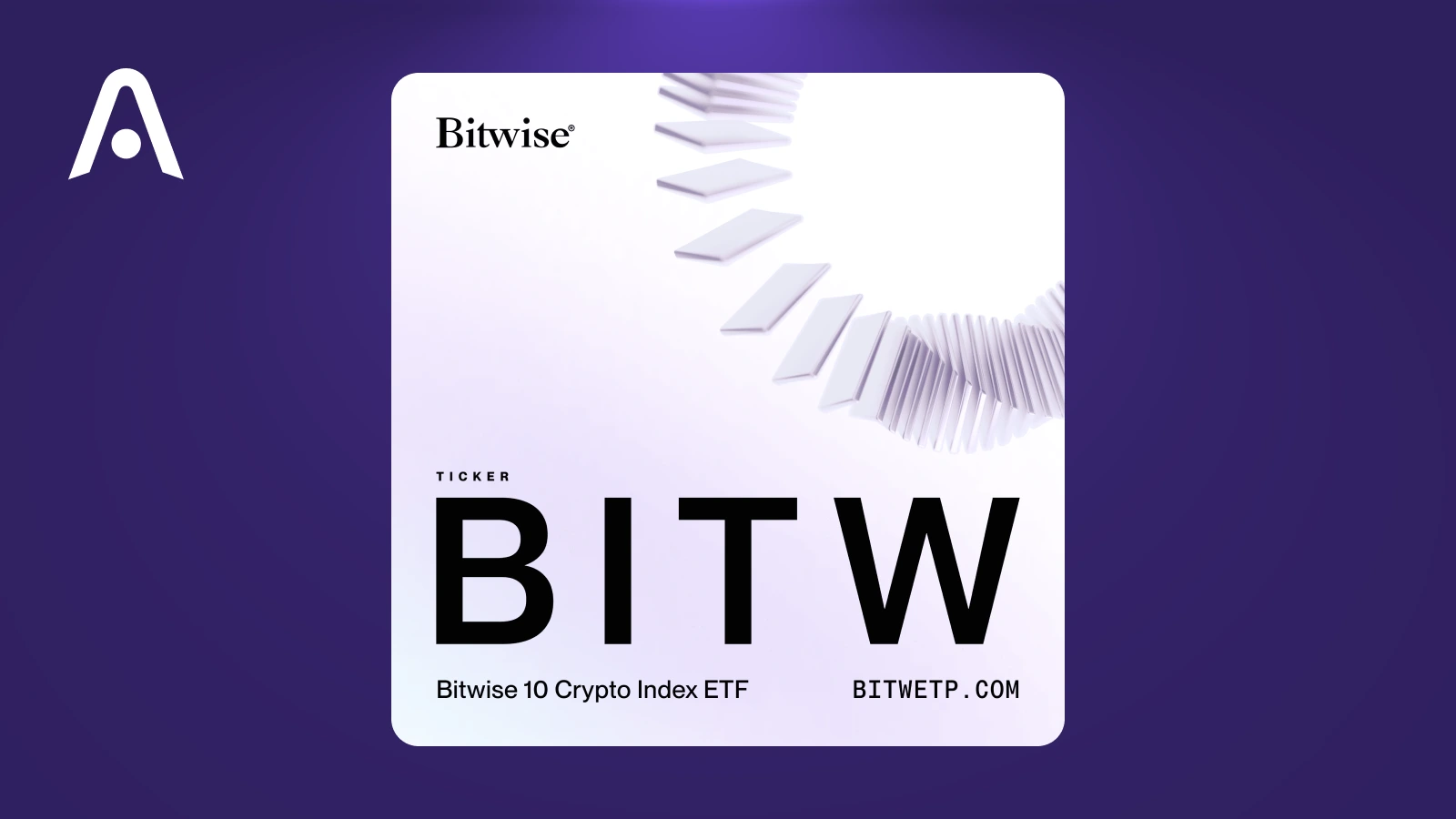
BITW is the world’s largest crypto index fund, now trading as an exchange-traded product (ETP) on NYSE Arca. Instead of tracking a single asset like Bitcoin or Ethereum, BITW provides exposure to the top 10 crypto assets by market capitalization, giving investors diversified access without having to select individual winners. Because BITW is structured as an ETP — not a ’40 Act ETF — it follows a different regulatory framework, similar to commodity-style products.
A few practical advantages:
- diversified exposure across leading crypto assets;
- fully rules-based index methodology;
- no need to manage wallets or private keys;
- easier access for brokers, RIAs, and retirement accounts.
If BTC or ETH ETFs let investors buy one asset at a time, BITW offers exposure to the crypto market as a whole.
How the Bitwise 10 Crypto Index Works
The Bitwise 10 Large Cap Crypto Index selects and weights the ten largest crypto assets based on free-float market capitalization, applying strict screens for liquidity, custody readiness, and regulatory compliance. The index rebalances monthly, adding or removing assets as the market evolves. There’s no cap on the largest holding — meaning if Bitcoin eventually dominates the entire market, BITW will naturally shift toward holding mostly BTC.
How the methodology works:
• top 10 eligible assets by free-float market cap;
• liquidity, trading-venue, and custody screening;
• monthly rebalancing and reconstitution;
• institutional-grade custody (e.g., Coinbase Custody / Anchorage, depending on Bitwise operational standards).
This rules-based structure makes BITW a dynamic product that adjusts as the crypto landscape changes — whether new assets rise or existing leaders fade.
Current Composition — What BITW Holds Today
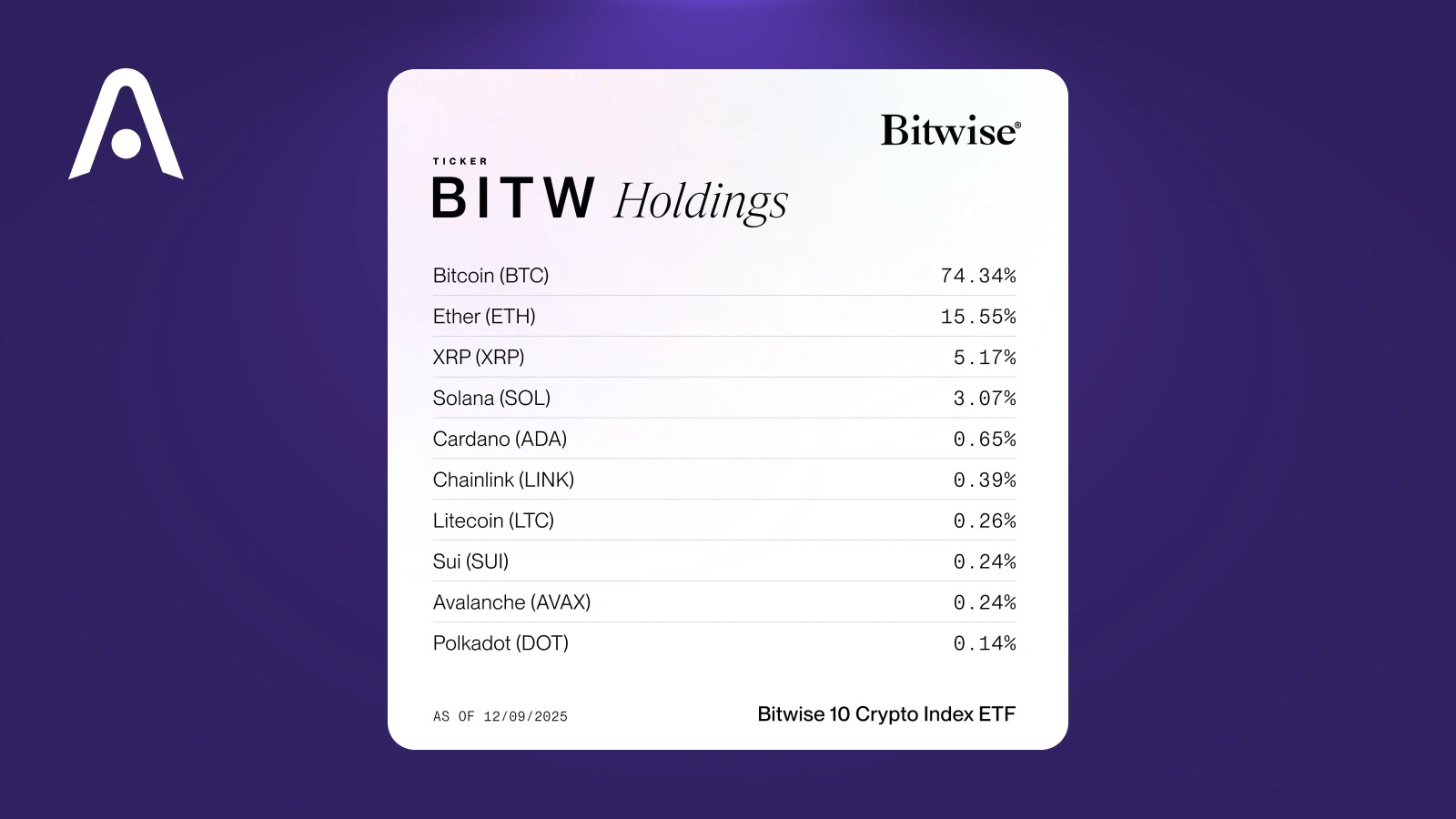
As of its NYSE debut, BITW includes a diversified mix of large-cap crypto assets:
- Bitcoin (BTC)
- Ethereum (ETH)
- XRP
- Solana (SOL)
- Cardano (ADA)
- Chainlink (LINK)
- Litecoin (LTC)
- Sui (SUI)
- Avalanche (AVAX)
- Polkadot (DOT)
Grouped by category, the index represents:
• money & payments → BTC, XRP
• smart-contract L1 ecosystems → ETH, SOL, ADA, SUI, AVAX
• infrastructure middleware → LINK
• established legacy assets → LTC, DOT
These assets meet the index’s screening rules and collectively track the sector Bitwise considers the “investable large-cap crypto market.”
Why BITW Matters — The First NYSE-Listed Crypto Index Fund
BITW’s debut on NYSE Arca marks a breakthrough for the entire digital asset class. For the first time, investors can access a broad, diversified crypto index fund through the same channels they use for stocks, bonds, and ETFs. Financial advisors, RIAs, family offices, and retirement accounts can now allocate to crypto without navigating wallets, custody, or individual asset selection.
In many ways, BITW plays the same role for crypto that SPY once played for equities — a simple, regulated, index-based entry point. It signals crypto’s transition from a niche market to a mainstream asset class with institutional infrastructure behind it.
BITW Stock Price — Recent Performance & Market Behavior
BITW stock price has shown strong engagement since its NYSE listing, reflecting both the hype around the first crypto index ETP and crypto’s broader volatility. Because BITW holds a market-cap-weighted basket of assets, its price tends to follow high-beta movements across Bitcoin, Ethereum, and large altcoins. Capital inflows or outflows can also push BITW temporarily above or below NAV, similar to how GBTC behaved before conversion.
Key market observations:
• 52-week high / low: shaped heavily by BTC and ETH cycles
• Spike days: listing day, ETF inflow surges, macro news releases
• Correlation: BITW ↔ BTC remains the strongest; altcoin rallies amplify upside
• Macro sensitivity: CPI reports, Fed meetings, regulatory developments frequently move BITW
As the index gains more institutional usage, BITW’s price behavior may become more stable — but for now, volatility remains part of the product’s DNA.
How BITW Differs From Buying Crypto Directly
BITW gives investors crypto exposure without the operational complexities of wallets, exchanges, or self-custody. It trades like a traditional security, fits into brokerage accounts, and can be held in retirement structures — benefits that direct crypto ownership cannot offer.
But there are trade-offs. Holding BITW does not give access to self-custody, staking rewards, airdrops, or on-chain ecosystems. BITW is purely a price-tracking vehicle, not a participation layer in crypto networks. For investors who want on-chain utility, or who prioritize sovereignty over private keys, spot crypto remains the better fit.
Key differences:
• No private keys or wallet setup
• No staking yield or on-chain utility
• Regulated brokerage asset vs. self-custodied crypto
• Zero exposure to DeFi, governance, or network activity
Why Some Assets (Like XRP) Matter More After Index Inclusion
Index inclusion is not a popularity contest — it’s a methodology-driven signal that an asset meets liquidity, security, and institutional-access criteria. When BITW adds an asset like XRP, SOL, or LINK, it effectively declares them “institutionally investable.” This matters because advisors, funds, and passive index allocators gain exposure automatically through BITW.
For many assets, inclusion becomes a structural catalyst:
• Legitimacy boost: the asset qualifies under strict screening rules
• Passive inflows: BITW holdings adjust monthly with no discretionary bias
• Visibility to TradFi: institutions see the asset alongside BTC and ETH
In 2025, XRP’s presence in BITW became a headline example — not because of sentiment, but because methodology placed it alongside the industry’s most established crypto assets.
What Could Move BITW Stock Price Next
Because BITW tracks the Bitwise 10 Large Cap Crypto Index, its price is highly sensitive to macro trends and crypto-market flows. The next catalysts are likely to come from broad market developments rather than individual asset news — though index rebalances can introduce short-term volatility. Large inflows from institutions, major regulatory shifts, or strong performance in top-weighted assets like BTC and ETH can all significantly impact BITW’s trading behavior.
Key potential drivers:
• Bitcoin & Ethereum price action — primary determinants of BITW NAV
• Institutional inflows into index products and crypto ETFs
• Index composition changes — new assets entering/exiting the top 10
• Macro forces — inflation prints, rate cuts, risk-on environments
• Regulatory clarity in the U.S. and EU around digital asset markets
Risks — What Investors Need to Know
BITW opens a new doorway for crypto exposure, but it carries its own structural risks. As an ETP — not a ’40 Act ETF — it lacks certain protections typical of traditional funds. The product also inherits the high volatility of the underlying crypto assets, meaning BITW stock price can move sharply during market stress.
Key risk factors:
• Extreme volatility driven by crypto-market liquidity
• Not a registered ’40 Act ETF, implying less regulatory protection
• Possible NAV deviations during periods of heavy flows
• Crypto-specific risks: technological, regulatory, security
• Methodology changes that may alter asset weightings over time
Who Should Consider BITW?
BITW appeals to investors who want broad crypto exposure but prefer to avoid the operational complexity of holding digital assets directly. It’s designed for individuals and institutions that value regulation, custody simplicity, and passive indexing over active asset selection. For many, BITW offers a clean way to participate in crypto’s upside without choosing specific tokens or managing wallets, seed phrases, or on-chain risk.
This includes:
• Traditional investors who want crypto exposure through a brokerage account
• Financial advisors building diversified portfolios for clients
• Retirement accounts (IRA/401k) that allow ETP allocations
• Newcomers to crypto who prefer a “basket approach” versus picking winners
BITW vs BTC/ETH ETFs — Key Differences
BITW serves a fundamentally different purpose compared to single-asset Bitcoin or Ethereum ETFs. While BTC and ETH ETFs track individual networks, BITW represents the entire large-cap crypto market. The diversification reduces single-asset dependency but introduces multi-asset dynamics and periodic rebalancing.
Key distinctions:
• Single-asset vs diversified exposure: BTC/ETH ETFs track one asset; BITW tracks ten.
• Volatility profile: BITW may be more balanced but also includes high-beta altcoins.
• Rebalancing: BITW adjusts monthly; BTC/ETH ETFs remain static.
• Use cases: BTC/ETH ETFs = targeted exposure; BITW = broad market exposure.
Conclusion — Why BITW Marks a Turning Point for Crypto
The launch of BITW on the NYSE isn’t just another product release — it’s a structural milestone for the crypto asset class. For the first time, investors can access a professionally managed, rules-based crypto index fund through the same venue where they buy stocks and ETFs. This is a major signal of maturity: indexation is how most asset classes transition from niche to mainstream.
BITW brings diversification, transparency, and institutional accessibility to a market previously dominated by single-asset products. As advisors, retirement accounts, and traditional funds gain exposure through BITW, the crypto market could benefit from steadier inflows and broader acceptance.
Manage Crypto Exposure Safely with Atomic Wallet
If you prefer direct exposure to crypto instead of holding it through an index fund, Atomic Wallet offers secure self-custody for assets included in BITW’s portfolio — BTC, ETH, SOL, XRP, AVAX, LINK, and more.
You maintain full control over your private keys, swap assets instantly, and manage your portfolio seamlessly in one place A simple, safe way to hold the underlying assets BITW tracks.