DigiDollar: A Decentralized USD Stablecoin for Non-Custodial Liquidity
Most stablecoins today fall into two categories: custodial tokens backed by bank-held reserves or smart contract-based DeFi systems that rely on liquidation mechanisms and on-chain leverage. While both models dominate the market, they introduce either centralized trust assumptions or liquidation risk during volatility.
DigiDollar is structured differently. It is a decentralized USD stablecoin built directly into the DigiByte protocol, using time-locked, over-collateralized positions rather than custodial reserves or smart contract vaults.
What sets it apart:
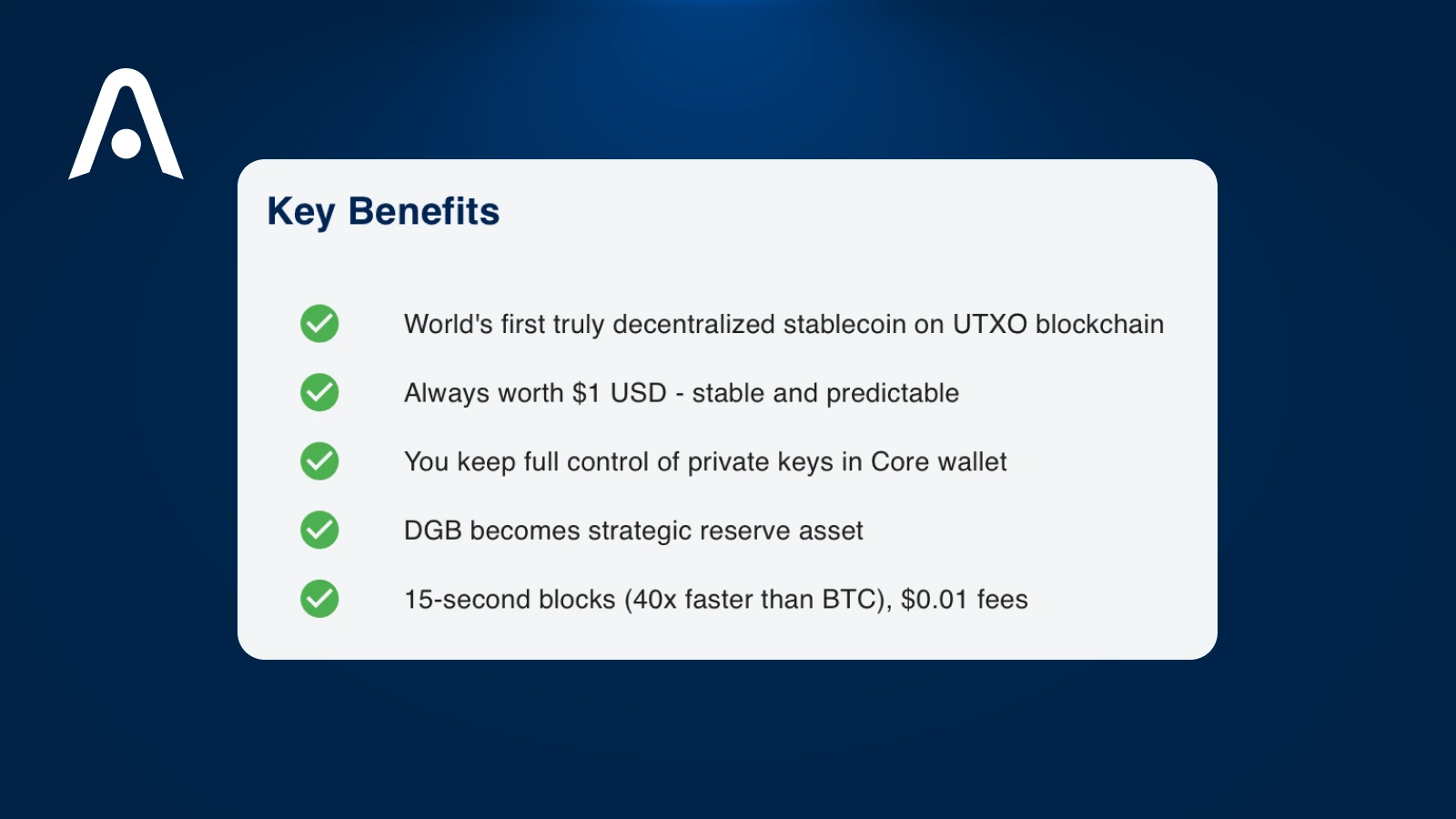
- Native UTXO-based architecture instead of external smart contracts
- Time-locked collateral enforced at the protocol level
- Fully non-custodial design – private keys never leave the user
- No forced liquidations during market volatility
This positions DigiDollar not as another synthetic dollar, but as a protocol-level liquidity layer built around self-custody and long-term collateral stability.
Liquidity Without Selling: The Core Idea Behind DigiDollar
For many crypto holders, accessing liquidity usually means selling. Selling triggers taxable events in many jurisdictions, reduces long-term exposure and often forces users to exit positions they would prefer to hold. DigiDollar is built around a different idea: liquidity does not have to mean liquidation.
Instead of selling DGB, users lock it as collateral and mint DigiDollars against it. Ownership and liquidity become two separate layers. The underlying DGB remains inside the user’s own wallet, under full key control, while DigiDollars provide stable USD-denominated spending power. The result is access to value without exiting a long-term position.
How DigiDollar Works (The Silver Safe Model)
Think of DGB as an asset stored in your own vault. Instead of selling it when you need liquidity, you temporarily lock it and unlock stable value against it.
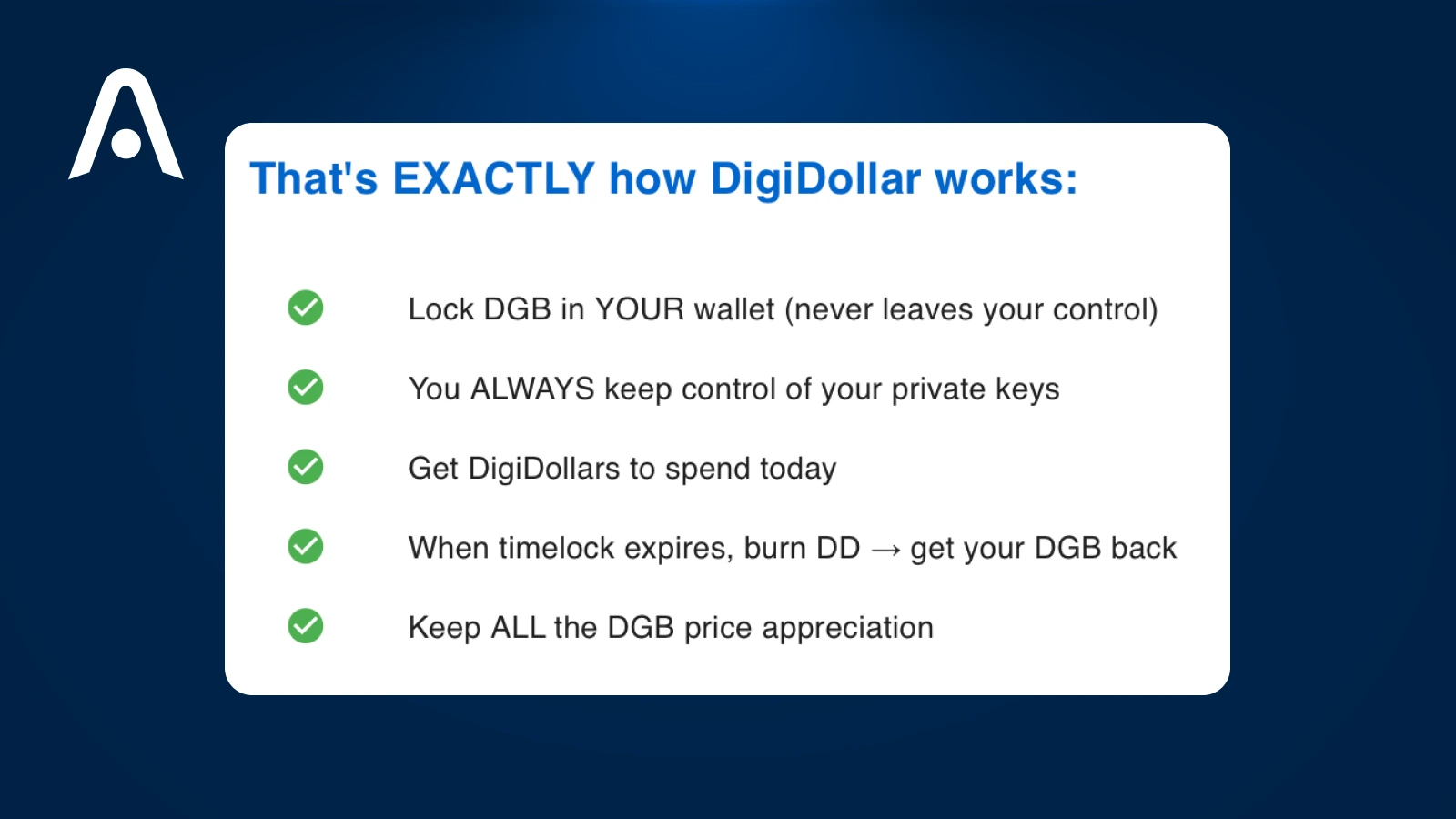
- Lock DGB as collateral inside your wallet
- Mint DigiDollars pegged to $1 USD
- Use DigiDollars for stable transactions
- After the timelock expires, burn DigiDollars
- Unlock the original DGB collateral
Economically, this model allows users to access stable purchasing power while retaining full exposure to potential DGB price appreciation.
Why DGB Becomes a Strategic Reserve Asset
DigiDollar does not exist independently from DGB – it is directly backed by it. Every DigiDollar minted requires DGB to be locked as an overcollateralized reserve, linking stable USD liquidity to the underlying asset’s scarcity.
DigiByte has a fixed maximum supply of 21 billion coins – roughly 1.94 DGB per person globally. When DGB is locked as collateral, it is removed from active circulation for the duration of the timelock. This reduces available supply in the market and shifts incentives from short-term selling toward long-term positioning.
As more DigiDollar positions are created, more DGB becomes strategically locked. The result is a reinforcing loop: stable liquidity demand drives collateral locking, which strengthens scarcity dynamics across the network.
No Forced Liquidations: How DigiDollar Manages Risk
Many DeFi stablecoin systems rely on liquidation engines and margin calls to maintain collateral ratios. When prices move sharply, positions can be forcibly closed, often amplifying volatility.
DigiDollar follows a different model. Because collateral is time-locked at the protocol level, there are no forced liquidations and no margin calls. Positions cannot be automatically unwound due to short-term price swings.
Instead, the system relies on structural safeguards:
- High initial collateral ratios (200%–500%)
- Dynamic collateral adjustments during system stress
- Emergency redemption ratio mechanisms
- Time-lock enforcement at the protocol level
Once a timelock expires, the position simply remains in the user’s wallet until enough DigiDollars are available to redeem the original DGB collateral. This design prioritizes resilience and user control over automated leverage mechanics.
How Is DigiDollar Different from Terra (LUNA)?
The collapse of Terra (LUNA) changed how the industry evaluates stablecoin design. While both Terra’s UST and DigiDollar aim to represent USD value, their underlying architecture differs significantly.
- Collateral Structure: Terra relied on an algorithmic mint-and-burn relationship between UST and LUNA. DigiDollar is backed by overcollateralized DGB locked directly on-chain, without a circular dependency between the stablecoin and its collateral asset.
- Redemption Mechanics: Terra allowed immediate redemptions, which accelerated withdrawal pressure during stress events. DigiDollar uses protocol-level time-locks, preventing early collateral withdrawal and structurally limiting rapid exit cascades.
- Supply Dynamics: LUNA supply expanded during instability as part of its stabilization process. DGB has a fixed maximum supply, removing reflexive supply expansion from the system.
- Control Model: Terra operated with foundation-managed reserves and coordinated stabilization efforts. DigiDollar positions are created and controlled individually, with collateral held in users’ own wallets under private key control.
DigiDollar is designed around collateral enforcement and protocol rules rather than algorithmic reflexivity.
Built Natively on DigiByte: UTXO, Taproot and Oracles
DigiDollar is not deployed as a smart contract on a separate layer – it is implemented natively within the DigiByte protocol. This distinction matters. Instead of relying on external virtual machines or bridge-based infrastructure, DigiDollar uses DigiByte’s UTXO scripting capabilities to enforce collateral rules directly at the transaction level.
Key components include:
- UTXO-based time-locked script design
- Taproot (P2TR) outputs with Schnorr signatures
- MAST-based script paths for efficient validation
- A multi-phase decentralized oracle system for price feeds
By operating at the protocol level, DigiDollar reduces reliance on bridges, sidechains or custodial intermediaries – keeping the architecture aligned with self-custody principles.
Testnet Status: DigiDollar Activation and RC21 Update
DigiDollar is now officially activated on testnet following the v9.26 release, marking a major milestone in its development cycle. The recent RC21 update resolved the block 7586 synchronization issue identified in RC20, demonstrating rapid iteration and active community support.
With testnet activation complete, the mainnet activation window has been set for May 1, 2026 through May 1, 2028. Miners will be able to signal and vote for activation beginning May 1, following the v9.26 release.
DigiDollar remains under active validation, with continued testing and refinement ahead of potential mainnet deployment.
Who DigiDollar Is For
DigiDollar is designed for users who value long-term exposure, self-custody and protocol-level transparency over short-term leverage.
It is particularly relevant for:
- Long-term DGB holders seeking stable liquidity
- Users who prioritize private key control
- Developers exploring UTXO-based financial primitives
- Participants who want stable USD value without centralized custody
Rather than targeting high-frequency DeFi speculation, DigiDollar focuses on durable liquidity aligned with long-term asset ownership.
What Comes Next for DigiDollar
Development is currently focused on completing the redemption system and advancing oracle validation toward full mainnet readiness. While core functionality is largely implemented, final safeguards and validation layers are still being refined.
Key priorities include strengthening multi-oracle consensus, finalizing redemption flows and ensuring network-wide stability under stress conditions. Continued testnet participation remains essential as the system approaches its next milestone.
The transition to mainnet will depend on successful validation, security review and sustained testing performance.
Manage DGB Securely with Atomic Wallet
As DigiDollar evolves on testnet, DGB remains the core reserve asset behind the system. Atomic Wallet allows you to store, send and exchange DGB in a fully non-custodial environment.
Take full control of your DGB with Atomic Wallet and stay connected to the growing DigiByte ecosystem.