Most Profitable Polymarket Categories: Where Trading Volume and Opportunity Concentrate

On Polymarket, “profitable” does not mean guessing outcomes correctly more often than others. It means operating in categories where liquidity, volatility, and time horizon create real opportunities to enter and exit positions. Some markets attract capital because they are clear and liquid, others because they are uncertain and narrative-driven. This guide breaks down Polymarket categories from a market-structure perspective — not promises, not tips, just where attention and volume actually concentrate.
What “Profitable” Means in Prediction Markets
In prediction markets, profitability is structural, not predictive. It depends less on being right and more on how markets behave before resolution.
Key points to understand:
- Profit ≠ win rate
You can be right and still lose if liquidity is thin or exits are impossible.
- Liquidity defines opportunity
Markets with depth allow repositioning, while illiquid ones often force hold-to-expiry.
- Volume is a prerequisite, not a guarantee
High volume attracts capital, but also improves efficiency and reduces obvious mispricing.
- “Smart” markets are not always the easiest
Highly informed categories can move aggressively and punish late positioning.
Understanding this distinction is essential before comparing Polymarket categories or deciding where to focus attention.
How Polymarket Categories Differ From Each Other
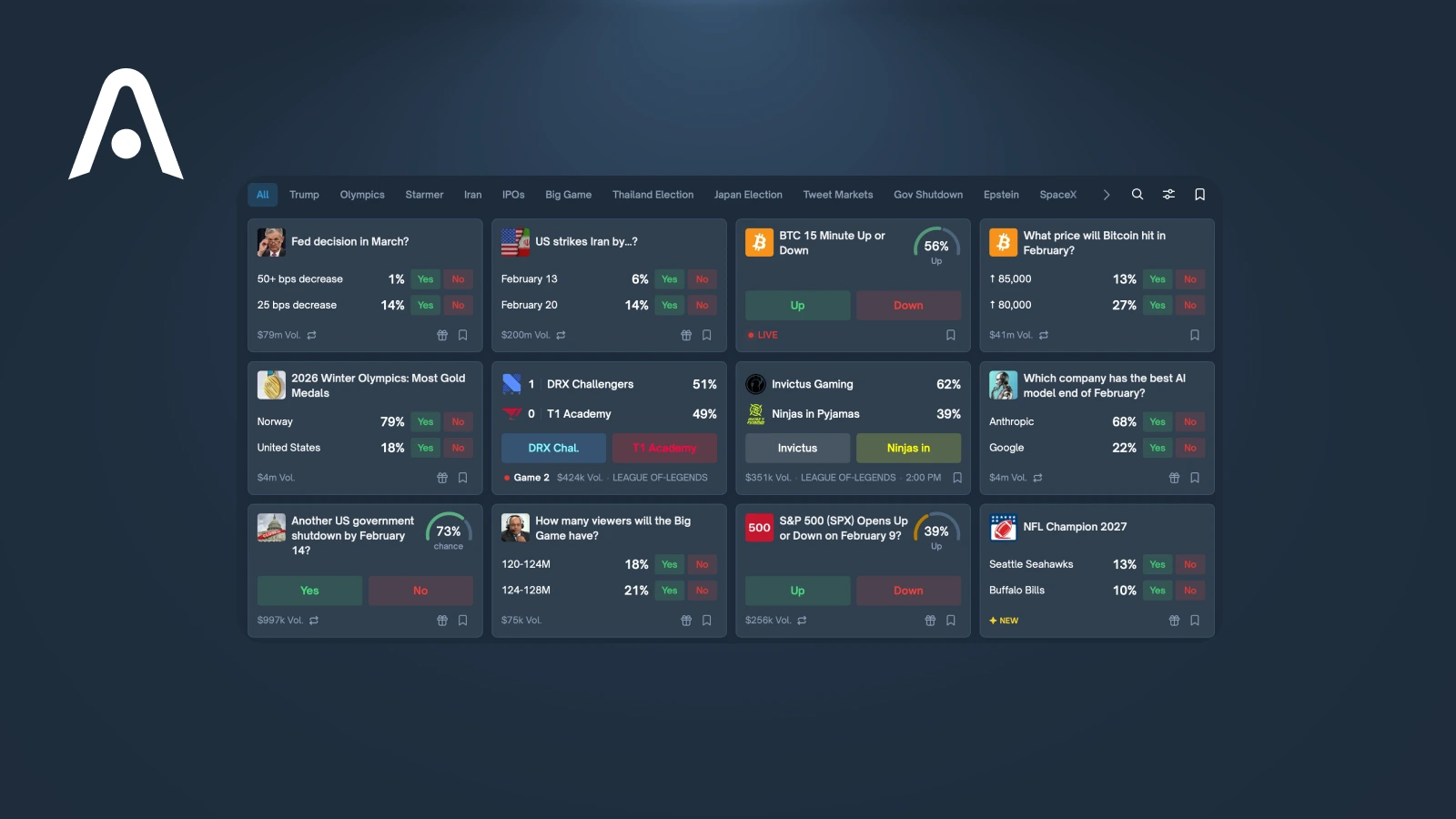
Not all Polymarket categories behave the same, even when they look similar on the surface. Each category has its own market dynamics shaped by time horizon, information flow, and who participates.
Key structural differences include:
- Duration
Some markets resolve in hours or days, others remain open for months or years, changing how capital is deployed.
- Information flow
Fast-moving categories react to headlines and data releases, while slower ones absorb narratives over time.
- Volatility profile
Certain categories move in sharp bursts, others grind gradually as probabilities adjust.
- Resolution risk
The clearer the outcome definition, the lower the chance of disputes or unexpected settlement results.
- Participant mix
Retail-heavy markets behave differently from those dominated by analysts, insiders, or domain specialists.
These differences explain why “profitability” varies by category even when total volume looks similar.
The Most Active Polymarket Categories in 2026
By 2026, trading activity on Polymarket has clustered into a small number of dominant categories. These markets consistently attract the most capital, discussion, and liquidity, making them the primary focus for serious participants.
What unites these categories is not predictability, but engagement. They generate frequent updates, emotional reactions, and sustained attention, which keeps prices moving and volume flowing. In the sections below, we break down each major category and explain why it concentrates opportunity — along with the risks that come with that attention.
Politics — The Largest and Most Controversial Category
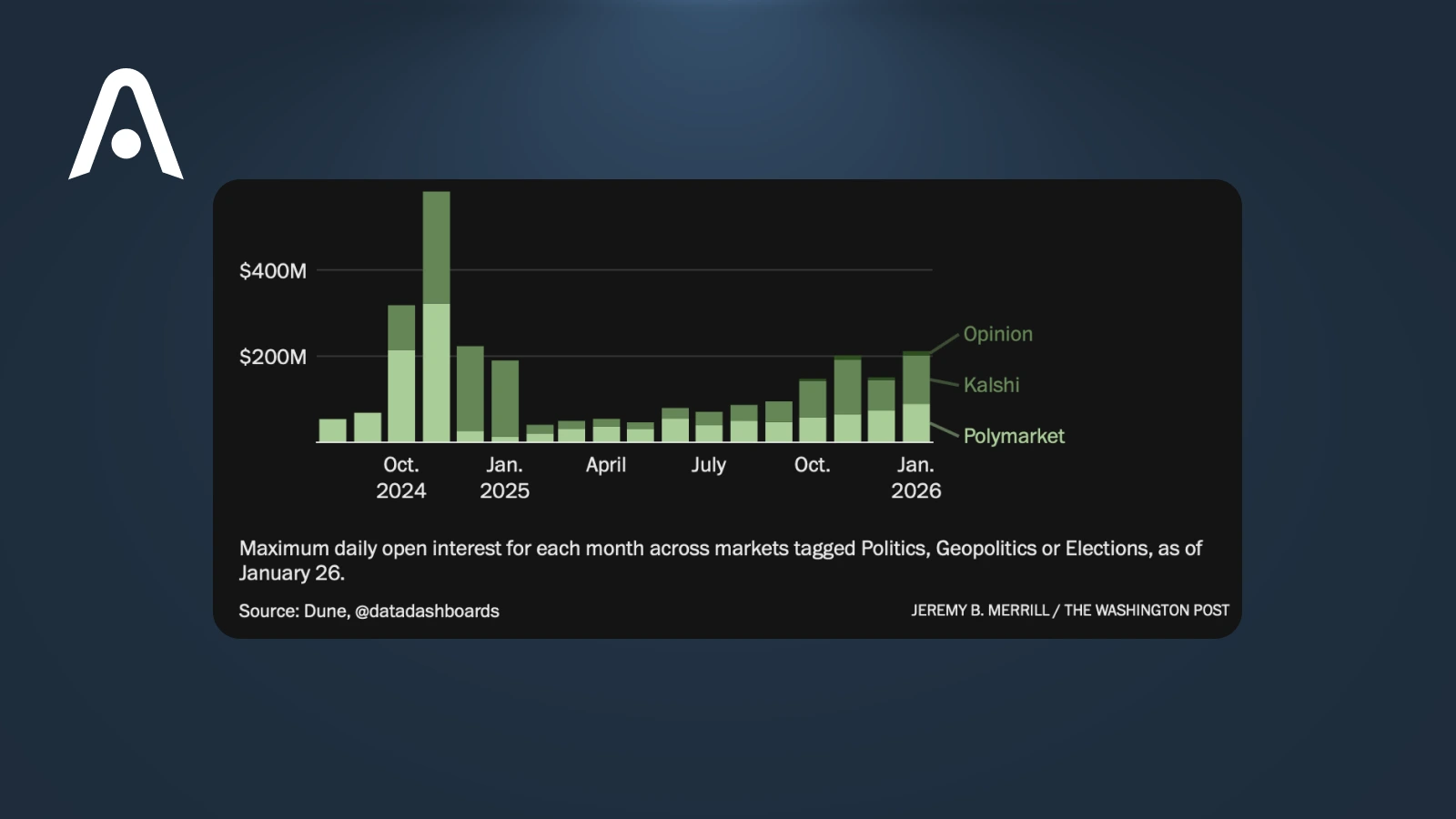
Political markets consistently generate the highest total volume on Polymarket. Elections, geopolitics, and government actions attract capital for months at a time, creating deep but often turbulent markets.
These markets share a few defining traits. They are long-duration, with probabilities shifting gradually as narratives evolve, polls change, or unexpected events occur. News flow is constant, and prices often move in anticipation rather than reaction. This makes politics one of the most dynamic categories — and one of the hardest to navigate.
Politics is often labeled “profitable” because it produces large probability swings and sustained engagement. At the same time, it carries the highest rule and resolution risk, along with ongoing debates around insider information and information asymmetry. Capital is drawn here because the stakes feel real, but that intensity cuts both ways.
Sports — The Cleanest Markets by Structure
Sports markets are widely considered the most structurally straightforward category on Polymarket. Outcomes are clearly defined, resolution criteria are rarely disputed, and liquidity is concentrated around major events and leagues.
Key characteristics include:
- High-volume events like the Super Bowl, NBA playoffs, World Cup, and top football leagues
- Clear start and end points with minimal ambiguity
- Lower narrative risk compared to politics or culture
- Prices that behave closely to implied probabilities
Sports markets are popular because they are easier to read and less prone to unexpected rule interpretations. For many users, this category feels closest to pure probability trading, which is why it often serves as an entry point before exploring more complex segments.
Crypto — Fast, Volatile, and Narrative-Driven
Crypto markets on Polymarket move faster than almost any other category. They are heavily influenced by price action, social sentiment, and onchain developments, which creates short reaction windows and frequent repricing.
Typical crypto markets include:
- Bitcoin and Ethereum price levels
- ETF approvals or regulatory decisions
- Protocol launches, upgrades, and governance votes
- Volatility and range-based outcomes
What makes crypto attractive is speed. Prices often adjust before headlines fully circulate, driven by traders who already track markets elsewhere. At the same time, this category has a short time horizon and high noise. Volatility creates opportunity, but it also compresses mistakes quickly, making timing and discipline critical.
AI — Markets of Expectations, Not Benchmarks
AI markets have emerged as one of the fastest-growing categories on Polymarket, despite relatively short histories. These markets are not about technical performance alone, but about expectations, perception, and distribution power.
Common AI markets focus on:
- Which model will be considered “best”
- Rankings and public benchmarks
- Adoption milestones or public recognition
Unlike crypto or sports, AI outcomes are resolved through external rankings and sources, not direct performance metrics. This creates a gap between technical reality and market pricing. Capital flows into AI markets because uncertainty is high, narratives change quickly, and perception often matters more than raw capability.
Entertainment and Culture — Attention as an Asset
Entertainment and culture markets are driven almost entirely by attention cycles. Celebrity actions, award shows, viral moments, and media narratives create sharp but often short-lived trading opportunities.
Common examples include:
- Celebrity statements or appearances
- Award outcomes and nominations
- Viral events tied to culture or media
These markets can move violently on limited information, which is why they attract speculative capital. At the same time, liquidity is often thin, spreads are wide, and exits can be difficult. Entertainment markets are “profitable” only in the sense that they are volatile — not because they are forgiving.
Economy and Macro — Slow, Dense, and Misunderstood
Macro and economic markets tend to attract less retail attention, but they play a crucial role in Polymarket’s ecosystem. These markets revolve around policy decisions, inflation, interest rates, and institutional actions.
Typical macro markets include:
- Federal Reserve rate decisions
- Inflation prints and economic indicators
- Policy-driven outcomes and timelines
What sets this category apart is duration and depth. Movements are slower, and reactions are often tied to statements rather than surprises. While volume is lower than politics or sports, macro markets are frequently less noisy and more disciplined, making them attractive to participants who think in scenarios rather than headlines.
Comparing Polymarket Categories by Risk and Structure
Each Polymarket category attracts capital for different reasons, and those reasons shape both opportunity and risk. Looking at categories side by side makes it clear why some feel easier to trade than others.
At a structural level, categories differ across a few key dimensions:
- Liquidity
Politics and major sports events dominate, while culture and niche markets often remain thin.
- Volatility
Crypto and entertainment show sharp, fast swings; macro markets move more slowly and deliberately.
- Duration
Sports and crypto often resolve quickly, while politics and macro can lock capital for months.
- Rule complexity
Sports has the clearest resolution rules; politics and AI rely heavily on wording and external sources.
- Information asymmetry
Politics and culture carry the highest risk of uneven information access, while sports and crypto are more transparent.
Understanding these trade-offs helps explain why “profitability” varies so widely between categories, even when headline volume looks attractive.
Why Volume Concentrates in Certain Categories
Trading volume on Polymarket does not spread evenly. It clusters where outcomes are widely discussed, emotionally engaging, and easy to understand.
Several factors drive this concentration:
- Familiarity
Elections, major sports, and crypto prices are topics most users already follow.
- Media coverage
Continuous news flow keeps probabilities moving and attention locked in.
- Emotional engagement
Strong opinions and fandom increase participation, even when edge is thin.
- Clarity of outcomes
Markets with clear resolution criteria attract more capital than ambiguous ones.
Volume follows attention, and attention follows narratives people already care about. That feedback loop explains why a handful of categories consistently dominate Polymarket activity.
Which Categories Are Better for New Users
Not all Polymarket categories are equally beginner-friendly. For new users, the biggest challenge is not prediction accuracy, but understanding market rules, liquidity conditions, and exit timing. Some categories offer a much smoother learning curve than others.
Choosing Categories Is as Important as Making Predictions
On Polymarket, outcomes matter less than where you choose to participate. Categories shape liquidity, volatility, time horizon, and risk long before any prediction is made. Understanding these structural differences is essential for navigating prediction markets responsibly.
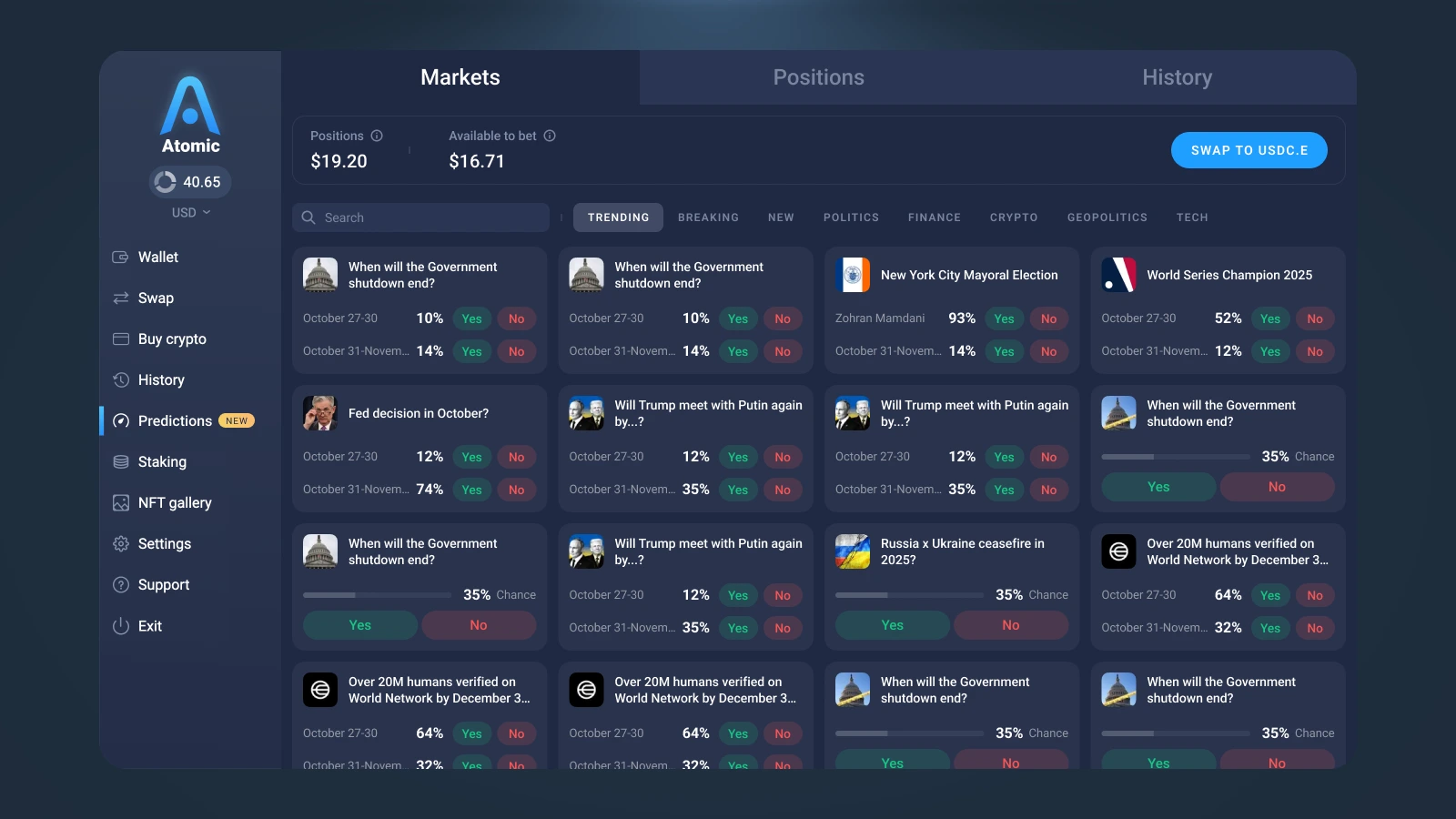
Atomic Wallet provides a neutral way to hold and manage USDC and other crypto assets used across prediction markets — without acting as a betting platform or influencing outcomes.