Telegram Launches Cocoon: Confidential AI Computing on the TON Blockchain

Cocoon, the new decentralized AI compute network built on the TON blockchain, is officially live. The first real user requests are already being processed privately through secure enclaves, and GPU providers have begun earning TON for supplying compute. This marks one of the most significant steps toward fully private, scalable AI infrastructure — powered not by centralized clouds, but by a blockchain ecosystem with over 1 billion Telegram users behind it.
For TON, this is more than a product launch. It’s the first major decentralized compute layer directly tied to a mainstream platform, setting the stage for AI features inside Telegram that operate with guaranteed confidentiality.
What Is Cocoon?
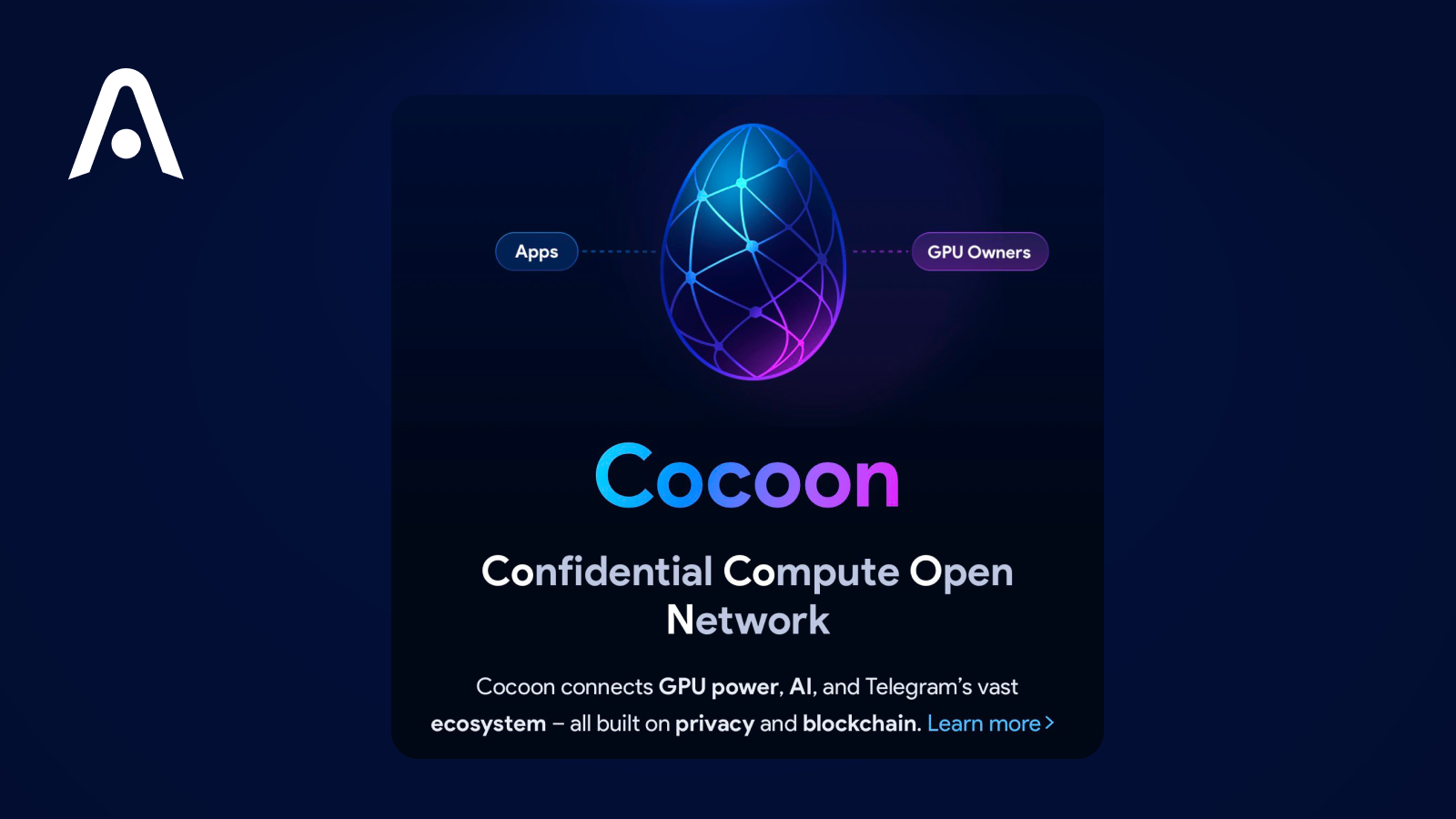
Cocoon is a decentralized confidential-compute network that connects AI developers with GPU providers through the TON blockchain. Instead of relying on traditional cloud platforms like AWS or Microsoft Azure, Cocoon uses a distributed network of Trusted Execution Environment (TEE) nodes to run AI workloads with full privacy.
The result is a compute marketplace where developers get cheaper, censorship-resistant AI processing, and hardware owners earn TON by powering the network. It’s Telegram’s answer to the rising cost, centralization, and data exposure risks of legacy cloud AI providers.
Why Telegram Is Building Cocoon
Telegram processes billions of user interactions every day and is rapidly evolving into an ecosystem where AI assistance is becoming essential. But running AI workloads on centralized clouds is expensive, slow to scale, and forces user data through intermediaries that can log, analyze, or store it. That model contradicts Telegram’s longstanding focus on privacy.
Cocoon solves this by giving Telegram a decentralized compute layer that scales with demand while keeping data opaque to everyone — including the node operators themselves. It also aligns perfectly with TON’s rapid growth, letting AI tasks be executed with the same trust-minimized logic that powers TON payments, storage, and gaming.
How Cocoon Works on TON
At its core, Cocoon operates through a network of TEE-secured nodes that process AI tasks without exposing input data or model outputs. Developers submit requests, TON validators verify commitments, and GPU providers run workloads inside enclave-protected environments. The entire workflow is designed so that no one — not even the hardware owner — can see what is being computed.
This architecture makes Cocoon both private and scalable. Developers get cheaper compute, users get confidentiality, and GPU suppliers earn TON through a transparent, on-chain marketplace. It’s a decentralized alternative to cloud AI compute — but with the speed and settlement finality of TON.
Cocoon Features — What Makes It Different
Cocoon is designed around one principle: AI tasks should be fast, cheap, and private by default. Because computation happens inside TEEs, developers don’t need to trust the GPU operator, and users don’t need to rely on centralized cloud giants. The result is a system that feels like a high-performance cloud but behaves like a decentralized network.
Key benefits include:
- private inference via TEE enclaves
- automatic settlement and payouts in TON
- flexible demand from Telegram’s billion-user ecosystem
- permissionless onboarding for GPU providers
As the network scales, costs decrease and task throughput increases — something centralized clouds struggle to match.
GPU Providers Earn TON for Processing AI Tasks
Anyone with a capable GPU can join Cocoon and start earning TON by providing compute power. The setup is simple: install the Cocoon node client, enable TEE support, and register your machine. From that moment, your hardware becomes part of a global AI compute marketplace.
Earnings depend on demand, hardware performance, and uptime. Early adopters already report stable task flow as Telegram begins routing translation and experimental AI features through Cocoon. This creates a rare opportunity for GPU owners to monetize idle hardware in a privacy-preserving, on-chain environment.
How Telegram Will Use Cocoon
Telegram is already testing Cocoon for message translation and other lightweight AI operations. Over the coming months, heavier AI tools — including summarization, media processing, and conversational assistants — will be routed through the network as well. This instantly gives Cocoon access to one of the largest user bases in the world.
Because all AI requests run inside TEEs, Telegram never sees raw user data. The platform simply becomes a demand engine powering a decentralized compute layer — a major shift from today’s centralized AI deployments.
A billion-user distribution channel on Day 1 positions Cocoon as one of the most consequential real-world deployments of decentralized AI.
Why Cocoon Matters for Decentralized AI
Most “decentralized AI” projects outsource key steps to centralized clouds or trusted operators. Cocoon doesn’t. It delivers something the industry has been promising for years but has struggled to execute: private, verifiable compute at scale. This is crucial as AI moves into messaging, finance, identity, and sensitive user workflows.
For TON, Cocoon becomes a flagship use case. For the broader market, it’s a live demonstration that decentralized AI can compete with AWS, Azure, and Google Cloud — not in theory but in production.
Manage TON & AI-Economy Tokens Safely in Atomic Wallet
Cocoon introduces a new on-chain economy where GPU providers earn TON and developers rely on decentralized confidential compute. If you’re participating in TON — as a GPU provider, builder, or investor — self-custody is the safest way to manage assets.
Atomic Wallet lets you:
- store TON and TON ecosystem tokens securely;
- swap inside the app with no accounts or KYC;
- manage AI-related and compute-economy tokens as they appear;
- maintain full control of your private keys at all times.
TON is evolving from payments and memecoins into an AI infrastructure layer. Atomic Wallet helps you stay in control as the ecosystem expands