What Is Algorand? High-Performance Layer 1 Blockchain Guide
Blockchain networks are increasingly being judged not by theoretical performance, but by their ability to support real-world applications. From digital payments and tokenized assets to AI-powered commerce, developers and institutions need infrastructure that combines speed, security, and predictable execution at scale.
Algorand was built with that goal in mind. Backed by its Pure Proof-of-Stake consensus, instant transaction finality, and low-cost architecture, the network has become a foundation for decentralized finance, enterprise applications, and digital payments. As initiatives like x402 expand onto Algorand and institutional adoption continues to grow, the blockchain is reinforcing its position as infrastructure for the next generation of financial applications.
What Is Algorand?
Algorand is a high-performance Layer 1 blockchain designed for scalable financial applications.
Founded by Turing Award winner Silvio Micali, Algorand was built to solve the blockchain trilemma by combining decentralization, security, and scalability without compromising any of the three. The network delivers fast transaction processing, low fees, and instant finality, making it suitable for decentralized applications, tokenized assets, payment systems, and enterprise solutions.
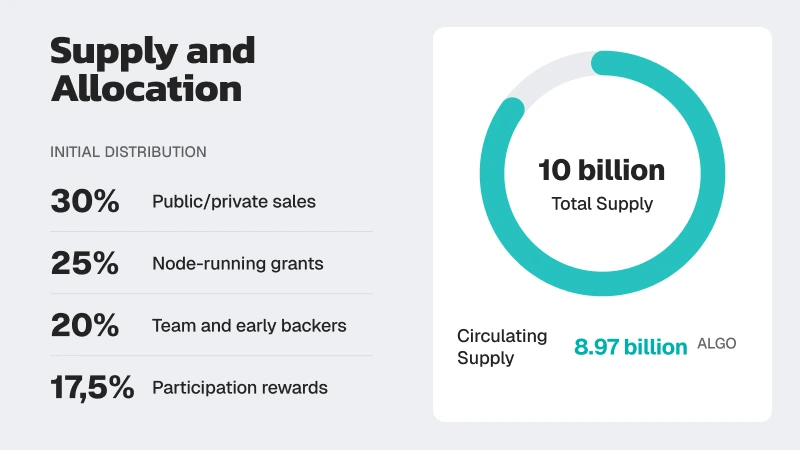
At the core of the ecosystem is ALGO, the network’s native token, which powers transactions, consensus participation, governance, and decentralized applications. Together with the Algorand Virtual Machine (AVM), native digital assets, and developer-friendly infrastructure, Algorand provides a complete platform for building blockchain applications that extend beyond traditional cryptocurrency use cases.
Why Is Algorand Built for Real-World Finance?
Many financial applications require speed, reliability, and predictable transaction costs.
Traditional payment systems often rely on intermediaries, while many blockchains still face network congestion, variable fees, or delayed transaction finality. These limitations make it difficult to build applications that require consistent performance, especially in areas such as digital payments, tokenized assets, and institutional finance.
Algorand was designed to address those challenges from the protocol level. Its architecture provides instant transaction finality, low transaction costs, and continuous network availability without forks. These characteristics have made the network suitable for payment infrastructure, stablecoins, tokenization, decentralized finance, and newer initiatives such as x402, which brings machine-to-machine and AI-powered payments to the blockchain.
How Algorand Delivers Speed and Security
Algorand combines efficient consensus with developer-friendly infrastructure.
Several core technologies power the network:
- Pure Proof-of-Stake (PPoS) secures the blockchain without requiring users to lock their ALGO, allowing them to retain full control of their assets.
- Instant Finality confirms transactions within seconds without the risk of blockchain forks.
- Algorand Virtual Machine (AVM) enables developers to build secure smart contracts and decentralized applications directly on Layer 1.
- Verifiable Random Functions (VRFs) randomly select block proposers and validators, helping strengthen network security and decentralization.
- Low transaction fees make the network practical for high-volume payments, tokenization, and enterprise applications.
Together, these technologies allow Algorand to support scalable blockchain applications while maintaining predictable performance and strong security.
Inside the Algorand Ecosystem
Algorand supports a broad ecosystem of financial, enterprise, and developer applications.
The network continues to expand beyond cryptocurrency transfers with infrastructure designed for a wide range of use cases:
- Smart Contracts — Build decentralized applications directly on Layer 1 using the Algorand Virtual Machine.
- Algorand Standard Assets (ASAs) — Create and manage fungible tokens, NFTs, stablecoins, and tokenized real-world assets.
- DeFi — Access decentralized exchanges, lending protocols, staking, and liquidity applications.
- Stablecoins & Payments — Support digital payments and asset settlement with low fees and instant finality.
- x402 Payments — Enable machine-to-machine and AI-driven payments using the emerging x402 payment standard.
- Enterprise Solutions — Develop applications for finance, identity, supply chains, and regulated industries.
Together, these capabilities position Algorand as infrastructure for both Web3 innovation and real-world digital finance.
Algorand vs Traditional Layer 1 Blockchains
Algorand prioritizes predictable performance for real-world applications.
Rather than optimizing for a single use case, Algorand provides infrastructure capable of supporting payments, tokenized assets, decentralized applications, and enterprise-grade blockchain solutions on the same network.
What Is ALGO Used For?
ALGO powers transactions, network security, and the broader Algorand ecosystem.
The ALGO token serves several important functions across the network:
- Paying transaction fees for transfers and smart contract interactions.
- Securing the network through Algorand’s Pure Proof-of-Stake consensus mechanism.
- Participating in governance by voting on ecosystem proposals through Algorand Governance.
- Using decentralized applications across DeFi, NFT marketplaces, gaming platforms, and payment services.
- Sending and receiving value quickly with low transaction costs and fast settlement.
As the ecosystem expands into tokenization, enterprise infrastructure, and AI-powered payments, ALGO remains the asset that powers activity across the network.
Managing ALGO Securely
Self-custody gives you complete control over your ALGO holdings.
Using a non-custodial wallet allows you to securely store, send, receive, and manage ALGO without relying on a centralized intermediary.
Atomic Wallet provides a secure way to manage ALGO alongside thousands of other digital assets while keeping full control of your private keys.
The Future of Real-World Blockchain Adoption
Blockchain networks are increasingly competing on real-world utility rather than theoretical performance.
Algorand has spent years building infrastructure for payments, tokenization, decentralized finance, and enterprise applications. More recently, initiatives such as x402 for machine-to-machine payments and growing institutional adoption have expanded the network’s role beyond traditional cryptocurrency use cases. These developments suggest that blockchain adoption is increasingly being driven by practical applications rather than speculation alone.
With its Pure Proof-of-Stake consensus, instant finality, and developer-friendly architecture, Algorand is well positioned to support the next generation of digital financial services. As demand grows for scalable and reliable blockchain infrastructure, networks capable of serving both Web3 developers and institutional users may play an increasingly important role in the broader digital economy.