What Is Arcium? The Confidential Computing Network for AI and Finance

Traditional computing has a major privacy problem. Data can be encrypted while it is stored and while it moves across networks, but the moment computation begins, that protection typically disappears. To process information, systems usually need direct access to the underlying data.
For decades, this tradeoff has been accepted as unavoidable. As artificial intelligence becomes more powerful and financial applications handle increasingly sensitive information, that assumption is being challenged. Organizations want to use private datasets, train AI models, analyze financial information, and build advanced applications without exposing the underlying data to third parties.
This is where confidential computing enters the picture. Rather than forcing users to choose between utility and privacy, confidential computing aims to make it possible to compute on data without revealing the data itself.
Arcium is one of the projects building toward that vision.
Designed as a decentralized confidential computing network, Arcium enables applications to perform computations on encrypted information while preserving privacy. The project positions itself as infrastructure for the next generation of AI, finance, and data-intensive applications that require both transparency and confidentiality.
Why Confidential Computing Matters
The future of AI and finance may depend on the ability to process sensitive information without exposing it.
Many of today’s most valuable datasets contain information that cannot simply be placed on a public blockchain or shared with external systems.
Examples include:
- financial records
- healthcare information
- enterprise data
- proprietary AI datasets
- trading strategies
This creates a major limitation for both Web2 and Web3 applications.
Companies want to benefit from collaboration and computation, but they often cannot risk revealing the underlying information that gives them a competitive advantage or creates regulatory obligations.
The challenge becomes even larger in the age of AI.
Modern AI systems require access to enormous amounts of data, yet privacy concerns continue to grow alongside adoption. As a result, developers are increasingly looking for ways to unlock AI capabilities without sacrificing confidentiality.
Confidential computing attempts to solve this problem by separating computation from data exposure.
Instead of revealing information to the system performing the work, confidential computing allows applications to generate results while keeping the underlying data protected.
For many industry observers, this represents one of the most important infrastructure challenges facing both AI and blockchain technology over the coming decade.
What Is Arcium?
Arcium is a decentralized confidential computing network that enables applications to compute on data without revealing the data itself.
The project describes its vision as building a confidential supercomputer capable of supporting AI, financial applications, decentralized infrastructure, and other privacy-sensitive use cases.
At its core, Arcium combines blockchain technology with Multi-Party Computation (MPC), a cryptographic approach that allows multiple participants to jointly perform computations without any individual party gaining access to the complete dataset.
Rather than sending sensitive information to a single trusted operator, Arcium distributes encrypted fragments of data across independent nodes.
These nodes cooperate to perform computations while preserving confidentiality throughout the process.
This architecture allows developers to build applications that require privacy while maintaining the benefits of decentralized infrastructure.
Potential use cases include:
- confidential AI systems
- encrypted financial applications
- private data marketplaces
- secure analytics
- institutional blockchain infrastructure
By focusing on confidential computing rather than general-purpose blockchain functionality, Arcium is targeting a rapidly growing category at the intersection of AI, cryptography, and decentralized networks.
How Arcium Works
Arcium uses Multi-Party Computation (MPC) to enable confidential computation across a decentralized network of independent nodes.
Traditional computing requires a system to access data before it can process it.
Arcium takes a different approach.
Instead of exposing information to a single machine or operator, the network divides data into encrypted fragments and distributes them across multiple participants. No individual node possesses the complete dataset, which helps preserve confidentiality throughout the computation process.
Secret Sharing
The foundation of Arcium’s architecture is secret sharing.
Sensitive data is split into multiple cryptographic shares and distributed across independent nodes. Each share on its own reveals nothing useful about the original information.
Only through coordinated computation can the network generate a valid result.
Clusters and Nodes
Computations are performed by groups of nodes known as clusters.
These clusters jointly process encrypted information without reconstructing the original data in a visible form. Because multiple participants contribute to every computation, trust is distributed across the network rather than concentrated in a single operator.
Confidential Computation
When an application submits a request, the participating nodes execute the required computation collectively.
The result is produced without exposing the underlying inputs, allowing developers to work with sensitive information while maintaining privacy guarantees.
Why No Single Node Can See the Data
One of Arcium’s core security assumptions is that confidentiality remains intact as long as at least one participating node behaves honestly.
Because data is fragmented and distributed, no single node ever gains complete visibility into the information being processed.
This model allows Arcium to deliver confidentiality without relying on a centralized trusted party.

Why Arcium Is Different From Traditional Privacy Solutions
Arcium approaches privacy differently from both public blockchains and many existing confidential computing systems.
Most blockchain networks prioritize transparency.
While transparency is valuable for verification and security, it also creates challenges for applications that require privacy.
Financial institutions, AI developers, and enterprises often need the opposite: the ability to keep sensitive information confidential while still benefiting from decentralized infrastructure.
Different technologies attempt to solve this problem in different ways.
Trusted Execution Environments rely on specialized hardware to protect sensitive workloads.
Fully Homomorphic Encryption allows computations on encrypted data but can introduce significant computational overhead.
Arcium’s MPC-based approach distributes trust across multiple independent participants, avoiding reliance on a single machine or hardware environment.
This positioning has helped Arcium emerge as one of the more closely watched projects within the broader confidential computing sector.
As privacy requirements increase across AI and finance, different approaches will continue competing to become the preferred infrastructure layer for secure computation.
Why AI Needs Confidential Computing
AI may become one of the largest drivers of demand for confidential computing infrastructure.
Modern AI systems depend on data.
The more valuable the data, the more difficult it becomes to share, process, and monetize safely.
This creates a growing challenge for businesses and institutions that want to benefit from artificial intelligence without exposing proprietary information.
Examples include:
- enterprise datasets
- customer information
- healthcare records
- financial data
- proprietary training data
In many cases, organizations are unwilling—or legally unable—to share this information with external systems.
As AI adoption accelerates, the ability to compute on sensitive data while preserving privacy could become increasingly important.
Confidential computing offers a potential solution.
Rather than revealing information to the model or infrastructure provider, confidential computing allows data to remain protected throughout the computation process.
This could unlock new categories of AI applications that are currently difficult to deploy because of privacy concerns.
For that reason, many investors view confidential AI as one of the most important long-term opportunities within the broader AI infrastructure sector.
Why Finance Needs Confidential Computing
Financial institutions require privacy, yet most blockchain activity remains completely transparent.
Public blockchains have created unprecedented visibility into transactions and asset movements.
While this transparency improves auditability, it also creates limitations for many financial applications.
In traditional finance, participants typically do not publish:
- trading strategies
- portfolio allocations
- order flow
- risk management data
- proprietary financial models
However, much of this information can become visible on public blockchain networks.
This creates a barrier for institutions that want to benefit from blockchain technology without sacrificing confidentiality.
Confidential computing can help bridge this gap.
By enabling computations on protected data, projects such as Arcium make it possible to build applications that preserve privacy while maintaining decentralized verification.
Potential use cases include:
- confidential trading systems
- encrypted derivatives markets
- institutional finance
- private analytics
- secure data sharing
As blockchain adoption expands beyond retail users and into institutional markets, confidential computing may become an increasingly important component of financial infrastructure.
For many observers, privacy is not optional—it is a requirement for bringing large-scale financial activity onchain.
What Is the ARX Token?
ARX is the native utility and governance token that powers participation across the Arcium network.
While Arcium focuses on confidential computing, ARX serves as the economic layer that helps secure, coordinate, and decentralize the protocol.
The token has a fixed supply of 1 billion ARX and is designed around a relatively focused set of functions rather than a broad list of utility claims.
Its primary roles include:
- staking
- node operation
- delegation
- governance
To participate as a node operator, participants must stake ARX as collateral.
This requirement helps secure the network by creating economic consequences for misbehavior while also discouraging Sybil attacks, where malicious actors attempt to spin up large numbers of nodes.
Users who do not wish to operate infrastructure themselves can delegate ARX to node operators and participate indirectly in network security.
Beyond staking, ARX also plays a central role in governance.
Token holders can participate in community decisions, while node operators help shape technical aspects of the protocol through voting mechanisms tied to staked ARX.
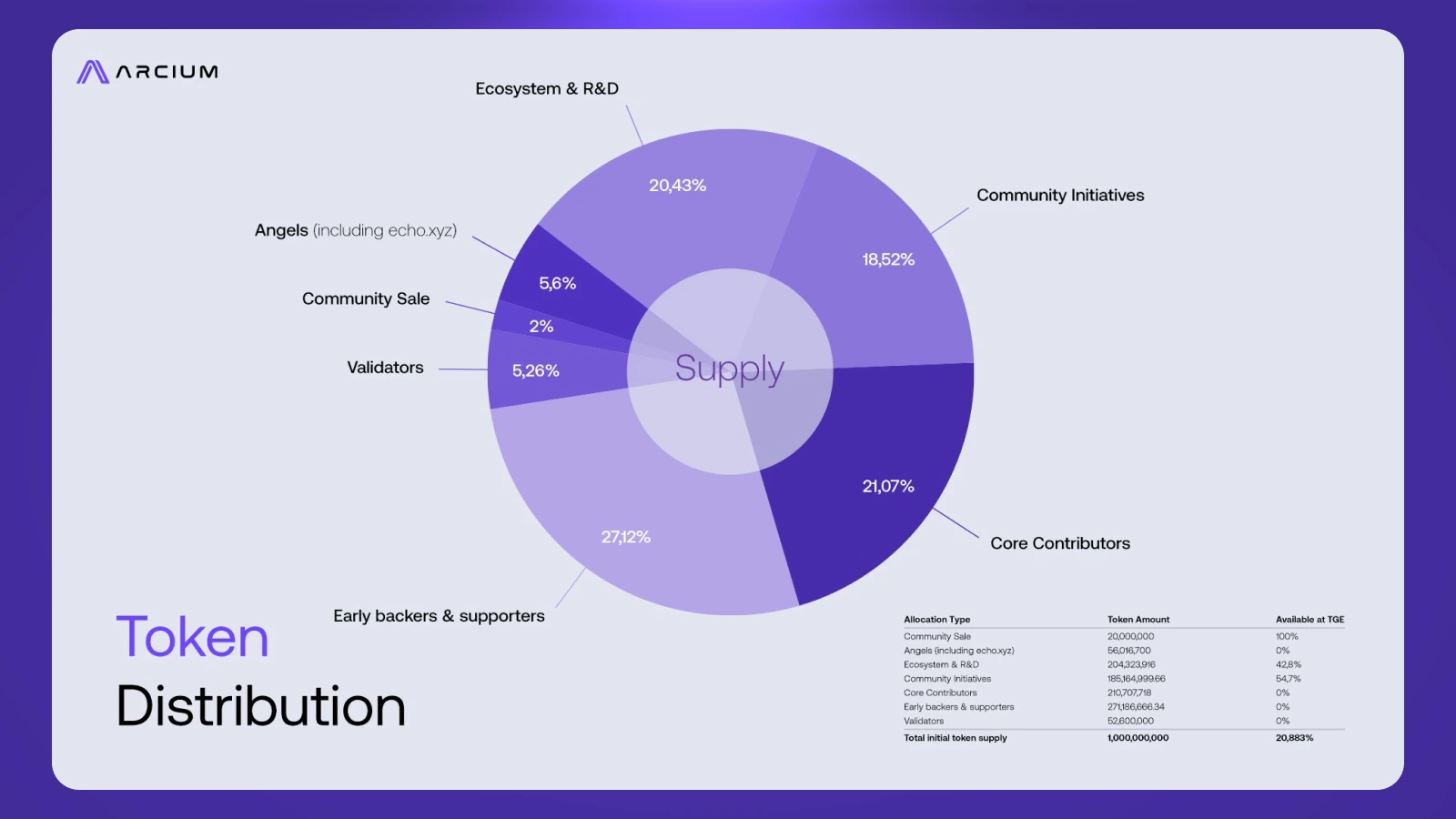
ARX Tokenomics Explained
Arcium’s token model is designed to align network participants, operators, contributors, and long-term ecosystem growth.
ARX has a fixed maximum supply of:
1,000,000,000 ARX
At launch, approximately 20.9% of the total supply entered circulation, while the remaining tokens were subject to predefined lockups and vesting schedules.
Several key design features stand out.
Fixed Supply
Unlike inflationary token models, ARX has a fixed supply cap, meaning no additional tokens will be created beyond the initial allocation.
Network Fees
Computation fees on Arcium are paid using the native asset of the underlying blockchain environment, such as SOL on Solana.
Those fees are distributed across the network according to a predefined structure:
This mechanism rewards infrastructure providers while helping fund long-term protocol development.
Staking and Security
The staking requirement creates economic incentives for honest behavior.
Node operators place ARX at risk in order to participate in confidential computation, helping align network security with economic incentives.
Vesting Schedule
A significant portion of ARX supply remains locked under multi-year vesting schedules.
Investor and contributor allocations are generally subject to cliff periods before unlocking begins, with the majority of supply expected to enter circulation gradually over several years.
For investors, understanding these unlock schedules is an important part of evaluating future token supply dynamics.
Can Arcium Benefit From the AI Boom?
The rapid growth of artificial intelligence could become one of the strongest long-term catalysts for confidential computing networks.
As AI systems become more powerful, access to high-quality data becomes increasingly important.
However, much of the world’s most valuable information cannot be freely shared.
Businesses, financial institutions, healthcare providers, and governments often operate under strict privacy requirements that limit how sensitive data can be used.
This creates a growing opportunity for confidential computing.
If organizations can securely compute on private information without exposing the underlying data, entirely new categories of AI applications may become possible.
Several trends support this thesis:
- rising enterprise AI adoption
- growing demand for private datasets
- increasing regulatory scrutiny
- expansion of AI agents
- demand for secure data collaboration
Arcium is positioning itself at the intersection of these trends.
Rather than competing directly with AI models, the project aims to provide infrastructure that allows AI systems to access and process sensitive information in a confidential manner.
If confidential AI becomes a major category over the coming years, demand for networks capable of supporting secure computation could increase significantly.
For that reason, many investors view Arcium not simply as a privacy project, but as a potential infrastructure layer for the broader AI economy.
Risks Investors Should Know
Like any emerging infrastructure project, Arcium faces several risks that could affect adoption and long-term success.
While confidential computing is an attractive narrative, the sector remains relatively early in its development.
One of the biggest challenges is execution.
Arcium must continue scaling its network, attracting developers, and demonstrating that confidential computing can support real-world applications at meaningful scale.
Other risks include:
- competition from alternative privacy technologies
- adoption uncertainty
- regulatory developments
- token unlock pressure
- technological complexity
The competitive landscape is particularly important.
Arcium operates alongside other approaches to privacy and confidential computation, including Trusted Execution Environments (TEEs), Fully Homomorphic Encryption (FHE), zero-knowledge technologies, and competing MPC networks.
It remains unclear which architectures will ultimately achieve the largest market share.
Investors should also recognize that many of the project’s long-term opportunities depend on broader adoption of AI, decentralized infrastructure, and confidential computing itself.
While the opportunity is significant, it remains a developing market rather than an established one.
As with any early-stage crypto project, balancing long-term potential against execution risk remains an important consideration.
Managing ARX Securely
As the Arcium ecosystem grows, secure self-custody becomes increasingly important for ARX holders.
Whether participating in governance, staking tokens, or gaining exposure to the confidential computing sector, investors should prioritize secure storage solutions that give them full control over their assets.
Atomic Wallet allows users to securely manage thousands of digital assets through a self-custody experience designed for long-term crypto ownership. By maintaining control of private keys and recovery phrases, users can reduce reliance on third parties while keeping access to their portfolios across devices.
As with any crypto asset, investors should combine secure storage practices with proper research and risk management before making investment decisions.
Conclusion: Is Confidential Computing the Next Big Crypto Narrative?
Confidential computing is emerging as one of the most important infrastructure categories at the intersection of AI, finance, and blockchain technology.
While public blockchains excel at transparency, many real-world applications require privacy.
Organizations want to analyze data, train AI models, execute financial transactions, and collaborate across networks without exposing sensitive information.
This is the problem Arcium is attempting to solve.
By combining decentralized infrastructure with Multi-Party Computation, the project enables confidential computation without relying on a single trusted party.
As demand for secure AI systems and privacy-preserving financial applications continues to grow, confidential computing could become an increasingly important part of the digital economy.
Whether Arcium ultimately becomes a leading platform in this category will depend on adoption, execution, and broader market demand.
But one thing is becoming increasingly clear:
The future of AI and finance may require infrastructure that can compute without exposing the data behind it.