What Is DeFi? Decentralized Finance Explained
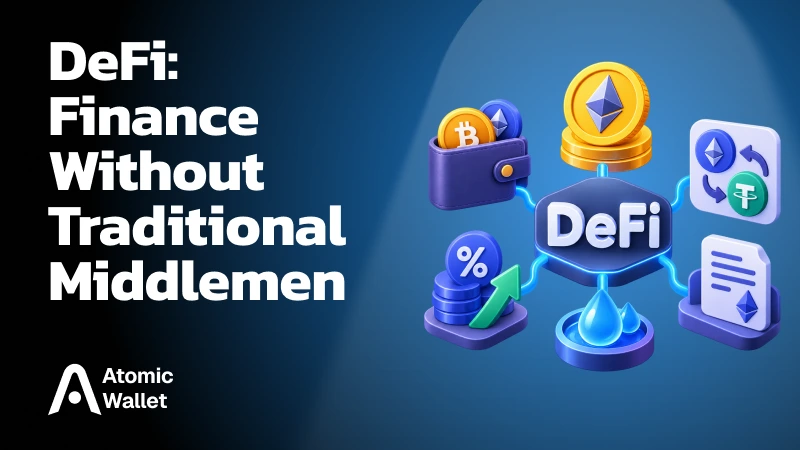
DeFi, short for decentralized finance, is a system of blockchain-based financial services where wallets and smart contracts replace much of the work normally handled by banks, brokers, and centralized exchanges.
Instead of opening an account with a financial institution, users typically connect a crypto wallet to a decentralized application, or dApp, and approve transactions themselves. Smart contracts then execute the rules for activities such as swapping tokens, lending, borrowing, or providing liquidity. Ethereum describes DeFi as financial services built with cryptocurrencies and smart contracts rather than traditional intermediaries.
But “decentralized” does not mean nothing has to be trusted. DeFi shifts trust toward blockchain networks, smart-contract code, liquidity, oracles, governance systems, and the wallet permissions a user signs.
DeFi markets now operate at trillion-dollar scale. By October 2026, the Uniswap Protocol alone had processed more than $4.7 trillion in cumulative trading volume.
How Does DeFi Work?
DeFi works by turning financial rules into smart contracts that users interact with directly from a crypto wallet.
Suppose you want to swap USDC for ETH on a decentralized exchange:
- Connect your wallet — The dApp can read your public address and relevant balances, but connecting alone does not give it control of your funds
- Choose the swap — You enter the amount of USDC you want to exchange for ETH
- The dApp prepares the transaction — Its interface calls the relevant smart contract and shows the expected output, fees, and other transaction details
- You approve and sign — Your wallet asks you to authorize the required token approval or transaction
- The smart contract executes — The protocol swaps against available onchain liquidity according to its programmed rules
- The blockchain records the result — Once confirmed, the new balances belong to your wallet; a state-changing smart-contract transaction also requires network gas.
This is fundamentally different from depositing assets on a centralized exchange. With a centralized platform, the company normally takes custody and updates balances inside its own systems. In DeFi, the transaction can be executed directly by blockchain contracts while the user signs from a self-custody wallet.
The dApp is also not the same thing as the protocol. A dApp combines a user-facing interface with underlying smart contracts; the contracts are the onchain logic that actually executes the financial rules.
That distinction helps explain what DeFi really changes. It does not remove financial infrastructure — it makes more of that infrastructure programmable and moves execution onchain.
What Can You Do With DeFi?
DeFi brings common financial activities onchain, including trading, borrowing, lending, earning fees, and accessing tokenized markets without relying on a traditional financial intermediary.
The main use cases include:
- Token swaps — Decentralized exchanges such as Uniswap let users trade directly from a wallet against onchain liquidity
- Lending and borrowing — Protocols such as Aave allow users to supply assets to lending markets or borrow against crypto collateral
- Providing liquidity — Users can deposit token pairs or other assets into liquidity pools and earn a share of trading fees
- Stablecoins — Dollar-linked tokens provide a common unit for trading, lending, collateral, and payments across DeFi
- Staking and yield strategies — Crypto can be committed to network security or deployed through protocols that generate rewards
- Derivatives and perpetuals — Some protocols offer onchain markets for leveraged or derivative positions
These services can also interact with one another. A token received from one protocol may be usable as collateral or liquidity somewhere else — a property often called composability.
Where Does DeFi Yield Come From?
DeFi yield is not created from nowhere: it usually comes from borrowers, trading fees, blockchain rewards, or incentives paid by a protocol.
The source matters because two protocols advertising the same APY may be generating it in completely different ways.
- Lending interest — Borrowers pay interest for access to supplied assets, and part of that interest goes to lenders
- Trading fees — Traders pay fees when swapping through liquidity pools, and liquidity providers can receive a share
- Staking rewards — Proof-of-stake networks reward participants for helping secure and operate the blockchain
- Protocol incentives — Projects may distribute their own tokens to attract liquidity or encourage use
Uniswap, for example, allows liquidity providers to earn fees generated by swaps through the liquidity positions they fund.
The last category deserves particular attention. Token incentives can make an APY look attractive without representing sustainable external revenue. If most of the return comes from newly issued tokens, its value depends heavily on continued demand for those tokens.
A useful question before chasing any DeFi yield is therefore simple: who is paying the return, and why?
What Are Liquidity Pools?
A liquidity pool is a set of crypto assets held in a smart contract so users can trade without waiting for a traditional buyer and seller to match through an order book.
On an automated market maker such as Uniswap, users called liquidity providers (LPs) supply assets to a pool. Traders then swap against those assets, while the protocol calculates prices according to its market-making rules. In return, liquidity providers can earn a share of the fees generated by swaps through their positions.
For example, an ETH/USDC pool contains both ETH and USDC. Someone buying ETH adds USDC to the pool and removes ETH; another trader can later make the opposite swap. The pool itself provides the liquidity rather than a centralized exchange holding customer balances and matching every trade through its own order book.
More liquidity generally means a large trade can be executed with less price impact. In a shallow pool, the same trade can move the quoted price much more sharply.
Providing liquidity is not risk-free. If the relative prices of the deposited assets change, an LP position can underperform simply holding the tokens — a phenomenon known as impermanent loss. Smart-contract risk and exposure to the underlying tokens also remain.
DeFi vs. CeFi
DeFi executes financial activity through blockchain-based protocols and user wallets, while CeFi relies on a centralized company to operate the service and typically control key parts of the user experience.
CeFi can be easier for beginners because a company handles infrastructure, custody, account recovery, and support. DeFi gives users more direct control and access to onchain protocols, but that control comes with more responsibility. Coinbase similarly distinguishes DeFi’s smart-contract-based model from centralized financial services operated by intermediaries.
Neither model is automatically safer. DeFi replaces some institutional trust with technical and economic dependencies; CeFi concentrates more trust in the company operating the service.
Is DeFi Really Decentralized?
DeFi can reduce reliance on traditional financial intermediaries, but it does not eliminate trust — it shifts trust toward code, governance, oracles, infrastructure, and whoever controls privileged protocol permissions.
A protocol may execute transactions on a public blockchain and still depend on components that are not fully decentralized:
- Smart contracts — Users depend on the code behaving as intended
- Oracles — Lending and derivatives protocols may rely on external price data
- Governance — Token holders, multisigs, or core teams may be able to change important parameters
- Admin keys — Some protocols retain privileged permissions to pause contracts, upgrade code, or control specific functions
- Stablecoins — A decentralized protocol may still rely heavily on centrally issued assets such as USDC
- Bridges — Moving assets between chains adds another layer of contracts, validators, or custodial assumptions
- Frontends — The underlying contracts may be permissionless even when the website users access is controlled by a company or team
Not every DeFi hack breaks the code. In the 2026 Resolv exploit, roughly $23 million was extracted after a privileged key was compromised — while the smart contracts operated as designed.
That is why “trustless” should not be read as “nothing can be trusted or compromised.” A better way to think about DeFi is:
DeFi changes where trust sits and makes more of the financial logic transparent and executable onchain.
What Are the Main Risks of DeFi?
DeFi risks come from both the protocol itself and the infrastructure around it, so self-custody alone does not make a DeFi position safe.
The main risks include:
- Smart-contract risk — Bugs or design flaws can allow attackers to drain or manipulate protocol funds
- Liquidation risk — Borrowers can lose collateral automatically if its value falls below a protocol’s required threshold
- Oracle risk — Incorrect or manipulated price data can trigger bad loans, artificial liquidations, or improper asset valuations. Ethereum’s security documentation specifically identifies oracle manipulation as a major DeFi attack vector.
- Liquidity risk — Thin markets can produce large price impact or make exiting a position expensive
- Stablecoin risk — A token designed to track $1 can still depeg or fail if its collateral, issuer, or mechanism breaks
- Bridge risk — Cross-chain bridges introduce additional smart-contract, technology, validator, and sometimes custody assumptions. Ethereum.org notes that several of DeFi’s largest historical hacks involved bridges.
- Token approval and phishing risk — Signing a malicious approval can give a contract permission to move tokens from a wallet
- Governance and admin-key risk — A protocol can have secure contracts while still depending on privileged keys or a small group with broad powers
The important point is that “onchain” does not mean “risk-free.” A protocol can fail because its code is flawed, its oracle reports bad information, its collateral collapses, a privileged key is compromised, or a user simply signs the wrong transaction.
DeFi therefore gives users more direct control, but it also removes much of the institutional safety net that exists in traditional finance. There is usually no bank desk or central operator that can simply reverse a valid blockchain transaction after it has executed.
DeFi security has improved, but exploits remain expensive. Immunefi found that median losses per incident fell 75% from $6 million in 2022 to $1.5 million in 2025, while total 2025 DeFi protocol losses still reached about $680 million.
What Is TVL in DeFi?
Total Value Locked, or TVL, measures the value of crypto deposited in DeFi protocols, but it is not the same as the total size or value of the DeFi industry.
Assets counted in TVL may be supplied to lending markets, placed in liquidity pools, deposited as collateral, or locked in other protocol contracts. This makes TVL useful for comparing how much capital different protocols and blockchain ecosystems currently hold.
TVL should not be confused with:
- Trading volume — How much value is traded during a period
- Protocol revenue — Fees or income actually retained by a protocol
- Token market cap — The market value of a protocol’s circulating token
- User count — How many people or wallets interact with a protocol
A protocol can therefore have high trading volume with relatively modest TVL, or billions locked without generating equivalent revenue.
TVL does not measure all DeFi activity. As of October 2026, DeFi held roughly $96.7 billion in TVL, while decentralized exchanges processed about $6.1 billion in spot volume and perpetual markets another $12.6 billion in just 24 hours.
How to Start Using DeFi
To use DeFi, you generally need a self-custody wallet, crypto on the correct blockchain, and enough of that network’s native asset to pay transaction fees.
A typical beginner flow looks like this:
- Set up a compatible wallet — A Web3 wallet lets you connect to DeFi applications while keeping control of your keys
- Choose the correct network — ETH on Ethereum, for example, is not automatically interchangeable with assets on every other chain
- Keep enough crypto for gas — Blockchain transactions and smart-contract interactions require network fees
- Open the protocol from an official source — Fake DeFi websites are commonly designed to imitate legitimate dApps
- Connect your wallet — Check the site, network, and wallet account before proceeding
- Review approvals carefully — A token approval can grant a smart contract permission to spend a specific asset
- Check the transaction before signing — Review the token, amount, network, expected output, fees, and permissions rather than treating the wallet popup as a formality
Atomic Wallet’s Web3 extension can connect to DeFi applications including Uniswap, PancakeSwap, and 1inch, while private keys remain encrypted on the user’s device. Atomic also maintains a dApp directory spanning DeFi, DEXs, lending, staking, bridges, and other Web3 categories.
A self-custody wallet, however, only solves the custody side of the equation. It cannot make a vulnerable smart contract, unstable token, or malicious DeFi protocol safe. Every protocol interaction still needs to be evaluated on its own merits.
Ready to explore DeFi? Get Atomic Wallet to connect to dApps, manage your crypto, and keep control of your private keys.