What Is FOMO in Crypto? Meaning, Risks and How to Avoid It
FOMO in crypto means Fear of Missing Out — the urge to buy, sell, or change a position because prices are moving and other people appear to be profiting.
The key signal is urgency. If your view of an asset has not changed but a sudden rally, viral posts, or screenshots of gains make you feel you need to act immediately, FOMO may be driving the decision more than your original analysis.
Crypto amplifies this effect because markets trade 24/7, price moves can be extreme, and hype spreads quickly across social platforms.
FOMO is more than crypto slang. In a Kraken survey of 1,248 U.S. crypto holders, 84% said FOMO had influenced an investment decision, while 63% believed emotional decisions had hurt their portfolios.
What Does FOMO Mean in Crypto?
Crypto FOMO happens when the fear of missing a potential gain starts influencing a decision more than research, strategy, or risk.
A common example is simple: a token jumps 30%, your feed fills with bullish posts, and suddenly buying feels urgent — even though you had no interest in the asset before the move.
That urgency is what separates FOMO from a normal investment decision. The price changed, the crowd got louder, but the underlying reason for buying may not have changed at all.
Why Crypto Triggers FOMO So Easily
Crypto is unusually prone to FOMO because prices move fast, markets never close, and social media can turn a rally into a global narrative within hours.
Four factors amplify the effect:
- 24/7 trading — There is no closing bell, so it can feel like an opportunity is disappearing while you wait
- Sharp price moves — Double-digit rallies make the cost of “missing out” feel immediate
- Social proof — Profit screenshots, bullish posts, and viral calls make gains more visible than losses
- Fast-moving narratives — Memecoins, AI tokens, new chains, and other themes can dominate the market almost overnight
Crypto FOMO is asymmetric. In Kraken’s survey, 60% of holders were most worried about missing a major price surge, compared with just 17% who feared missing a dip.
Fear & Greed Index and FOMO
The Crypto Fear & Greed Index can help show when market sentiment is becoming unusually euphoric, but it does not predict whether prices will rise or fall next.
The index runs from 0 to 100, with lower values associated with fear and higher values with greed. Alternative.me calculates it using market volatility, momentum and volume, social-media activity, Bitcoin dominance, and Google Trends. (alternative.me)
High greed often appears in the same environments that fuel crypto FOMO: fast price gains, rising attention, and growing confidence that the move will continue. Extreme readings can therefore be useful as a reminder to check whether a decision is based on research or simply on market excitement.
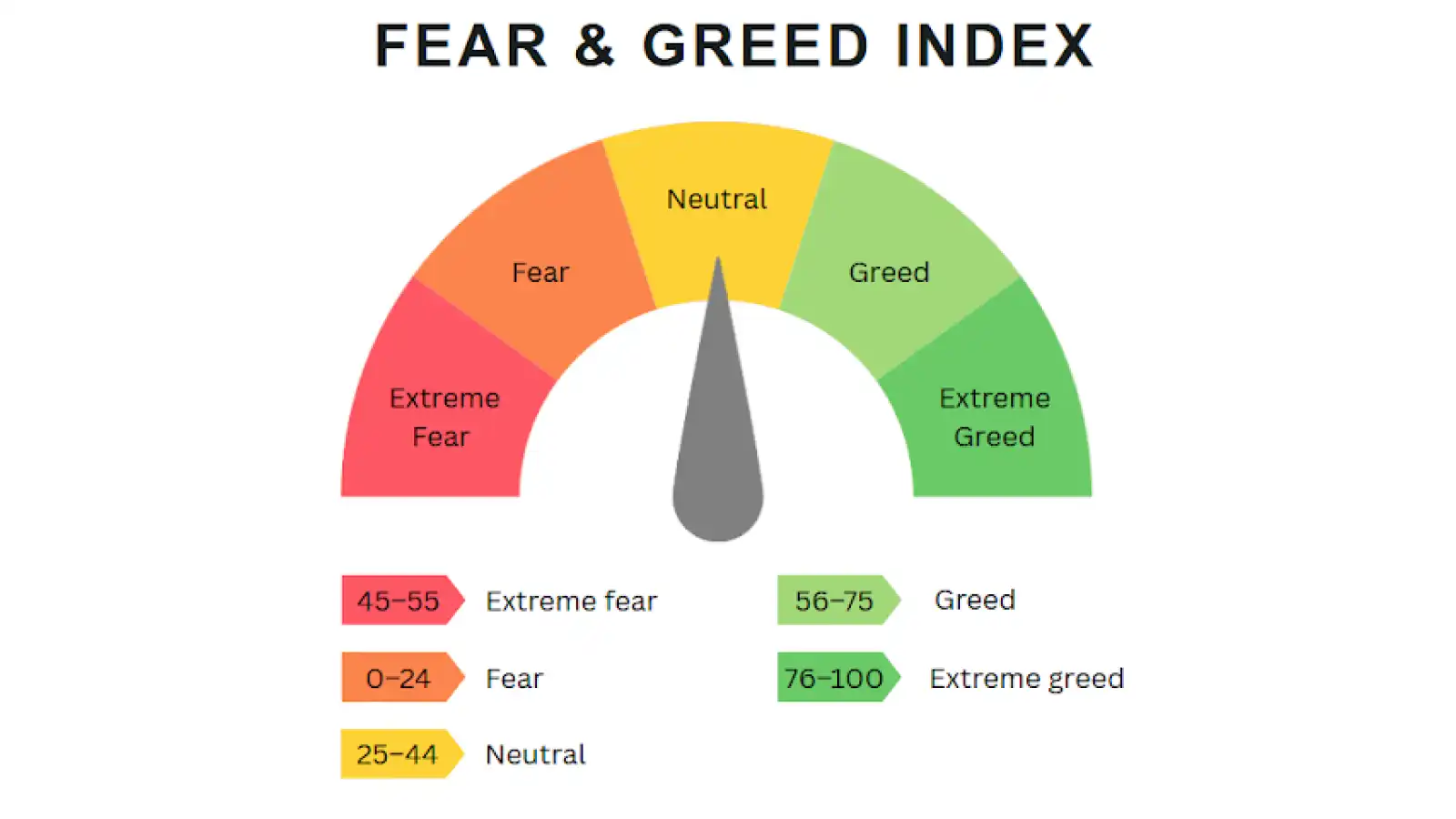
The index should be treated as sentiment context, not a buy or sell signal. A high score does not mean a reversal is imminent, just as extreme fear does not guarantee a bottom.
How to Spot FOMO Before You Act
The clearest sign of FOMO is that your urgency has changed even though your actual investment thesis has not.
Before acting on a fast-moving coin or token, ask:
- What changed besides the price? — A green chart alone is not new fundamental information
- Would I want this asset if it had not just rallied? — If not, the price move may be driving the decision
- Did I research it before seeing the hype? — Research done after deciding to buy easily becomes confirmation-seeking
- Was this position size planned in advance? — Suddenly increasing it because a token is pumping is a common FOMO signal
- Am I reacting to other people’s gains? — Screenshots and viral posts show winners far more often than failed trades
A useful test is simple: if waiting a few hours to research the asset feels unbearable, the sense of urgency may be more important to examine than the trade itself.
FOMO vs. FUD
FOMO pushes people toward a trade because they fear missing gains, while FUD can push them away from a position because fear and uncertainty suddenly dominate the narrative.
Both can distort decisions in opposite directions. The common problem is letting the market’s emotional intensity replace your own analysis.
How to Avoid FOMO in Crypto
The goal is not to eliminate emotion, but to make sure urgency does not become the reason for entering a trade.
- Research before the rally — It is easier to judge an asset before price action and social hype become overwhelming
- Set your position size in advance — Do not increase exposure simply because the price is accelerating
- Ignore profit screenshots as evidence — They show an outcome, not the risk taken or the losses that are missing from the feed
- Accept missed opportunities — Not owning every asset that rallies is part of participating in any market
- Use sentiment tools as context — Indicators such as the Crypto Fear & Greed Index can show unusually euphoric conditions, but they are not buy or sell signals
One practical rule helps: if the main reason to act is “I may never get another chance,” slow the decision down and look for a reason that does not depend on urgency.
Another practical step is to separate long-term holdings from the places where you actively trade.
Keeping assets in a self-custody wallet such as Atomic Wallet can reduce the temptation to react to every short-term market move.