What Is GAEA? The AI Training Network for Emotional Intelligence

Artificial intelligence is becoming more capable every year, but intelligence alone isn’t enough. While today’s leading AI models excel at reasoning and problem-solving, they still struggle to understand emotions, empathy, and the subtle human interactions that shape real-world communication.
GAEA is building infrastructure to address that gap. Instead of focusing only on computing power or larger datasets, the project creates a decentralized network for collecting, evaluating, and supplying high-quality emotional data for AI training. By combining human participation with decentralized infrastructure, GAEA aims to help train AI systems that better understand not only what people say—but also how they feel.
What Is GAEA?
GAEA is a decentralized AI training network built around human emotional data.
GAEA is developing infrastructure that allows individuals to contribute valuable data for AI training while giving researchers and developers access to higher-quality datasets through a decentralized marketplace. The project’s goal is to improve the emotional intelligence of future AI models by creating a reliable source of verified, multimodal emotional data.
Beyond data collection, GAEA is building a broader ecosystem that includes AI training infrastructure, decentralized resource sharing, and GAEA Certification—a framework designed to evaluate and establish standards for emotional intelligence in AI systems. Together, these components aim to support the next generation of AI applications in areas such as education, healthcare, digital assistants, and human-computer interaction.
Why Does AI Need Emotional Data?
Modern AI models are intelligent, but they still struggle to understand human emotions.
Most large language models are trained on enormous amounts of publicly available text and images. While this enables impressive reasoning and language generation, much of that data lacks the emotional context needed for natural conversations, empathy, and human-like interactions. Low-quality or noisy datasets can also reduce training efficiency and increase development costs.
GAEA aims to solve this challenge by treating emotional data as a valuable AI resource. Through structured collection, quality evaluation, and privacy-focused processing, the network seeks to provide developers with cleaner, more meaningful datasets that can help AI better recognize emotions, respond appropriately, and interact more naturally with people.
How GAEA Trains AI
GAEA combines decentralized participation with structured data validation to improve AI training.
The network is designed around several key stages:
- Human data contribution through participants who provide valuable emotional and behavioral data.
- Quality assessment to filter low-value or noisy information before it reaches AI models.
- Privacy-first processing that protects user data throughout the collection and evaluation process.
- AI model training using higher-quality emotional datasets to improve contextual understanding.
- GAEA Certification to evaluate AI systems and establish common standards for emotional intelligence.
By focusing on data quality instead of simply increasing data volume, GAEA aims to make AI training more efficient while helping future models better understand real-world human interactions.
Inside the GAEA Ecosystem
GAEA is building more than a dataset—it is creating infrastructure for emotionally intelligent AI.
The ecosystem combines several components that work together to support AI development:
- Emotional Data Network — A decentralized marketplace for collecting and supplying high-quality emotional training data.
- GAEA Certification — A standardized framework for evaluating the emotional intelligence and performance of AI models.
- Distributed AI Training — Community-contributed computing and network resources that help support decentralized AI development.
- Contributor Rewards — Incentives for users who provide valuable data, resources, or participate in ecosystem growth.
- Developer Infrastructure — Tools designed to help AI builders access verified datasets and integrate them into future applications.
Together, these components aim to create a transparent ecosystem where contributors, developers, and AI applications all benefit from higher-quality training data.
GAEA vs Traditional AI Training
GAEA focuses on improving data quality rather than simply increasing data quantity.
Rather than competing to collect the biggest dataset, GAEA is building infrastructure that helps AI models learn from higher-quality emotional information, making future AI systems more capable of understanding human behavior and communication.
What Is the GAEA Token Used For?
The GAEA token powers participation across the network’s AI ecosystem.
The GAEA token is designed to align incentives between contributors, developers, and infrastructure providers while supporting long-term ecosystem growth.
Its primary functions include:
- Rewarding contributors who provide valuable emotional data, computing resources, or participate in the ecosystem.
- Supporting AI infrastructure through ecosystem incentives and decentralized network expansion.
- Funding developer and community initiatives that build applications and services on GAEA.
- Providing liquidity across centralized and decentralized exchanges.
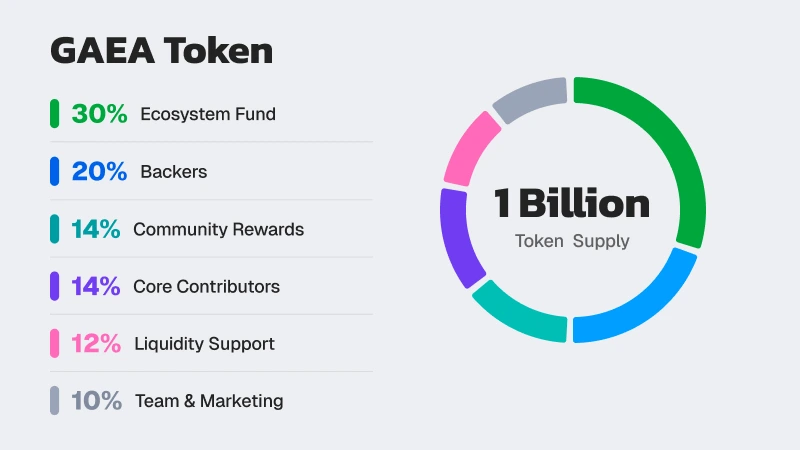
- Supporting long-term token sustainability through a fixed supply of 1 billion tokens and a deflationary economic model governed by the ecosystem.
As the network grows, the token is intended to become the economic layer connecting data contributors, AI developers, and decentralized infrastructure.
Managing GAEA Securely
Self-custody gives you complete control over your GAEA tokens.
Once supported, storing GAEA in a non-custodial wallet allows you to manage your assets without relying on centralized custodians.
Atomic Wallet provides a secure way to store, send, receive, and manage GAEA alongside thousands of other cryptocurrencies while keeping full control of your private keys.
The Future of Emotional AI
The next leap in artificial intelligence may depend more on better data than bigger models.
As AI becomes part of education, healthcare, customer support, and digital companionship, the ability to understand emotions will become increasingly important. Training models on larger datasets alone may not solve that challenge. Instead, higher-quality emotional data, consistent evaluation standards, and decentralized participation could play a critical role in making AI more natural, trustworthy, and effective.
GAEA is positioning itself around that opportunity by building infrastructure for emotional data collection, AI training, and standardized evaluation. If emotional intelligence becomes a core benchmark for future AI systems, decentralized networks that can supply verified, high-quality training data may become an important part of the broader AI ecosystem.