What Is Meteora? Solana’s Dynamic Liquidity Protocol Explained
Solana has become one of crypto’s busiest trading ecosystems, creating massive demand for liquidity that can adapt to fast-moving markets. As token launches, memecoins, stablecoins, and DeFi activity expand, liquidity providers need more efficient ways to deploy capital without relying on traditional one-size-fits-all AMMs.
Meteora is building infrastructure for that market. With dynamic liquidity pools, token launch tools, and a growing suite of products for LPs and traders, the protocol has evolved beyond a simple decentralized exchange. More recently, its MET buyback program has added another layer to the story, connecting protocol-generated revenue with the economics of its native token.
What Is Meteora?
Meteora is a dynamic liquidity protocol built to power trading and token launches across Solana.
Rather than focusing only on token swaps, Meteora provides liquidity infrastructure for LPs, launchpads, token teams, traders, and developers. Its products are designed to improve capital efficiency, deepen markets, and give liquidity providers greater control over how their capital is deployed.
At the center of the ecosystem are products such as DLMM, DAMM v2, and the Dynamic Bonding Curve. Together, they support concentrated liquidity, dynamic fees, customizable token launches, and automated transitions from launch curves into active liquidity pools. Meteora also provides SDKs and APIs, allowing other Solana applications to integrate its liquidity infrastructure directly into their own products.
Why Does Solana Need Dynamic Liquidity?
Fast-moving markets need liquidity that can adapt as trading conditions change.
Traditional AMMs typically distribute liquidity according to predefined formulas, which can leave large amounts of capital sitting outside the price ranges where most trading actually happens. On Solana, where new tokens can launch and experience major shifts in volume and volatility within hours, this can reduce capital efficiency and make liquidity management more difficult for LPs.
Meteora approaches the problem with liquidity models that respond more effectively to different market conditions. LPs can concentrate capital around specific price ranges, while dynamic fees can adjust as volatility changes. This allows liquidity to work more efficiently across stable pairs, volatile assets, and newly launched tokens without forcing every market into the same structure.
How Meteora’s Liquidity Pools Work
Meteora gives liquidity providers more control over where capital sits and how it earns fees.
The protocol combines several mechanisms designed for different market conditions:
- DLMM — Organizes concentrated liquidity into discrete price bins, allowing LPs to deploy capital around selected price ranges.
- Zero-Slippage Bins — Swaps occurring entirely within a single active bin can execute without price impact from the pool’s curve.
- Dynamic Fees — Trading fees can increase during periods of higher volatility, helping LPs capture more revenue when markets become more active.
- DAMM v2 — Provides constant-product liquidity with position NFTs, optional concentrated ranges, and features designed for token launches.
- Flexible LP Strategies — Liquidity providers can choose how capital is distributed across ranges instead of relying on a single fixed liquidity model.
This architecture allows Meteora to serve everything from relatively stable trading pairs to highly volatile token launches while giving LPs greater flexibility over capital deployment.
Inside the Meteora Ecosystem
Meteora has expanded from liquidity pools into a broader infrastructure stack for Solana markets.
Its products cover the full lifecycle of liquidity—from launching a token to building deeper secondary markets and supporting professional integrations:
- DLMM — Concentrated liquidity with discrete price bins and volatility-aware dynamic fees.
- DAMM v2 — A flexible AMM with position NFTs, concentrated ranges, and built-in tools designed for token launches.
- Dynamic Bonding Curve — Customizable launch infrastructure that can automatically graduate tokens into DAMM liquidity pools after predefined conditions are reached.
- Limit Orders — Allow traders to set target prices while potentially earning fees when their liquidity is used for execution.
- Launch Infrastructure — Gives launchpads and token teams tools to bootstrap liquidity and transition into active markets.
- Developer Tools — TypeScript and Rust SDKs alongside public APIs make Meteora’s liquidity primitives available to other Solana applications.
Together, these products position Meteora as a liquidity layer that can serve LPs, traders, token issuers, launchpads, and developers rather than functioning solely as a swap interface.
Meteora vs Traditional AMMs
Meteora is designed to make liquidity more responsive to different market conditions.
The difference is not simply about executing swaps faster. Meteora gives liquidity providers and builders more control over how markets are created, funded, and maintaineWhat Is the MET Token Used For?
MET connects token holders with participation in the broader Meteora liquidity ecosystem.
Launched in October 2025 with a fixed supply of 1 billion tokens, MET is the native token of Meteora. Its role extends beyond holding the asset, with the protocol introducing mechanisms that connect MET to liquidity activity and ecosystem participation.
Key uses include:
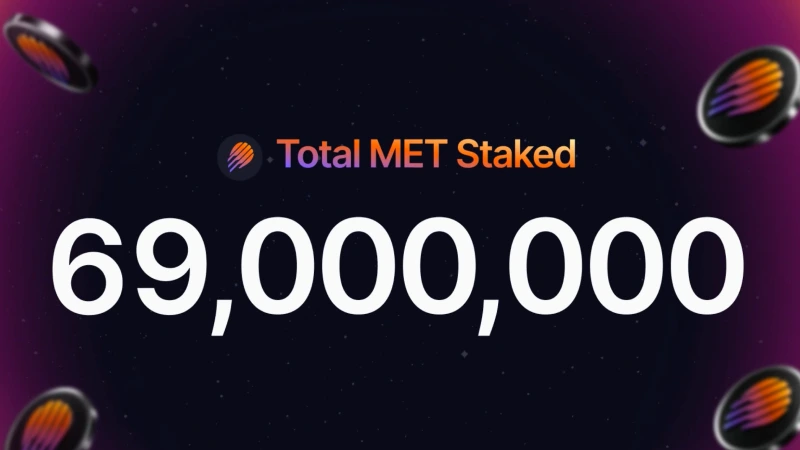
- Staking MET to participate in Meteora’s staking ecosystem.
- Referral rewards that allow stakers to grow LP networks and earn a share of eligible DLMM protocol fees.
- Ecosystem incentives designed to support liquidity providers and long-term participation.
- Protocol economics through revenue-funded MET buybacks.
- Community alignment as Meteora expands its liquidity products and integrations across Solana.
Meteora also launched MET with 48% of the total supply circulating at TGE, while the team and Meteora Reserve allocations follow long-term vesting schedules.
How Meteora Buybacks Support MET
Meteora is using protocol-generated revenue to buy MET directly from the market.
The buyback program creates a direct connection between activity across Meteora and demand for its native token. Rather than relying exclusively on token emissions to incentivize participation, the protocol can allocate part of the revenue generated by its liquidity infrastructure toward purchasing MET.
In its Q1 2026 Token Holder Report, Meteora reported approximately $13.67 million in cumulative USDC spending on buybacks, acquiring around 39.58 million MET, equivalent to roughly 3.97% of the fixed total supply. This gives MET a revenue-linked mechanism that can offset part of the selling pressure created by future token unlocks.
The long-term impact, however, depends on continued protocol activity. Buybacks are most meaningful when trading volume, liquidity, and fee generation remain strong enough to sustain them over time—making Meteora’s underlying usage as important to MET holders as the buyback program itself.
Managing MET Securely
Self-custody gives you direct control over your MET tokens.
Using a non-custodial wallet allows you to store, send, receive, and manage MET without leaving your assets with a centralized exchange.
Atomic Wallet provides a secure way to manage MET alongside thousands of other cryptocurrencies while keeping control of your private keys.
The Future of Liquidity on Solana
As Solana markets expand, liquidity infrastructure is becoming as important as the applications built on top of it.
Token launches, stablecoins, DeFi protocols, and high-volume trading all depend on deep and efficiently deployed liquidity. Meteora is positioning itself within this infrastructure layer by combining concentrated liquidity, dynamic fees, launch mechanisms, limit orders, and developer tools within the same ecosystem.
The next stage will depend on whether Meteora can turn that infrastructure into sustained protocol activity and revenue. If trading volume, integrations, and LP participation continue to grow, its revenue-linked token model could further connect the success of the protocol with MET. That makes Meteora a useful example of how Solana DeFi is evolving from standalone trading applications into interconnected liquidity infrastructure.