What Is Pharos? The RealFi Blockchain for Finance and AI
Over the past few years, blockchain projects have competed to become faster, cheaper, and more scalable. Pharos is taking a different approach.
Rather than focusing solely on transaction throughput, the project is positioning itself around a broader question: what infrastructure is needed if tokenized assets, digital payments, and AI-powered applications all become part of the same economy?
That vision sits at the center of Pharos, a Layer 1 blockchain built around what the team calls RealFi. The goal is not simply to support crypto-native activity, but to create an environment where institutional-grade assets, real-world financial products, stablecoins, and intelligent applications can operate onchain together.
This makes Pharos different from many traditional Layer 1 networks.
The project is simultaneously pursuing two of the biggest themes in crypto today: the growth of real-world assets and the emergence of AI-powered applications. Rather than treating them as separate markets, Pharos is building infrastructure designed to support both.
What Is RealFi?
RealFi is Pharos’ vision for bringing real-world finance fully onchain.
For years, decentralized finance largely revolved around crypto-native assets. Lending protocols, liquidity pools, and yield strategies created new financial opportunities, but most activity remained tied to digital assets already living inside the blockchain ecosystem.
RealFi expands that idea.
Instead of focusing only on crypto assets, it aims to bring real-world financial products and institutions onchain. This includes tokenized assets, stablecoins, payment infrastructure, and other financial instruments that connect blockchain networks to the broader economy.
The shift is already underway.
Asset managers are launching tokenized funds. Stablecoins are becoming a settlement layer for global payments. Financial institutions are exploring blockchain-based infrastructure for everything from treasury management to asset issuance.
As this trend accelerates, new requirements emerge. Institutions need transparency, compliance, verifiable assets, and infrastructure capable of supporting large-scale financial activity.
This is the opportunity Pharos is targeting.
Rather than building another blockchain optimized purely for crypto speculation, the project is attempting to create a foundation for a more institutionally connected financial ecosystem where digital assets, real-world assets, and programmable finance can interact seamlessly.
Why Traditional Blockchains Struggle With Real-World Finance
Bringing financial assets onchain is often easier than building the infrastructure needed to support them.
Most blockchains were originally designed for crypto-native activity. They work well for token transfers, decentralized trading, and onchain applications, but real-world finance introduces a different set of requirements.
Institutions care about more than throughput and transaction costs. They need reliable settlement, transparent asset verification, compliance frameworks, predictable performance, and infrastructure capable of supporting large-scale financial activity.
This creates a gap between what traditional blockchains were built for and what institutional finance often requires.
Several challenges continue to slow adoption:
- fragmented liquidity across networks
- limited interoperability
- compliance and regulatory requirements
- asset verification and transparency concerns
- performance bottlenecks during periods of high demand
As tokenized assets become more common, these challenges become harder to ignore. The next phase of blockchain adoption may depend less on creating new assets and more on creating infrastructure capable of supporting them at scale.
How Pharos Is Built
Pharos was designed as a modular blockchain stack rather than a single execution layer.
Instead of relying on one layer to handle every task, the network separates responsibilities across different components. This approach allows the protocol to optimize performance while remaining flexible enough to support a wide range of applications, from financial services to AI workloads.
The architecture is built around three primary layers:
Each layer serves a different role within the ecosystem.
The Base layer focuses on infrastructure and efficiency. The Core layer provides the blockchain itself, delivering high throughput and fast finality through decentralized validators. On top of that sits the Extension layer, which enables custom environments for more specialized use cases.
This modular design is particularly important because Pharos is not trying to support a single category of application. The network is being built to accommodate financial infrastructure, tokenized assets, AI services, and other workloads that may have very different technical requirements.
Rather than forcing every application into the same environment, Pharos aims to provide a framework where different types of networks and services can operate while remaining connected to a shared ecosystem.
Why Parallel Execution Matters
Performance becomes far more important when blockchains move beyond simple token transfers.
Many networks advertise impressive transaction-per-second figures, but real-world conditions often tell a different story. As activity increases, users can face congestion, higher fees, and slower execution.
For crypto-native applications, this can be frustrating.
For payments, tokenized assets, and AI-powered services, it can become a serious limitation.
Pharos is designed around the idea that future blockchain applications may require significantly more computing power than today’s typical DeFi transaction. Real-time payments, institutional settlement systems, AI inference, machine learning workloads, and large-scale consumer applications all place different demands on infrastructure.
This is why the project emphasizes parallel execution and modular computation.
Rather than processing every workload in the same environment, Pharos aims to distribute activity more efficiently across its architecture, helping maintain performance as network usage grows.
The goal is not simply higher TPS.
The goal is creating infrastructure capable of supporting applications that would be difficult to run on many existing blockchain networks.
The Role of AI in the Pharos Ecosystem
Most blockchain projects treat AI as an application. Pharos is exploring how AI can become part of the network economy itself.
This is one of the most distinctive aspects of the project.
As AI adoption accelerates, developers increasingly rely on services such as large language models, inference engines, and specialized machine-learning tools. Accessing those services typically requires traditional payment systems, subscriptions, or centralized platforms.
Pharos is experimenting with a different approach.
Through integrations that support payments for services like ChatGPT, Claude, Gemini, DeepSeek, and other AI tools, the project is exploring how blockchain-based assets can be used to access AI resources directly.
This introduces an interesting possibility.
Historically, demand for blockchain tokens has largely come from:
- gas fees
- staking
- governance
- ecosystem incentives
AI introduces a new category: consumption.
If developers begin paying for AI services with crypto-native assets, token demand could become linked to actual usage rather than purely network activity. That would create a very different economic model from the one most blockchain ecosystems rely on today.
Whether that vision succeeds remains to be seen, but it highlights why Pharos is positioning itself at the intersection of finance, infrastructure, and artificial intelligence.
Can AI Create New Demand for Crypto Assets?
AI may introduce a form of token demand that looks very different from traditional crypto economics.
Most blockchain ecosystems rely on a familiar set of demand drivers. Users pay transaction fees, stake assets to secure the network, participate in governance, or interact with applications built on top of the chain.
AI opens another possibility.
If blockchain assets become a payment layer for AI models, inference services, data processing, and developer tools, token demand could increasingly be tied to consumption rather than speculation or incentives.
The difference is significant.
This idea remains early, but it helps explain why Pharos is investing heavily in the intersection of AI and blockchain infrastructure. The project is effectively exploring whether real economic activity from AI applications can become a long-term source of network demand.
If that happens, the relationship between blockchain networks and their native assets could begin to evolve.
Pharos and the Future of RWAs
AI may be the newest narrative around Pharos, but RealFi remains the foundation of the project.
The network is being built around the expectation that tokenized assets will become a much larger part of global finance over the coming decade.
That trend is already visible.
Asset managers are launching tokenized funds. Stablecoins continue gaining traction as settlement infrastructure. Institutions are increasingly exploring ways to bring traditional financial products onto blockchain networks while maintaining transparency and auditability.
Pharos is positioning itself to support that transition.
The project’s RealFi vision focuses on several areas:
- tokenized assets
- stablecoin payments
- institutional finance
- verifiable onchain assets
- programmable financial infrastructure
Rather than treating RWAs as a standalone sector, Pharos views them as part of a broader financial ecosystem that includes payments, asset issuance, liquidity, and settlement.
If tokenization continues expanding beyond crypto-native markets, infrastructure capable of supporting both institutional finance and onchain applications could become increasingly valuable.
What Is the PROS Token?
PROS is the native asset that powers the Pharos ecosystem.
Like most Layer 1 networks, the token plays a central role in network operations. It is used to secure the blockchain, facilitate transactions, coordinate governance, and support ecosystem growth.
However, the long-term vision for PROS extends beyond traditional blockchain functions.
Because Pharos is positioning itself around RealFi, tokenized assets, and AI-powered services, the token could eventually sit at the center of a much broader economic system than a typical Layer 1 asset.
That possibility is one reason the project has attracted attention from both infrastructure-focused investors and participants interested in emerging AI-blockchain use cases.
PROS Token Utility
PROS is designed to support multiple layers of network activity.
Current and potential uses include:
- transaction fees and onchain execution costs
- staking and network security
- validator participation and delegation
- governance voting
- ecosystem incentives and grants
- liquidity and growth programs
The project has also discussed future RealFi-oriented use cases that could emerge as the ecosystem develops.
Examples include:
- collateral for financial applications
- access to ecosystem services
- participation in tokenized asset infrastructure
- other utilities introduced through governance
This multi-purpose design reflects the broader ambitions of the network. Rather than serving a single function, PROS is intended to operate as the economic layer connecting payments, applications, tokenized assets, and potentially AI-related services within the Pharos ecosystem.
Understanding PROS Tokenomics
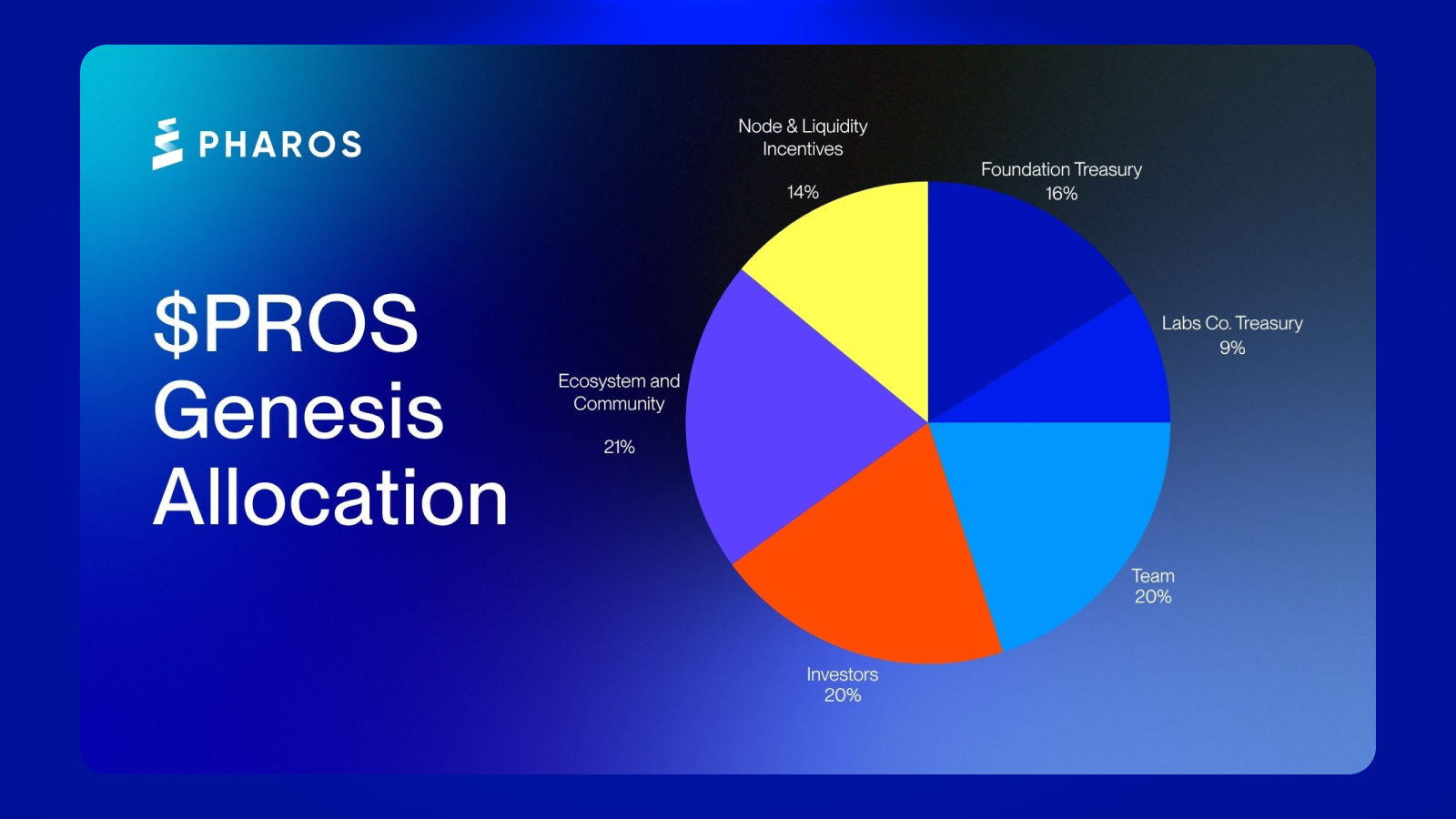
Pharos has allocated a significant portion of the supply toward ecosystem growth while reserving substantial allocations for long-term development and investors.
The genesis supply of PROS is fixed at 1 billion tokens.
The current allocation structure is as follows:
The distribution reflects a balance between ecosystem expansion, network development, and long-term funding for the project.
At the same time, tokenomics have generated discussion within the community due to the public sale valuation. Some market participants have pointed to the difference between the public sale’s implied valuation and the effective valuation derived from earlier fundraising rounds.
While opinions differ on the implications, the debate highlights an important reality for investors: evaluating a token requires understanding not only the technology and narrative, but also supply dynamics, unlock schedules, and valuation assumptions.
For long-term participants, tokenomics will remain an important factor alongside adoption of the RealFi and AI initiatives that Pharos is pursuing.
Can Pharos Become a RealFi Infrastructure Layer?
Pharos is attempting to position itself at the intersection of three major trends: tokenized assets, digital payments, and artificial intelligence.
Each of these markets is large on its own.
Together, they represent a potential shift in how financial infrastructure is built and used. Tokenized assets require transparent settlement and verification. Stablecoins need efficient payment rails. AI applications increasingly require global, programmable payment systems that can operate across borders.
Pharos is trying to build infrastructure for all three.
This creates a larger opportunity than simply competing as another high-performance Layer 1. If the project succeeds, its value proposition may come from enabling entirely new forms of economic activity rather than just processing transactions faster than competing networks.
Several themes could support that vision:
- growth of tokenized assets
- expansion of stablecoin payments
- increasing AI consumption
- demand for programmable finance
- institutional blockchain adoption
The opportunity is significant.
The challenge is execution. Pharos must prove it can attract developers, users, capital, and real-world applications while competing in highly crowded markets.
Risks Investors Should Know
Ambitious narratives create large opportunities, but they also introduce meaningful risks.
Pharos is pursuing multiple fast-moving sectors simultaneously. RealFi, tokenized assets, stablecoins, and AI infrastructure are all promising markets, but each comes with its own competitive and regulatory challenges.
The biggest risk is adoption.
Building infrastructure is only the first step. Long-term success depends on whether developers choose to build on the network, institutions adopt its infrastructure, and users interact with applications powered by the ecosystem.
Investors should also consider:
- execution risk
- competition from other Layer 1 networks
- competition in the RWA sector
- uncertainty around AI-driven token demand
- regulatory developments
- token valuation concerns
Many blockchain projects have strong visions. Far fewer achieve meaningful adoption. Ultimately, the success of Pharos will depend on whether it can translate its RealFi and AI narratives into sustained network activity.
Managing PROS Securely
As with any digital asset, secure self-custody remains essential.
Whether holding PROS for exposure to RealFi, tokenized assets, or the emerging intersection between blockchain and AI, investors should prioritize secure storage and control of their private keys.
Atomic Wallet allows users to securely manage thousands of digital assets through a self-custody experience designed to keep users in control of their funds.
Maintaining ownership of private keys reduces reliance on third parties and provides greater flexibility as blockchain ecosystems continue to evolve.
Conclusion: Can One Blockchain Power Finance and AI?
Most blockchain networks focus on a single narrative. Pharos is attempting to combine several of the industry’s largest opportunities into one ecosystem.
The project’s vision extends beyond transaction throughput and scalability. Through its RealFi strategy, Pharos aims to support tokenized assets, stablecoin payments, institutional finance, and programmable financial infrastructure. At the same time, it is exploring how AI services and blockchain-based payments can interact within a shared economy.
That combination makes the project stand out in an increasingly crowded Layer 1 landscape.
Whether Pharos succeeds will depend on adoption. Developers must build applications, institutions must bring assets onchain, and users must find value in the services the ecosystem provides.
If those pieces come together, Pharos could become more than another blockchain network.
It could become infrastructure for a future where finance and artificial intelligence operate on the same rails.