What Is Pons (PONS)? The Launchpad Taking Over Robinhood Chain
Pons has become one of the biggest applications on Robinhood Chain almost overnight. At its recent peak, the token launchpad generated roughly $5.95 million in daily fees — more than the entire Robinhood Chain network collected that day.
The surge follows an explosion in token creation and trading. Pons has processed billions of dollars in cumulative volume, while its share of Robinhood Chain launchpad activity has climbed above 60% on some days. The momentum has also pushed PONS into wider market exposure, including a September 2 addition to Binance Alpha.
But the more important story is what happens to those fees. Part of Pons’ economics feeds back into PONS purchases and burns, reducing token supply as platform activity grows. That creates a simple flywheel behind the rally: more launches → more trading → more fees → more pressure to remove PONS from circulation.
What Is Pons?
Pons is a non-custodial platform for launching and trading tokens on Robinhood Chain.
Anyone can create a token, establish its trading pool and make it available to other users directly onchain. Pons does not take custody of user funds; launches and trades are transactions that users approve through their own wallets.
The platform is designed to make token creation almost immediate. Instead of requiring founders to separately deploy a token, configure liquidity and build basic trading infrastructure, Pons packages those steps into a standardized launch process.
That simplicity has made Pons one of the first major consumer applications to emerge on Robinhood Chain. Rather than competing as another general-purpose DeFi protocol, it has concentrated activity around one of crypto’s most speculative use cases: creating and trading new tokens as quickly as possible.
How Pons Token Launches Work
Pons turns token creation, liquidity and trading into a single onchain launch process.
Each launch starts with a fixed supply of 1 billion tokens and a dedicated WETH trading pool. The creator chooses the token’s name, ticker, image, description, links and fee wallet, while Pons handles the underlying deployment.
The process has three main stages:
- Create — The token is minted and its WETH liquidity pool goes live in the same transaction. Liquidity is automatically locked.
- Trade — Users buy and sell directly against WETH in that pool, with a 1% pool fee applied to trades.
- Graduate — Once the required amount of WETH has been paired, the launch graduates while trading continues through the same liquidity setup.
Creating a launch also carries a small 0.0005 ETH fee. Unlike launch models built around a temporary bonding curve followed by a separate liquidity migration, Pons starts tokens with their trading pool already in place. That removes an extra transition between initial price discovery and open-market trading.
How Pons Became Robinhood Chain’s Breakout App
Token speculation has turned Pons into one of the largest sources of activity on Robinhood Chain.
Pons launched in July and expanded rapidly as Robinhood Chain activity accelerated. DeFiLlama described it as the network’s breakout application after tracked daily fees climbed from roughly $150,000 in mid-July to nearly $4.9 million by the end of August.
The distinction between fees and revenue matters. Traders may pay tens of millions of dollars through Pons, but not all of those fees belong to the protocol itself. Creator payouts and other fee flows mean gross fees can be substantially higher than protocol revenue.
Still, the scale shows how quickly Pons has captured Robinhood Chain’s early retail activity. For a new network looking for its first high-frequency consumer use case, token launches have provided exactly that — thousands of new assets and continuous trading concentrated inside one application.
Pons Hits $5.95M in Daily Fees
Pons recently generated a record $5.95 million in fees over a single day.
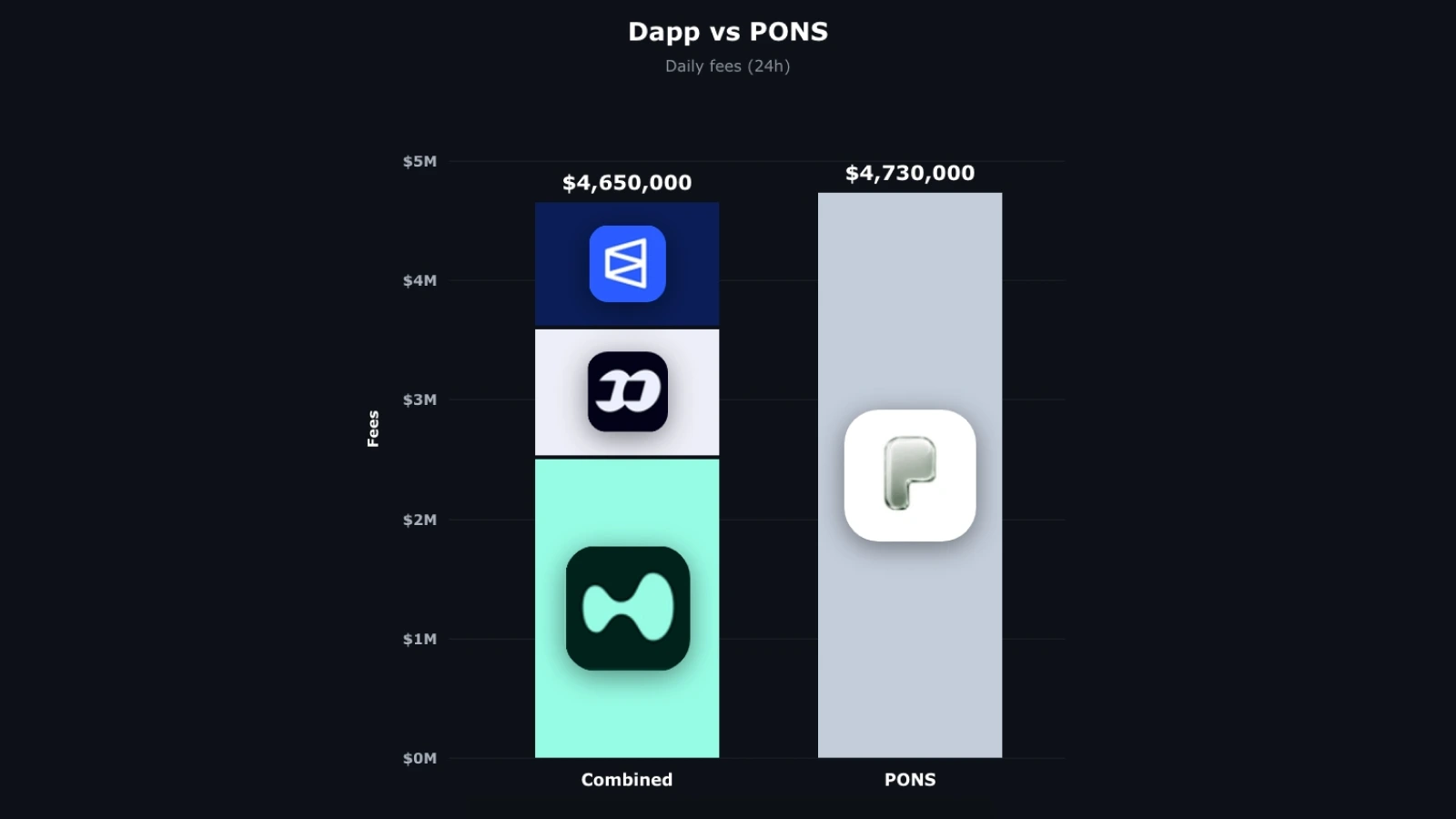
At that peak, DeFiLlama data placed the launchpad among the highest fee-generating crypto protocols for the day. Pons processed more fees than Pump.fun and even the entire Robinhood Chain network underneath it, while also exceeding several much larger DeFi and trading platforms on the same 24-hour snapshot.
That comparison shows how intense activity became, but it needs context. The $5.95 million figure represents fees generated through Pons, not $5.95 million of protocol revenue. A significant share of trading fees flows elsewhere in the platform economy, including token creators.
More importantly, one record day does not establish a permanent ranking. Pons reached those numbers during an exceptional burst of token launches and speculative trading. Whether it can repeatedly generate multi-million-dollar daily fees will matter much more than briefly overtaking established protocols.
What Is PONS and How Does the Burn Work?
PONS connects the growth of the launchpad to a shrinking token supply.
As trading activity generates fees, part of the platform’s economics is used to accumulate PONS, with tokens subsequently removed from circulation through burns. That creates a feedback loop between usage of the product and the supply dynamics of its native token:
Trading activity → Fees → PONS purchases → Token burns
The mechanism has already become significant. During the recent surge, Pons reported removing roughly 20% of PONS supply in just eight days, while subsequent figures put cumulative burns even higher. The exact percentage changes quickly as additional tokens are acquired and burned, making the live burn count more useful than a fixed historical number.
This is the core of the PONS investment narrative. Higher launchpad volume can generate more fees, which can increase the resources available for PONS accumulation and accelerate supply reduction. But the relationship works in both directions: if trading volume falls, the economic engine supporting aggressive burns weakens with it.
Why PONS Is Surging
PONS is benefiting from a rare combination of rising platform usage and rapidly shrinking supply.
The demand side starts with Pons itself. Token launches and trading have pushed the platform into billions of dollars in cumulative volume, while record fee generation has made it one of the most visible applications on Robinhood Chain. That gives the token a measurable protocol-activity narrative rather than relying entirely on speculation.
At the same time, buybacks and burns are reducing available PONS supply. The faster Pons grows, the stronger that mechanism can become, creating a reflexive market narrative around higher activity, higher fees and lower supply.
Exchange exposure has added another catalyst. PONS was added to Binance Alpha on September 2, expanding access to the token as launchpad activity was already hitting new highs. The result has been a sharp repricing of PONS, although future performance remains heavily tied to whether the underlying volume can persist.
Can Pons Keep the Flywheel Running?
PONS depends on Pons remaining a high-volume destination for token launches and trading.
The recent numbers are exceptional, but token launchpads can be highly cyclical. A decline in speculative demand would hit several parts of the PONS narrative simultaneously: fewer launches can mean less trading, lower fees, weaker token accumulation and a slower burn rate.
Competition is another variable. Pons currently has a powerful position on Robinhood Chain, but low barriers to token creation mean alternative launchpads can compete for creators through different fee structures, incentives or launch mechanics. Maintaining market share will require more than the novelty of a new chain.
For users participating across emerging onchain ecosystems, Atomic Wallet provides a self-custodial way to manage supported crypto assets while retaining control of private keys.
The next metrics to watch are therefore straightforward: trading volume, daily fees, new launches, Robinhood Chain market share and the PONS burn rate. If those remain strong after the initial speculative rush fades, Pons could establish itself as a durable fee-generating application. If they fall together, the same flywheel that amplified PONS on the way up can lose momentum just as quickly.