What Is Rain Protocol? The Prediction Market Infrastructure on Arbitrum

Prediction markets are becoming one of crypto’s loudest new battlegrounds.
Rain Protocol entered that conversation by positioning itself as infrastructure for anyone to create and trade prediction markets on-chain. Built on Arbitrum, the project wants to go beyond a single betting app and become a protocol layer for builders, traders, and liquidity providers.
The attention is real. So are the questions. Rain’s recent liquidity push, RAIN price momentum, and rapid rise in prediction market rankings have brought the project into focus — while also attracting scrutiny around valuation, transparency, and token concentration.
Why Rain Protocol Is Getting Attention
Rain has emerged as one of the most talked-about projects in prediction markets thanks to its rapid growth, major liquidity commitments, and controversial valuation.
Prediction markets are heating up ahead of major global events, and Rain is trying to capture that demand with an infrastructure-first model.
Several factors pushed the project into the spotlight:
- $100M liquidity commitment
- Rain V2 rollout
- World Cup prediction market narrative
- rapid RAIN price movement
- growing debate around valuation and transparency
That mix makes Rain different from a typical early-stage DeFi launch. It has a strong sector narrative, visible liquidity expansion, and a clear attempt to position itself near players like Polymarket and Kalshi.
But the same momentum has also made Rain one of the most debated projects in the category.
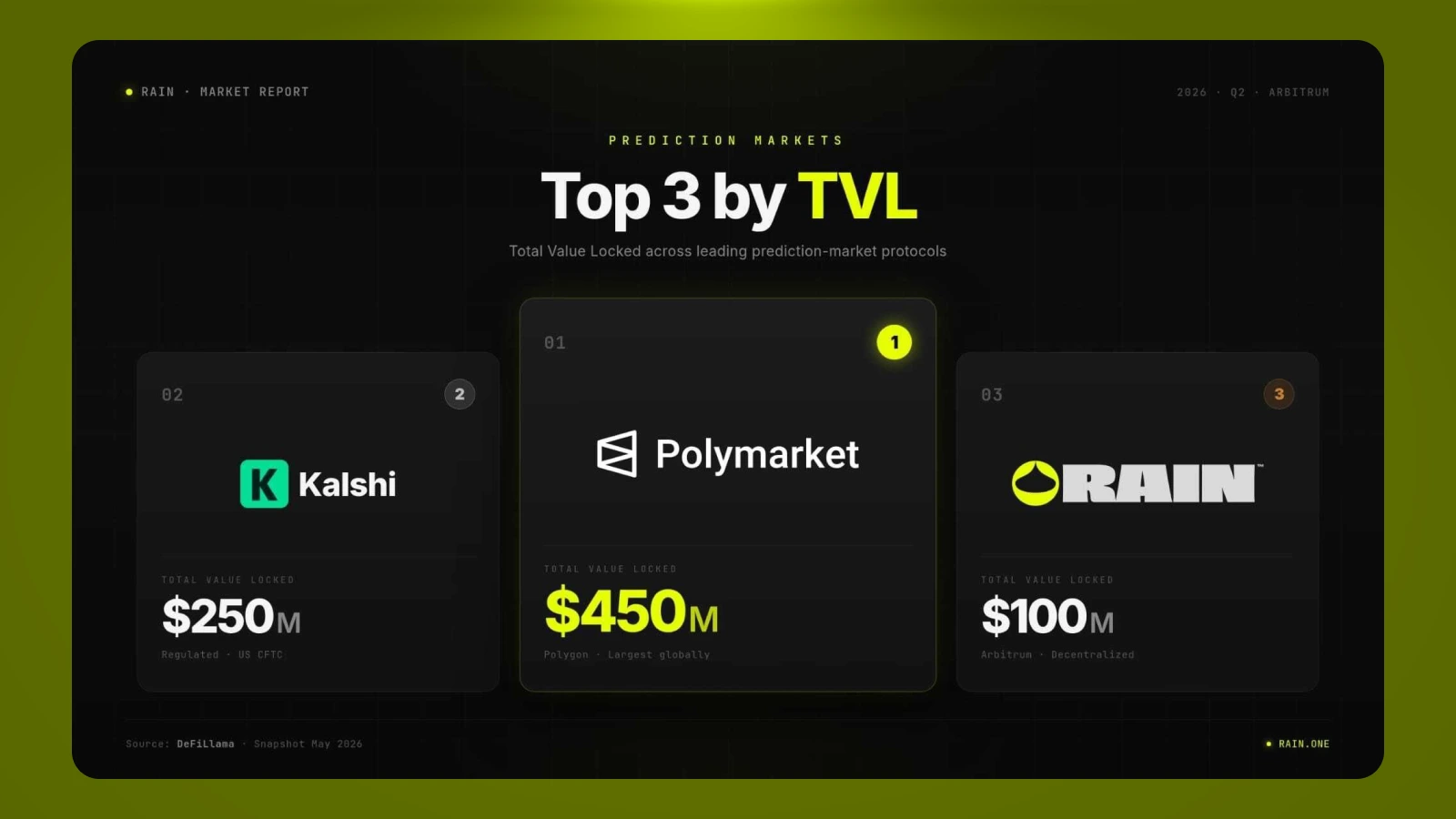
What Is Rain Protocol?
Rain is a decentralized prediction market infrastructure protocol built on Arbitrum that allows anyone to create and trade custom markets.
The project describes itself as the “Uniswap of prediction markets,” meaning its goal is not just to operate one prediction app, but to provide the underlying infrastructure for many markets and applications.
Rain is designed around:
- permissionless market creation
- prediction trading
- liquidity systems
- decentralized settlement
- builder-focused infrastructure
Users and developers can create markets around events such as sports, crypto prices, elections, economic outcomes, and cultural moments.
Instead of treating prediction markets as closed platforms, Rain aims to make them more open and composable — closer to how DEX infrastructure allowed anyone to create and trade token markets on-chain.
How Rain Protocol Works
Rain provides the infrastructure needed to create, trade, and settle prediction markets through a decentralized protocol built on Arbitrum.
Rather than acting as a single destination for users, Rain is designed as a toolkit that other applications and communities can build on top of.
Its architecture combines several components:
- custom market creation
- trading infrastructure
- liquidity mechanisms
- decentralized settlement
- cross-chain accessibility
A market creator can define an event and its possible outcomes, while traders take positions based on how they expect that event to unfold.
Once markets resolve, participants are rewarded according to the outcome, with settlement handled through the protocol’s infrastructure rather than a centralized operator.
This model aims to make prediction markets more scalable, permissionless, and accessible to both users and builders.
Why Rain Calls Itself the “Uniswap of Prediction Markets”
Rain’s long-term vision is to become the infrastructure layer behind prediction market applications rather than competing as a standalone product.
The comparison to Uniswap reflects the protocol’s emphasis on openness and composability.
Instead of controlling the end-user experience, Rain wants developers to build their own products using its underlying technology.
Key aspects of this approach include:
- permissionless deployment
- third-party applications
- creator incentives
- shared liquidity
- open market access
In theory, this could allow a wide variety of prediction products to emerge, from sports-focused applications and election markets to specialized tools covering crypto events and niche communities.
If successful, Rain would benefit from ecosystem growth in the same way decentralized exchange infrastructure expanded alongside the broader DeFi sector.
Prediction Markets and Their Growing Role in Crypto
Prediction markets are evolving from niche betting products into one of crypto’s fastest-growing information markets.
At their core, prediction markets allow participants to trade on the probability of future events. The resulting prices can reflect collective expectations and sentiment in real time.
Markets can be created around topics such as:
- sporting events
- elections and politics
- cryptocurrency prices
- macroeconomic developments
- entertainment and cultural events
Supporters argue that prediction markets aggregate information more efficiently than traditional polling methods by attaching financial incentives to forecasts.
The sector has expanded rapidly in recent years, with platforms such as Polymarket helping bring prediction markets into mainstream crypto conversations.
As adoption grows, infrastructure providers like Rain are attempting to power the next generation of these applications.
Rain V2 Explained
Rain V2 introduces upgraded infrastructure designed to support deeper liquidity and larger-scale market activity.
The protocol’s latest iteration focuses on improving execution quality and creating a better environment for both traders and builders.
Key improvements include:
- enhanced trading systems
- deeper liquidity support
- improved scalability
- upgraded builder tooling
- more efficient market infrastructure
These updates are intended to prepare the ecosystem for periods of elevated activity, particularly around major global events that can drive significant prediction market volume.
Rain V2 also reflects the project’s broader ambition: moving beyond an experimental protocol and establishing itself as a serious contender within the growing prediction market ecosystem.
The RAIN Token Explained
RAIN is the native ecosystem token designed to support incentives, governance participation, and broader protocol growth.
As the prediction market ecosystem expands, the token is intended to align participants across traders, liquidity providers, and the wider community.
The token plays an important role in encouraging activity across the network while helping bootstrap liquidity and community participation.
As with many emerging protocols, the long-term value of RAIN will ultimately depend on adoption, sustained usage, and the growth of the underlying ecosystem.
Why Investors Are Watching Rain
Rain has attracted significant attention as prediction markets become one of crypto’s fastest-growing narratives.
Several developments have pushed the project onto investors’ radar.
Key catalysts include:
- growing interest in prediction markets
- the FIFA World Cup narrative
- major liquidity commitments
- expanding ecosystem visibility
- institutional attention surrounding the sector
Rain’s rapid rise has led many observers to compare the current prediction market cycle to earlier DeFi expansion phases, where infrastructure providers captured significant value as adoption increased.
At the same time, its elevated valuation and strong market performance have increased expectations, making execution and user growth critical factors to monitor going forward.
Concerns and Controversies Around Rain
Despite its momentum, Rain has become one of the most debated projects in the prediction market sector.
The protocol’s rapid rise has attracted scrutiny from analysts and on-chain investigators questioning whether its valuation and ecosystem metrics accurately reflect underlying activity.
Areas of concern raised by critics include:
- token concentration among a limited number of wallets
- questions surrounding valuation levels
- concerns about liquidity transparency
- debates over on-chain activity and user adoption
- allegations highlighted by independent investigators
It is important to distinguish between verified facts and public claims.
While critics have voiced concerns and called for greater transparency, these allegations have not been conclusively proven. Users should review multiple sources and conduct their own research before making investment decisions.
The controversy itself highlights a broader reality of crypto markets: high-growth narratives often attract both enthusiasm and skepticism at the same time.
Risks of Investing in Prediction Market Protocols
Prediction markets remain an emerging sector and carry meaningful risks alongside their growth potential.
Although the category has gained traction, long-term success is far from guaranteed.
Some of the primary risks include:
- regulatory uncertainty
- token price volatility
- changing market sentiment
- liquidity fluctuations
- competition from established platforms
- execution challenges
Prediction markets also operate at the intersection of finance, information markets, and gaming regulations, creating additional complexity compared with more established crypto sectors.
For investors, understanding both the opportunities and the risks is essential when evaluating projects operating within this rapidly evolving space.
Managing RAIN Safely
Secure asset management is essential when interacting with emerging DeFi ecosystems and high-volatility tokens.
Prediction market protocols often require users to connect wallets, approve smart contracts, and interact with newly launched applications. Taking a cautious approach can help reduce unnecessary risks.
Good security practices include:
- protecting recovery phrases
- verifying official websites and contract addresses
- reviewing token approval permissions
- avoiding phishing links shared on social media
- using trusted wallet solutions
Many users participating in DeFi choose to combine protocol interactions with self-custody, allowing them to maintain control over their private keys and assets.
Atomic Wallet provides a self-custodial environment for managing thousands of cryptocurrencies while keeping ownership of funds in users’ hands.
Conclusion: Can Rain Become the Infrastructure Layer for Prediction Markets?
Rain is attempting to build the technology stack behind the next generation of decentralized prediction applications.
By focusing on permissionless market creation, liquidity infrastructure, and builder tools, the project is pursuing a different strategy from consumer-facing prediction apps.
Its future will likely depend on several factors:
- adoption by developers and traders
- the continued growth of prediction markets
- successful execution of its roadmap
- greater ecosystem transparency
- the ability to navigate regulatory challenges
If prediction markets continue expanding into mainstream crypto, Rain could emerge as one of the protocols powering that growth.
At the same time, the debate surrounding its valuation and ecosystem metrics means investors should balance the upside narrative with careful due diligence.