What Is Squid? The Cross-Chain Infrastructure Connecting Web3
Crypto has become increasingly multi-chain.
Users hold assets on Ethereum, Base, Solana, Arbitrum, BNB Chain, Cosmos, Bitcoin, and dozens of other networks. While this expansion has created more opportunities, it has also introduced a new problem: moving assets and applications across blockchains is still far more complicated than it should be.
Squid was built to simplify that experience.
Rather than operating as another blockchain or standalone bridge, Squid provides cross-chain infrastructure that allows users and developers to swap assets, move liquidity, and interact with applications across more than 100 blockchain networks through a single integration.
Most users may never realize they are using Squid.
Wallets, DeFi protocols, payment platforms, and other Web3 applications integrate Squid behind the scenes, allowing cross-chain transactions to feel like a single action instead of a series of manual bridges, swaps, and approvals.
As Web3 continues expanding across multiple ecosystems, infrastructure that removes complexity may become just as important as the blockchains themselves.
Why Cross-Chain Crypto Is Still Broken
More blockchains solved one problem while creating another.
New networks brought lower fees, faster transactions, specialized applications, and greater innovation. But they also fragmented liquidity, users, and assets across dozens of independent ecosystems.
Moving between those ecosystems often remains a frustrating process.
A user may need to bridge tokens, swap assets, acquire gas on a new network, approve multiple transactions, and repeat the same steps every time they switch chains. Even experienced crypto users regularly encounter unnecessary friction.
The challenges are familiar:
- fragmented liquidity
- multiple wallets and networks
- bridge complexity
- separate gas tokens
- inconsistent user experiences
For developers, the problem becomes even larger. Supporting multiple blockchains often requires separate integrations, additional infrastructure, and ongoing maintenance as new ecosystems emerge.
As crypto becomes increasingly multi-chain, the challenge is no longer connecting one blockchain to another.
The challenge is making the entire ecosystem feel like a single network.
That is the problem Squid is trying to solve.
How Squid Solves Cross-Chain Complexity
Squid is designed to make cross-chain transactions feel like a single action instead of multiple separate steps.
Traditionally, moving assets between blockchains meant using a bridge, swapping tokens on the destination chain, funding a new wallet with gas, and manually completing each transaction along the way.
Squid abstracts much of that complexity.
Through a single request, the protocol can route assets across multiple networks, source liquidity, execute swaps, and complete onchain actions without requiring users to coordinate every step themselves.
Instead of thinking about bridges, users simply focus on the result they want.
For developers, Squid provides infrastructure that can be integrated through APIs, SDKs, and widgets, allowing cross-chain functionality to become part of wallets, DeFi protocols, payment platforms, and other Web3 applications without building custom routing logic from scratch.
More Than a Cross-Chain Bridge
Calling Squid a bridge only tells part of the story.
A traditional bridge is designed to move assets from one blockchain to another.
Squid goes further by combining several pieces of cross-chain infrastructure into a single routing layer.
Rather than relying on one bridge or one liquidity source, the protocol coordinates multiple components behind the scenes to complete more complex transactions across different ecosystems.
That includes:
- cross-chain swaps
- liquidity routing
- bridge aggregation
- cross-chain contract calls
- intent-based execution
This broader approach is important because users rarely want to “bridge.”
They want to buy a token on another chain, deposit into a DeFi protocol, interact with an application, or complete a payment. Bridging is simply one step in that journey.
Squid’s objective is to make the underlying infrastructure invisible, allowing users to interact with Web3 applications without constantly thinking about which blockchain they are using.
Why Developers Build With Squid
Cross-chain infrastructure is only valuable if applications actually use it.
Squid has focused as much on developers as end users. Instead of requiring every wallet, exchange, or DeFi protocol to build its own routing system, the project provides a single integration that brings cross-chain functionality into existing applications.
Developers can integrate Squid through multiple options, including APIs, SDKs, and embeddable widgets, making it easier to support cross-chain swaps, bridging, and contract execution without maintaining separate integrations for every blockchain.
The scale of the network reflects that strategy.
Today, Squid supports more than 100 blockchain networks, connects over 130 decentralized exchanges, works with more than 20,000 tokens, and powers cross-chain functionality for more than 1,000 integrated applications. With billions of dollars in routed volume, the protocol has already moved beyond an experimental product into production infrastructure.
How Squid Works
Squid combines multiple layers of cross-chain infrastructure into a single routing network.
Rather than relying on one bridge or one source of liquidity, the protocol coordinates different services to complete transactions as efficiently as possible.
Its core capabilities include:
This architecture allows developers to build applications that work across ecosystems without asking users to manage every bridge, swap, or routing decision themselves.
The result is a simpler user experience and an infrastructure layer designed for a Web3 ecosystem where interacting across multiple blockchains is becoming the norm rather than the exception.
What Is the QUID Token?
QUID is the native token designed to support long-term participation in the Squid ecosystem.
Unlike many crypto projects that launched a token before shipping a product, Squid spent years building infrastructure first. By the time QUID was announced, the protocol had already processed more than $6 billion in routed volume, served over one million users, and supported more than 1,000 integrations across the Web3 ecosystem.
That sequence is an important part of the project’s story.
Rather than using a token to bootstrap adoption, Squid introduced QUID after establishing product-market fit. The token is intended to strengthen ecosystem participation while supporting the protocol’s long-term development as cross-chain infrastructure continues to expand.
Why Squid Launched QUID After Building the Product
Squid followed a path that is relatively uncommon in crypto: build first, tokenize later.
Many blockchain projects raise capital through token launches before users arrive. Squid took the opposite approach, spending several years expanding its infrastructure, integrating with wallets and applications, and processing billions of dollars in transaction volume before introducing a native token.
That approach offers several potential advantages.
The token enters an ecosystem with existing users, established infrastructure, and proven demand rather than relying entirely on future expectations.
At launch, the project already had:
- $6B+ in routed volume
- 1M+ users
- 100+ supported blockchains
- 1,000+ integrations
- a live production network
Of course, a successful product does not automatically guarantee a successful token.
Ultimately, QUID’s long-term value will depend on whether the protocol continues attracting developers, expanding usage, and strengthening its position as cross-chain infrastructure for Web3.
QUID Token Utility
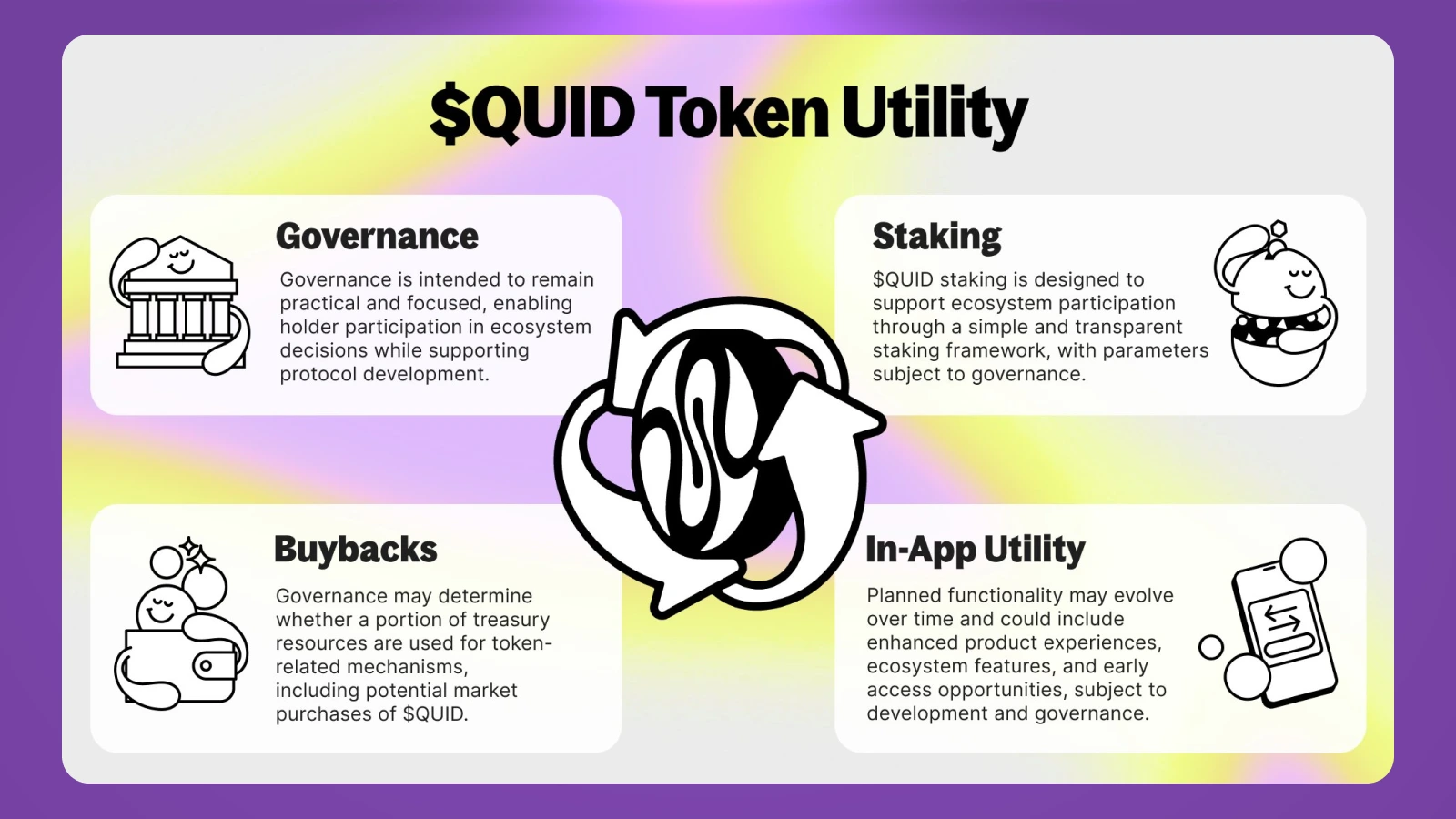
QUID is designed to align long-term ecosystem participation with the growth of the protocol.
Rather than serving a single purpose, the token is expected to support several functions across the Squid ecosystem as additional features are introduced.
Current and planned utilities include:
- staking
- governance
- treasury-backed buyback mechanisms
- ecosystem participation
- future in-app functionality
The roadmap also points toward deeper integration inside Squid’s products over time. As new features are released, QUID is expected to become a larger part of the user experience rather than existing solely as a governance asset.
Understanding QUID Tokenomics
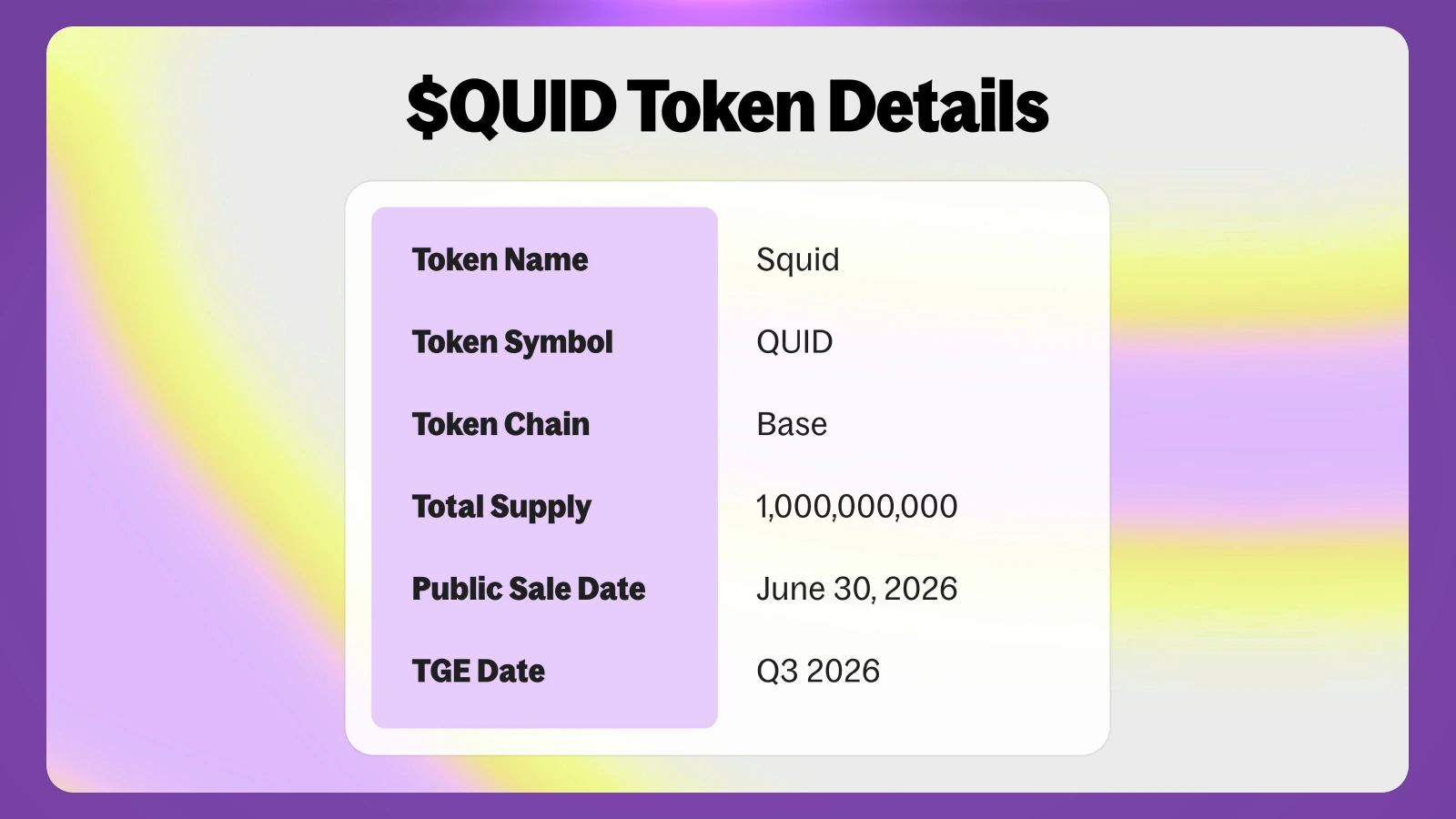
QUID has a fixed supply of 1 billion tokens with no planned inflation.
The initial allocation is structured to balance long-term ecosystem growth, project development, and investor participation.
Several aspects of the launch attracted attention from the community.
Public sale participants receive their allocation unlocked at the token generation event, while team and investor allocations are subject to a 12-month cliff. At the same time, the project opted not to conduct a community airdrop, choosing instead to distribute tokens through public sale mechanisms.
For investors, tokenomics are only part of the picture.
Long-term performance will ultimately depend on whether Squid continues expanding its routing network, attracting developers, and increasing usage across an increasingly multi-chain crypto ecosystem.
Can Squid Benefit From a Multi-Chain Future?
The investment thesis behind Squid is closely tied to one question: will crypto remain multi-chain?
So far, the answer appears to be yes.
New Layer 1 and Layer 2 networks continue to launch, while users increasingly move assets between ecosystems instead of staying on a single blockchain. Wallets, decentralized exchanges, gaming platforms, payment applications, and DeFi protocols all need infrastructure that allows assets and data to move seamlessly across networks.
This trend plays directly into Squid’s strategy.
As more blockchains emerge, the value of routing infrastructure may increase alongside them. Rather than competing with individual chains, Squid is designed to connect them, making interoperability a core part of its long-term opportunity.
Several trends could support future growth:
- continued expansion of multi-chain ecosystems
- rising demand for cross-chain applications
- greater developer adoption
- increasing wallet and protocol integrations
- broader institutional use of blockchain infrastructure
If Web3 continues becoming more interconnected, routing layers like Squid could become increasingly important pieces of the ecosystem.
Risks Investors Should Know
Strong infrastructure does not eliminate execution risk.
The cross-chain sector has become one of the most competitive areas of crypto. Squid operates alongside bridges, interoperability protocols, and routing solutions that are all competing to become the preferred layer for moving assets between blockchains.
Competition is only one challenge.
Long-term success will also depend on whether developers continue integrating the protocol, users maintain transaction volume, and the token develops meaningful utility alongside the growth of the network.
Investors should consider:
- competition from other cross-chain protocols
- execution and adoption risk
- evolving security expectations for interoperability
- token valuation and market conditions
- dependence on continued ecosystem growth
Infrastructure businesses often benefit from network effects, but reaching that position requires sustained adoption over many years. Squid has already demonstrated meaningful product traction; the next challenge is translating that traction into long-term ecosystem value.
Managing QUID Securely
Owning digital assets begins with controlling your private keys.
Whether you hold QUID to participate in governance, stake within the ecosystem, or gain exposure to the growth of cross-chain infrastructure, secure self-custody remains one of the most important aspects of long-term asset management.
Atomic Wallet enables users to securely manage thousands of cryptocurrencies through a self-custodial wallet, giving them full control over their digital assets without relying on centralized custodians.
Conclusion: Can Squid Become Web3’s Default Routing Layer?
Cross-chain connectivity is no longer a niche feature—it is becoming a fundamental requirement for Web3.
As blockchain ecosystems continue to expand, users increasingly expect applications to work across networks without manually bridging assets, managing multiple gas tokens, or navigating fragmented liquidity.
That is the opportunity Squid is pursuing.
Rather than competing as another blockchain, the project is building infrastructure designed to make blockchain boundaries less visible. If successful, users may interact with dozens of networks without ever thinking about the routing happening behind the scenes.
The launch of QUID marks the next stage of that journey.
With a live product, billions of dollars in routed volume, and an expanding developer ecosystem, Squid enters the token era from a very different position than many early-stage crypto projects.
The long-term question is not whether more blockchains will exist.
It is whether the infrastructure connecting them becomes just as valuable as the networks themselves.