What Is StakeShark? A Guide to Non-Custodial Crypto Staking
StakeShark is a non-custodial staking validator that operates infrastructure across multiple Proof-of-Stake (PoS) blockchains. Unlike yield platforms or centralized staking services, it does not take custody of user funds. Instead, it provides validator nodes that users can delegate to while retaining full control of their tokens. This guide explains what StakeShark does, how it works, and what to consider before delegating.
What Does StakeShark Do?
StakeShark operates validator nodes on multiple PoS networks, allowing token holders to delegate their stake and participate in securing blockchains without running their own infrastructure.
• Acts as a staking validator across 20+ PoS networks
• Secures over $100M in delegated assets
• Serves 150,000+ delegators since launch
• Runs and maintains blockchain nodes with high uptime
• Earns block rewards and distributes them to delegators (minus validator commission)
In simple terms, StakeShark provides the technical backbone that enables users to stake their tokens securely while keeping custody in their own wallets.
Proof-of-Stake (PoS) Explained
Proof-of-Stake (PoS) is a blockchain consensus mechanism where network participants validate transactions and secure the chain by locking up tokens as stake rather than using computational power, as in Proof-of-Work.
• Validators secure the network by staking tokens
• Token holders can delegate their stake instead of running a node
• Rewards are distributed for participating in validation
• Misbehavior or downtime can result in penalties (in some networks)
• Unlike Proof-of-Work, PoS does not rely on mining hardware
In PoS systems, validators are responsible for block production and network security, while delegators support validators with their stake and share in the rewards.
How Non-Custodial Staking Works
Non-custodial staking allows users to delegate their tokens to a validator while retaining full ownership and control of their assets.
• Tokens remain in the user’s wallet at all times
• Delegation assigns staking power to a validator
• The validator takes a commission from generated rewards
• Rewards are distributed proportionally to delegators
• Risks arise from validator performance and network rules
In this model, users do not transfer funds to the validator. Instead, they grant staking rights on-chain, maintaining custody while participating in network security.
StakeShark as a Validator Infrastructure Provider
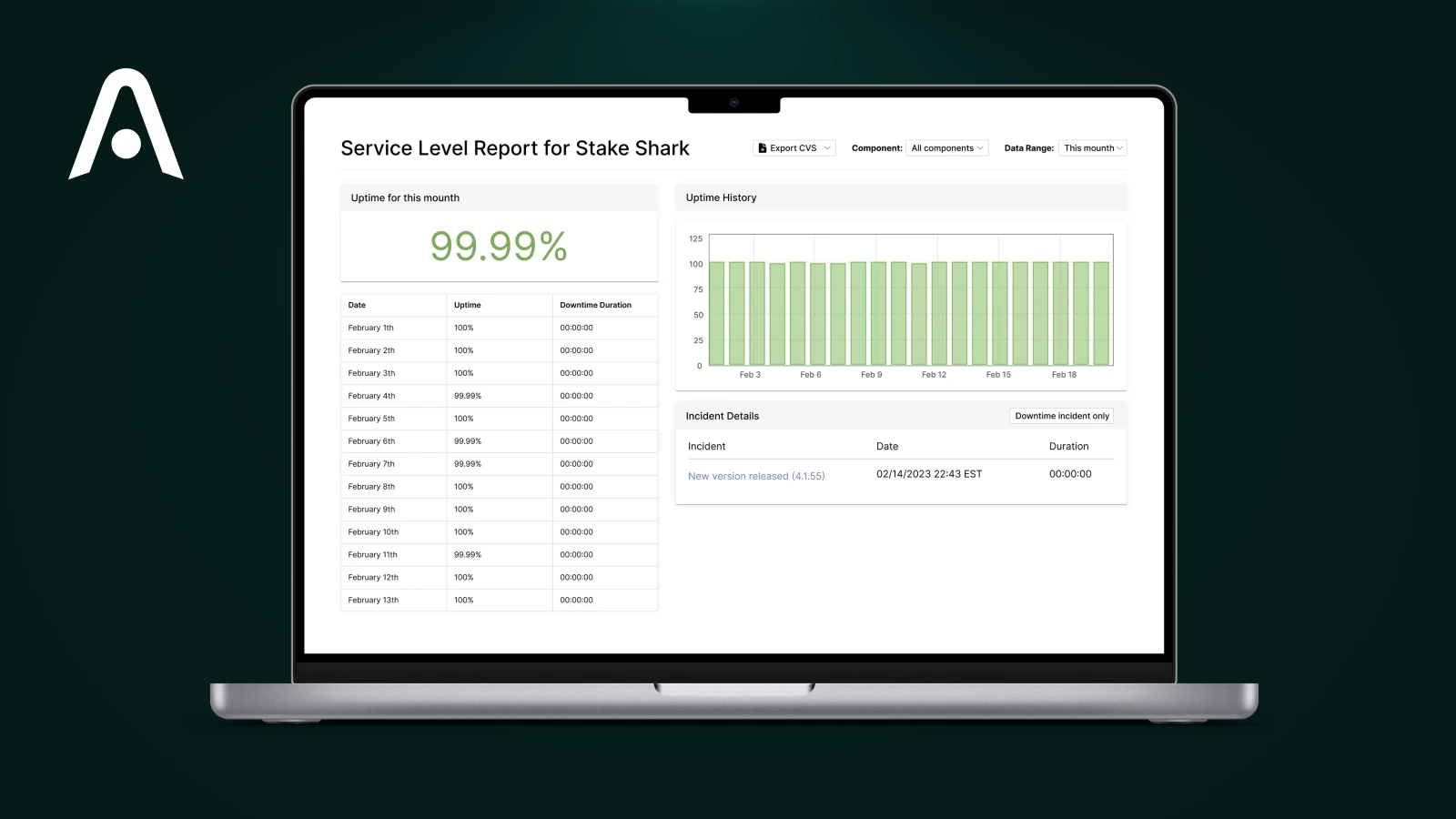
As a validator infrastructure provider, StakeShark focuses on operational reliability rather than asset custody. Its role is to maintain stable node performance across supported networks and ensure consistent participation in block validation. The platform advertises 99.99% uptime with 24/7 monitoring and fast recovery systems. In Proof-of-Stake networks, uptime directly impacts reward consistency, as missed blocks or high skip rates can reduce earnings or, in some cases, trigger penalties. Infrastructure quality, monitoring systems, and operational discipline are therefore central to a validator’s reliability.
Supported Networks on StakeShark
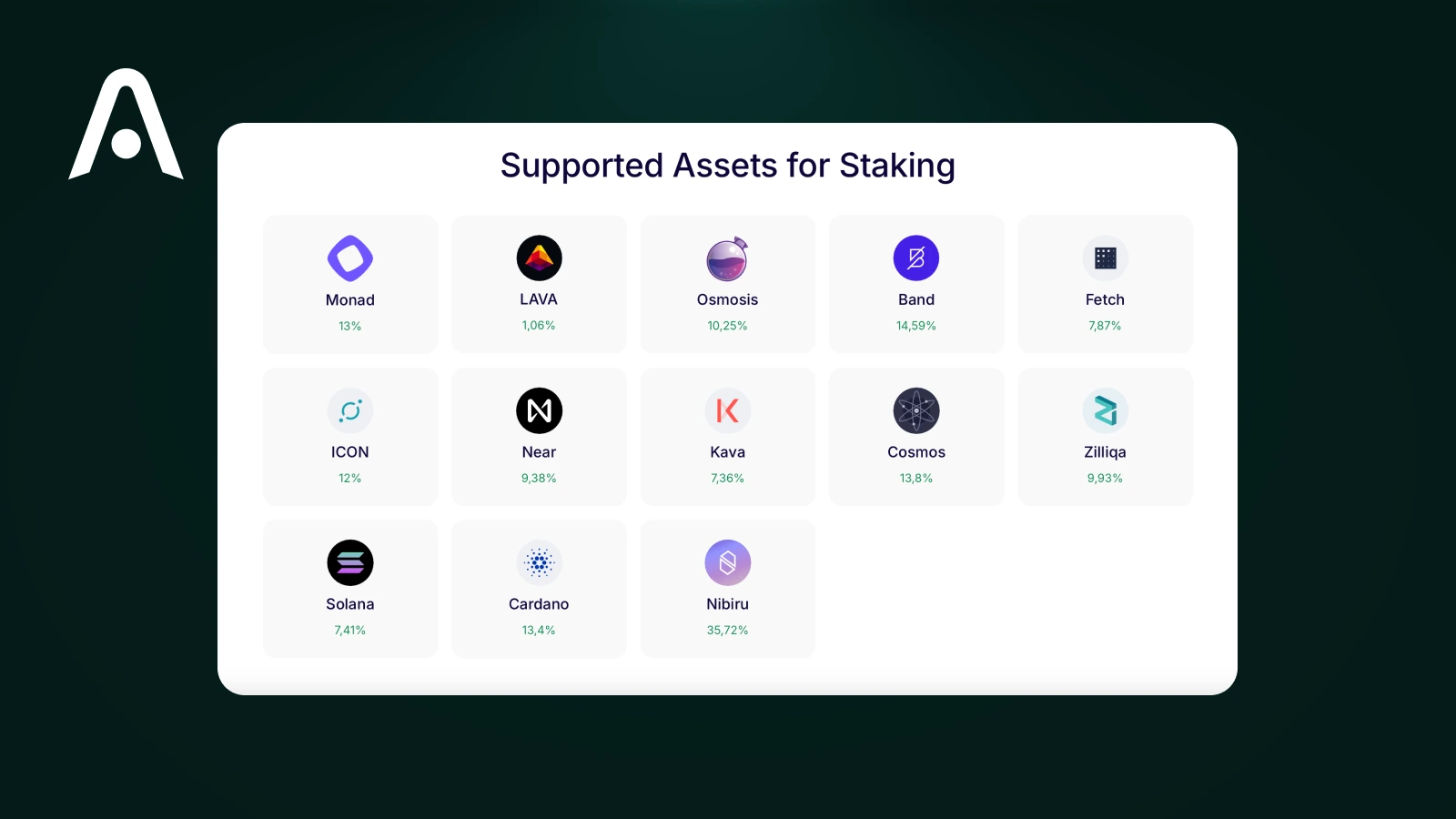
StakeShark operates across a broad range of Proof-of-Stake networks, with a strong presence in Cosmos-based ecosystems and major PoS chains.
Supported assets include:
• SOL (Solana)
• ATOM (Cosmos)
• NEAR
• ADA (Cardano)
• OSMO (Osmosis)
• KAVA
• FET (Fetch.ai)
• BAND
• ZIL (Zilliqa)
• ICX (ICON)
• MON
• LAVA
• NIBI
Overall, the validator has a Cosmos-heavy, multi-chain PoS focus, allowing delegators to participate across different blockchain ecosystems through a single infrastructure provider.
Key Features of StakeShark
StakeShark positions itself as an infrastructure-focused validator with an emphasis on reliability and multi-network coverage.
• Non-custodial staking model — users retain full control of their private keys and tokens
• High operational uptime — advertised 99.99% uptime with continuous monitoring
• Multi-network coverage — support for 20+ PoS ecosystems
• Large delegator base — over 150,000 delegators contributing stake
• Network-dependent APR — rewards vary by blockchain economics, not fixed returns
These features define StakeShark as a validator service rather than a yield product or custodial staking platform.
Benefits of Using a Staking Validator Like StakeShark
Delegating to a validator removes the need for technical setup while still allowing participation in Proof-of-Stake networks.
• No need to operate and maintain your own node
• Lower technical barrier to entry
• Participation in protocol-level rewards
• Contributing to network security through delegation
Using a validator simplifies access to staking infrastructure, but it does not eliminate blockchain-level risks or market volatility.
Risks of Staking With Validators
Staking through a validator reduces technical complexity but does not remove risk. Delegators remain exposed to both validator performance and underlying network conditions.
• Validator downtime — missed blocks can reduce rewards
• Slashing risk — some networks penalize validator misbehavior
• Reward variability — APR changes based on network participation and inflation
• Token price volatility — staking rewards do not protect against market declines
• Governance or protocol risk — network upgrades or rule changes can affect outcomes
Understanding these risks is essential before delegating to any validator.
Slashing Risks Explained
Slashing is a penalty mechanism in some Proof-of-Stake networks that reduces a validator’s staked amount if it behaves improperly or fails to meet protocol requirements. This can occur due to extended downtime, double-signing blocks, or other violations of consensus rules.
When slashing occurs, delegators can also be affected proportionally, depending on network design. While reputable validators invest in infrastructure and monitoring to minimize this risk, slashing is a protocol-level mechanism — not something fully controlled by delegators.
Lock-Up and Unbonding Periods
In many Proof-of-Stake networks, staked tokens cannot be withdrawn instantly. When a user decides to stop staking, they must go through an unbonding period defined by the protocol.
Unbonding times vary by network and can range from a few days to several weeks. During this period, tokens typically do not earn rewards and cannot be transferred or sold. This creates a liquidity trade-off: staking may generate rewards, but it reduces short-term flexibility. Understanding lock-up mechanics is important before delegating funds.
How to Stake Crypto Securely
Staking securely involves more than choosing a validator. It requires understanding network mechanics and protecting your private keys.
• Understand the specific staking rules of the network
• Verify the validator’s identity and track record
• Review commission rates and historical performance
• Diversify stake across multiple validators when possible
• Never share private keys or seed phrases
Security in staking begins with custody. The validator operates infrastructure, but control of funds should remain with the user.
Choosing a Reliable Validator
Selecting a validator is a strategic decision that can affect both reward consistency and risk exposure. While high advertised uptime is important, it should not be the only factor considered.
A reliable validator typically demonstrates stable historical performance, transparent communication, reasonable commission rates, and a commitment to decentralization. Validators that control too much stake on a network may introduce centralization risks, while very small validators may face operational instability. Reviewing on-chain statistics and community reputation can provide additional context before delegating.
Using a Non-Custodial Wallet
Non-custodial staking means the user retains full control over private keys at all times. Tokens remain in the wallet, and delegation happens on-chain without transferring ownership to the validator.
This model differs significantly from exchange staking, where assets are deposited into a centralized platform. With a non-custodial wallet, the wallet acts as the control layer — enabling delegation, reward tracking, and eventual unbonding — while maintaining direct custody of the underlying tokens.
StakeShark vs Other Validators
Not all validators operate at the same scale or with the same operational standards. Evaluating StakeShark against other validators requires focusing on measurable infrastructure factors rather than promotional claims.
What Users Should Understand Before Delegating
Staking is a participation mechanism within blockchain networks — not a guaranteed income strategy. Delegating to a validator does not eliminate protocol-level or market risks.
Validator performance affects rewards, but token price volatility ultimately determines portfolio value. Infrastructure quality, network rules, and liquidity constraints all play a role. Before delegating, users should understand that staking involves trade-offs between yield, flexibility, and risk exposure.
Self-Custody Comes First
Before delegating to any validator, maintaining secure self-custody is essential. Staking participation should begin from a wallet where you control the private keys, ensuring direct ownership of your PoS assets.
Managing tokens in a non-custodial wallet provides the control layer needed to delegate, monitor rewards, and unbond securely. Atomic Wallet can serve as that infrastructure layer — giving users custody and control before interacting with staking validators.