What Is Umia (UMIA)? The Onchain Venture Protocol Putting Tokenholders in Control
UMIA is now trading after an auction that reached its maximum valuation in minutes. Around $6.2 million in USDC was bid for a token launching at a $0.36 clearing price and $18 million FDV, with more than 2,700 wallets connecting during the sale.
But the token launch is only the first test. Umia is building an onchain venture protocol where projects can raise capital, manage their treasury and make strategic decisions through the same token-based system rather than splitting control across a company, foundation and DAO.
UMIA is the first project using that model on itself. Its auction has already tested demand; now the token gives the market a chance to test the bigger idea behind Umia: can tokenholders have meaningful control over the companies they fund?
What Is Umia?
Umia is an onchain venture protocol for launching, funding and governing token-native projects.
Founders can use the platform to create a legal structure around their project, raise capital through onchain auctions and place the proceeds into a noncustodial treasury. Instead of handing the entire raise to a founding team, Umia keeps major capital allocation and strategic decisions connected to tokenholder governance.
The goal is to make the token part of the company’s operating structure rather than an asset sitting beside it. IP, the operating team and treasury can exist under one legal wrapper, while onchain contracts define how capital is raised and controlled.
Umia itself is the first major demonstration of the model. UMIA governs the protocol using the same infrastructure Umia wants future projects to adopt, turning its own token launch into a live test of the token-first company thesis.
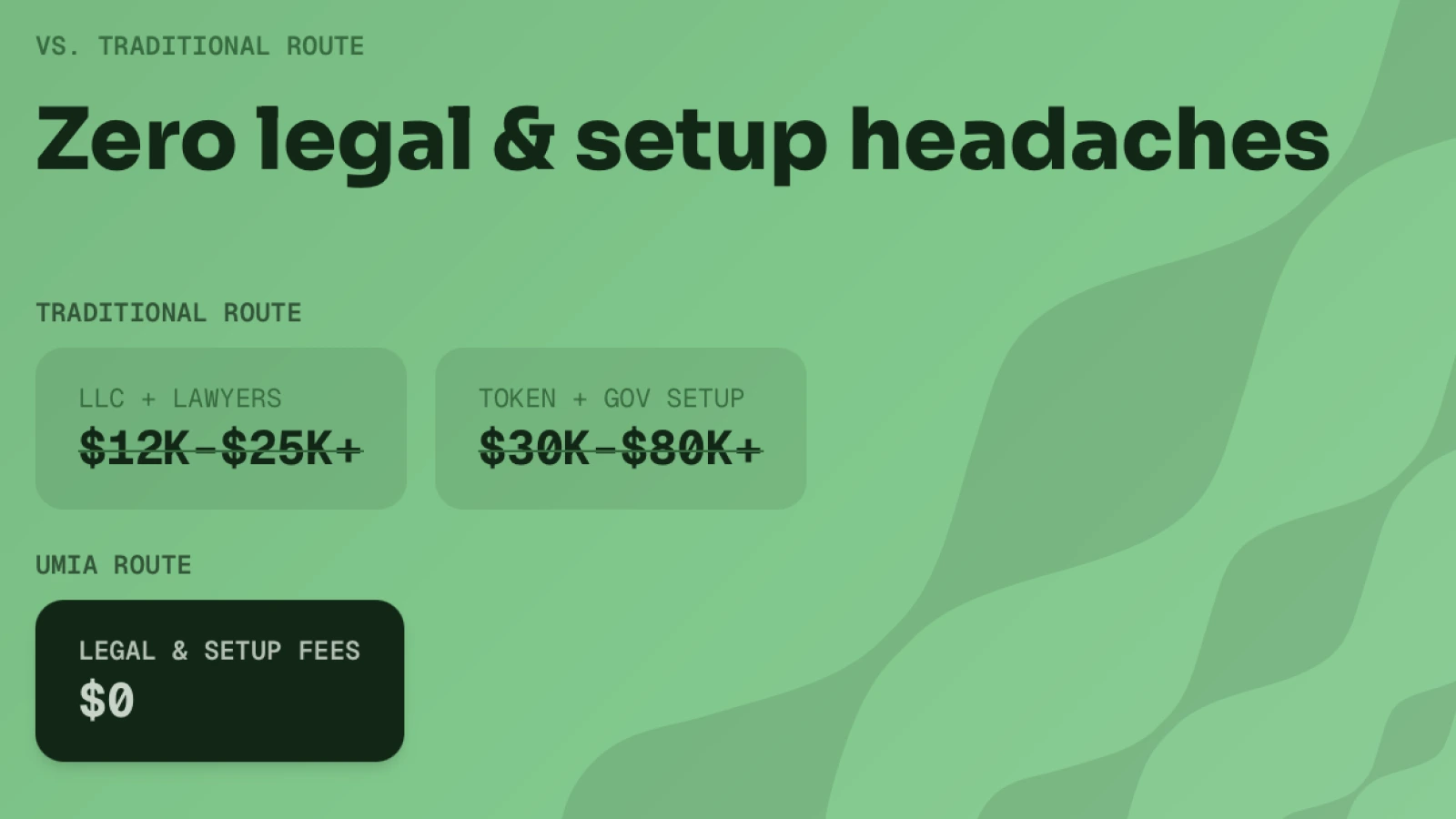
How Umia Changes the Crypto Startup Model
Umia is designed to reduce the gap between owning a project’s token and having meaningful influence over the value behind it.
Many crypto projects separate their operating company, IP, foundation, DAO and treasury. Tokenholders may vote on governance proposals, but the founding team can still control key assets, development and capital through separate legal entities or multisigs.
Umia puts those pieces under a legal token wrapper built around a segregated portfolio within its Cayman structure. Decision-making authority over the onchain treasury is delegated to smart contracts, while the project’s IP and operating team sit within the same structure.
The model does not remove founders from the business. Teams still receive operating capital and continue building independently. The difference is what happens to capital beyond normal operations: instead of automatically remaining under founder control, larger decisions can move through the project’s governance system.
Tailored Auctions: How Projects Raise Capital on Umia
Tailored Auctions let projects raise capital onchain while the market determines the token price.
Founders can configure different auction phases, eligibility requirements and participation limits around a launch. Once the auction closes, proceeds flow into the project’s onchain treasury rather than a founder-controlled wallet, connecting fundraising directly to Umia’s governance model.
Projects can reach the platform through two routes. The Curated Track is selected by Umia, while the Community Track allows the market to surface potential launches. Both ultimately lead toward the same structure: token distribution, price discovery and treasury capitalization happen onchain.
UMIA’s own auction showed how flexible that process can become. An Early Bid phase used zkTLS proofs to verify eligible participants without requiring them to publicly connect the wallet to the credential being proved. MetaDAO participants, Echo investors and ETHGlobal hackers were among the groups able to qualify, with 235 wallets submitting verified proofs.
The public phase then opened participation more broadly, initially limiting bids to $5,000 USDC per wallet. Demand quickly pushed UMIA to its auction cap, providing the first real-world test of the fundraising system Umia now wants other token-native projects to use.
Decision Markets: Giving Tokenholders Real Control
Umia uses markets to decide major project decisions instead of relying only on token-weighted votes.
The system is based on decision markets, a governance model related to futarchy. When a major proposal appears, markets can price different outcomes based on how participants expect each option to affect the project. The preferred outcome can then become binding rather than serving as an advisory community poll.
This matters most when money is involved. Teams receive a predefined monthly operating budget — Umia itself starts with a $120,000 monthly allowance — so routine development does not require constant governance. Capital beyond that budget remains in the noncustodial treasury, where larger spending decisions can be routed through the governance process.
The model changes the role of tokenholders. Instead of simply voting on proposals after a team has already raised and taken custody of the capital, holders participate in decisions over how that capital is deployed. Whether markets consistently make better decisions than founders or conventional DAO votes remains unproven, but that is precisely what UMIA is now testing.
UMIA Token Launch: $6.2M in Bids and an $18M FDV
UMIA reached its auction cap roughly seven minutes after public bidding opened.
More than 2,700 wallets connected during the auction, with approximately $6.2 million USDC in total bids. Demand pushed the auction to its maximum clearing price of $0.36 per UMIA, establishing an $18 million fully diluted valuation.
The wallet figure should not be confused with the number of successful bidders: connecting to the auction did not guarantee an allocation. What the numbers do show is that demand was sufficient to hit Umia’s maximum auction valuation almost immediately.
After the sale, 20% of auction proceeds were paired with UMIA to seed onchain DEX liquidity, while the remaining capital moved into the protocol treasury. That completes the first half of Umia’s model — raising and placing capital onchain. The next test is whether its governance system can allocate that treasury effectively.
UMIA Tokenomics: Who Controls the Supply?
UMIA has a fixed 50 million token supply, with 34.6% distributed through the public auction.
The launch allocation spreads tokens across public buyers, liquidity, the protocol treasury and long-term contributors. Another 10 million UMIA sits outside the initial 40 million allocation as a performance reserve, creating a different supply model from tokens that unlock entirely on a fixed calendar.
Auction tokens enter the market without long-term vesting, while the allocations for backers, service providers and the team are subject to longer restrictions. These contributor allocations follow a 36-month vesting structure with a 12-month cliff, limiting how quickly insider supply can reach the market.
The performance reserve is more unusual. Rather than releasing its 10 million tokens simply because enough time has passed, Umia connects access to this supply with sustained token-price milestones. That ties a significant 20% of UMIA supply to measurable performance, although investors still need to watch the exact conditions under which those tokens can eventually enter circulation.
Can Umia Make Token-First Companies Work?
The UMIA auction proved demand for the token, not the model behind it.
Umia now has to show that putting fundraising, treasury management and governance into one onchain structure produces better outcomes after the sale. The important metrics will not be another oversubscription headline, but how efficiently the treasury is deployed, whether decision markets attract informed participation and whether new founders choose to launch under the same constraints.
There is also a harder governance question. Markets can attach economic incentives to predictions, but that does not automatically mean they will make better strategic decisions than experienced founders or boards. Thin liquidity, short-term speculation or poorly structured proposals could all affect the signals those markets produce.
As UMIA moves into the broader crypto market, users who prefer to control their assets directly can manage supported crypto through Atomic Wallet, rather than relying entirely on custodial platforms.
If Umia succeeds, its most important product may not be UMIA itself. It could be a reusable framework where the token, treasury, legal structure and governance represent different parts of the same organization — giving future crypto projects a way to make token ownership matter beyond price speculation.