What is Bitcoin?
Bitcoin is a decentralized digital currency that works without a bank or any company in the middle. Payments go directly from one person to another and are recorded on a public ledger called the blockchain, which thousands of computers around the world keep in sync.
Bitcoin (BTC) was the first cryptocurrency and is still the largest by market cap. People use it to send value across borders, to save, and as a hedge against inflation, since no government or central bank can print more of it.
How does Bitcoin work?
New transactions are grouped into blocks. Miners compete to add the next block by solving a hard math puzzle with specialized hardware, a process called proof of work. The winner adds the block to the chain and earns newly created BTC plus the fees of the transactions inside it. A new block appears about every 10 minutes.
Each block refers to the one before it, so changing an old transaction would mean redoing the work for every block after it. That is what makes the Bitcoin ledger practically impossible to rewrite.
BTC supply and the halving
There will only ever be 21 million bitcoin. Around 20.12 million BTC are in circulation today. The reward miners get for a block is cut in half every 210,000 blocks, roughly every four years. This event is called the halving.
The last halving, in April 2024, lowered the reward to 3.125 BTC per block. Each halving slows the flow of new coins, and the last bitcoin is expected to be mined around 2140.
Lightning and other upgrades
Bitcoin changes slowly and on purpose. SegWit in 2017 let blocks hold more transactions and opened the way to the Lightning Network, a second layer for fast and cheap payments. Taproot in 2021 added more private and flexible ways to spend coins.
A short history of Bitcoin
A person or group using the name Satoshi Nakamoto published the Bitcoin white paper on October 31, 2008 and mined the first block on January 3, 2009. In May 2010 a programmer paid 10,000 BTC for two pizzas, the first known purchase with bitcoin. Satoshi stopped posting in 2011, and volunteers have developed Bitcoin ever since. In January 2024 the first spot Bitcoin ETFs started trading in the US.
What moves the price of BTC?
The supply of bitcoin is fixed, so its price depends on demand. Demand rises and falls with the wider market: interest rates, inflation, regulation and the mood of investors. Flows into spot ETFs and purchases by companies that keep BTC on their balance sheets have become big drivers too.
Halvings cut the flow of new coins. Past halvings were followed by strong price moves, but that is no guarantee for the future.
How to store Bitcoin safely
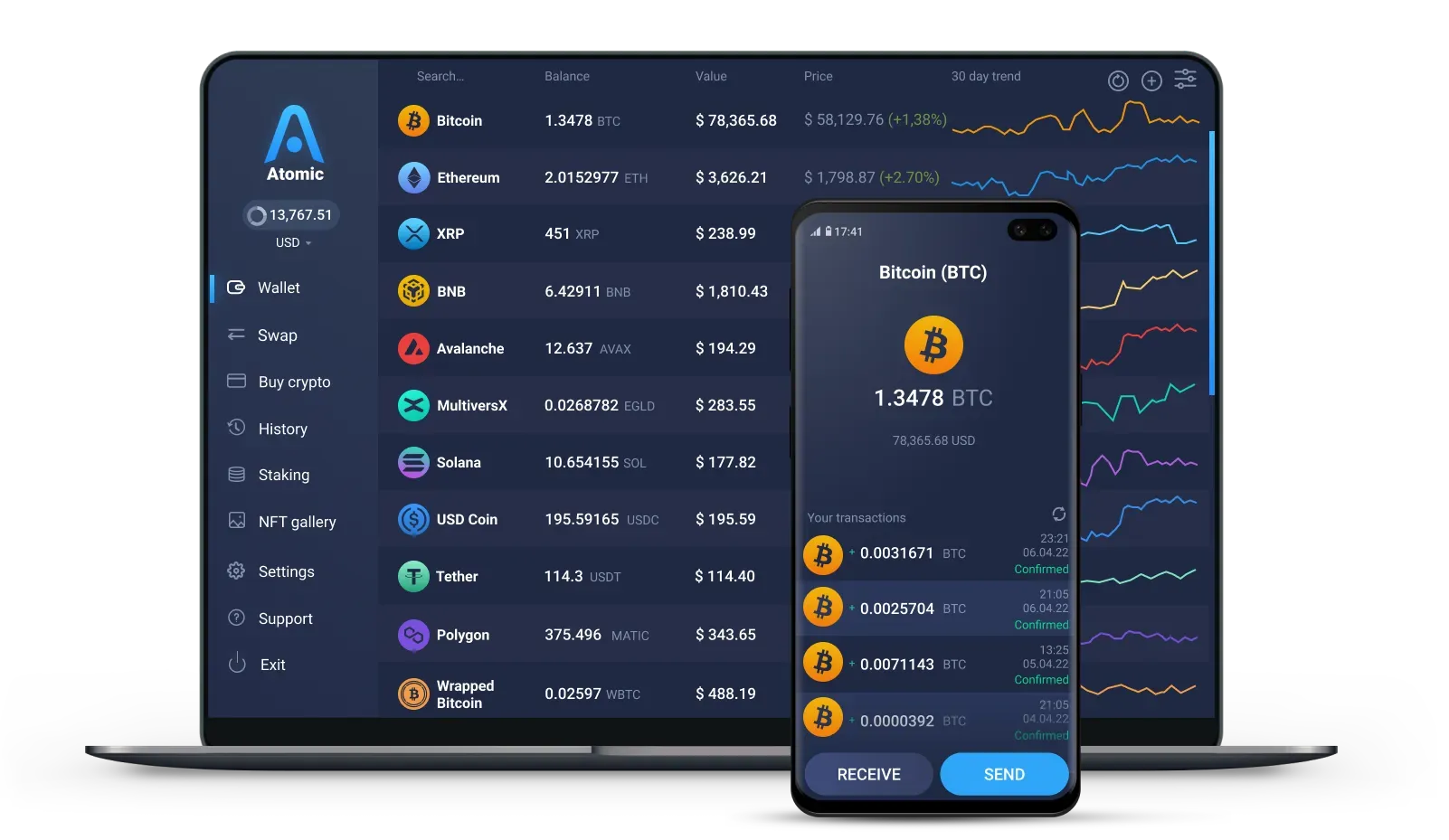
The safest way to hold BTC is a self-custody wallet, where only you control the private keys. In Atomic Wallet your keys are encrypted and never leave your device, and a 12-word backup phrase lets you restore your wallet on any device. You can buy, swap and hold BTC next to 1000+ other coins in one app.