How to Mint an NFT: Step-by-Step Guide for 2026
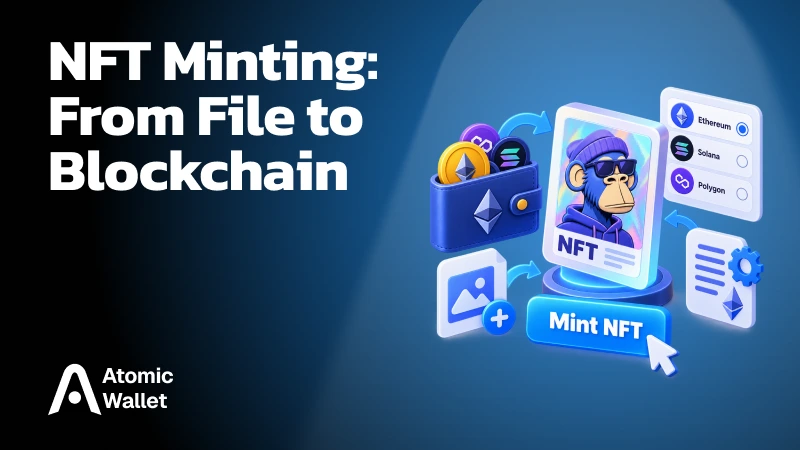
To mint an NFT, prepare a digital file, choose a blockchain and minting platform, connect and fund a compatible wallet, add the NFT’s metadata, and sign the mint transaction.
Once the transaction is confirmed, the NFT exists as a blockchain token assigned to a wallet address. You can then keep it, transfer it, or list it for sale — listing is a separate action from minting
The term “mint” is also used in two different situations:
- Creator minting — You turn your own artwork, image, video, music, or other digital asset into an NFT
- Collector minting — You participate in an NFT drop and become the first owner of a token created from the project’s existing smart contract
This guide focuses primarily on creating your own NFT without coding, while also explaining how minting from a public drop works.
What Does It Mean to Mint an NFT?
Minting an NFT means creating a unique or edition-based blockchain token and assigning its initial ownership to a wallet address.
On Ethereum and other EVM networks, the mint transaction interacts with an NFT smart contract. For an ERC-721 NFT, the asset is identified by a combination of its smart contract address and token ID. The blockchain records the token’s existence and ownership.
What usually does not happen is the entire image, video, or audio file being written directly to the blockchain.
The metadata can contain information such as the NFT’s name, description, attributes, and a URI pointing to its media. For example, both the metadata and image may be stored using IPFS and referenced through ipfs:// links.
This distinction makes several commonly confused actions easier to separate:
So minting an NFT does not automatically put the artwork itself onchain, list it for sale, or transfer it to another person. It creates the blockchain asset that can then be owned, transferred, and traded.
Before You Mint: What You Need
Before minting an NFT, you need the digital asset, permission to use it, a blockchain and minting platform, a compatible wallet, and enough of the network’s native token to cover any required fees.
Prepare these first:
- Digital file — The image, video, audio, animation, or other media you want to turn into an NFT
- Rights to the content — Mint only work you created or have permission to use; minting an NFT does not override copyright
- Blockchain — Choose where the NFT will exist, such as Ethereum or another compatible network
- Minting platform — A no-code marketplace or creator tool can handle the smart contract and mint transaction for you
- Crypto wallet — You need a wallet compatible with both the chosen network and minting platform
- Native token for fees — For example, ETH is used to pay gas on Ethereum; other networks use their own native assets
- NFT details — Prepare the name, description, traits, supply, and any external links before starting
The blockchain choice matters because an NFT is not easily moved between networks by default. It affects transaction fees, wallet and marketplace compatibility, available NFT standards, and where potential collectors can interact with the asset.
You should also decide whether you are creating a one-of-one NFT, multiple editions of the same asset, or a larger collection. That choice can affect the token standard and minting setup used by the platform.
How to Mint an NFT Step by Step
The basic NFT minting process is to prepare the asset, choose where it will live, create its metadata, and sign an onchain transaction that creates the token in your wallet.
The exact interface varies by platform, but the underlying process is broadly the same:
- Prepare your digital asset — Finalize the image, video, audio, or other file and confirm that you have the right to mint it
- Choose a blockchain — Consider network fees, NFT ecosystem, marketplace support, and wallet compatibility
- Set up and fund a compatible wallet — Add enough of the network’s native token to cover contract deployment or minting gas if required
- Choose a minting platform — Use a reputable creator platform that supports your selected blockchain and NFT format
- Create or select a collection — Some platforms first deploy a collection smart contract from which individual NFTs will be minted
- Upload the media — Add the digital file and choose the storage method offered by the platform
- Add the metadata — Enter the NFT name, description, traits, links, and other information associated with the token
- Set the supply — Choose whether there will be one NFT or multiple editions where the platform supports them
- Review the transaction and fees — Check the network, contract, destination wallet, and estimated costs before approving anything
- Sign the mint transaction — Your wallet authorizes the blockchain transaction that creates the NFT
- Verify the NFT — After confirmation, check the contract address, token ID, ownership, and metadata before sharing or listing it
At this point, the NFT has been minted, but it is not automatically for sale. Listing it on a marketplace is a separate step and may require another signature or transaction.
The first NFT in a new collection can also involve more than one blockchain transaction. If the platform requires you to deploy a collection contract first, contract deployment and NFT minting are separate operations with separate potential costs.
How to Mint an NFT on OpenSea
OpenSea Studio lets you mint an NFT without coding by deploying a collection smart contract, uploading your media and metadata, and signing the mint transaction from your wallet.
For an individual NFT or small collection, the current OpenSea flow is:
- Open OpenSea Studio — Choose
Create newand select the option to create a collection - Set up the collection contract — Add a logo, contract name, and token symbol
- Choose an EVM network — OpenSea Studio requires you to select the blockchain before deployment
- Deploy the contract — Approve the deployment transaction in your wallet and pay the required network gas
- Upload your media — Add the image, video, or other supported file for the NFT
- Add metadata — Enter the item name, description, external link, and optional traits
- Choose the supply — OpenSea’s direct creation flow currently uses ERC-1155; setting the supply to
1creates a unique item, while a higher supply creates multiple copies - Click Mint and review the request — Approve the mint transaction in your wallet
- Verify the NFT — Once confirmed, the item is minted directly to your wallet and can later be listed separately for sale
OpenSea requires a collection smart contract even if you only want to create a single NFT. The contract deployment and the NFT mint are separate blockchain operations, so both can require gas.
One important 2026 limitation: OpenSea Studio cannot currently create or mint Solana NFTs. It supports Ethereum and other EVM chains for creation, although compatible Solana NFTs can still be traded on OpenSea.
For larger collections, OpenSea’s Drop workflow supports bulk media and metadata uploads of up to 15,000 files. Its current upload limit is 50 MB for a single item and 5 GB for Drops.
How Much Does It Cost to Mint an NFT?
There is no fixed NFT minting price because the total cost depends on the blockchain, smart-contract setup, network activity, storage method, and platform you use.
The cost can include:
- Contract deployment — Required when creating a new collection contract
- Minting gas — The network fee for the transaction that creates the NFT
- Storage costs — Possible fees for hosting or persistently storing metadata and media
- Platform fees — Some platforms charge for certain minting or drop services
- Later listing or sale fees — Separate from the cost of creating the NFT
This is why a universal claim such as “minting an NFT costs $20” is misleading. Gas prices vary with both the network and current demand, while some platforms abstract away parts of the infrastructure or use lower-cost chains.
On OpenSea, for example, the platform does not take an OpenSea fee when you mint an NFT through Create a Collection; you pay the blockchain gas required to deploy the contract and mint the item. Gas goes to the network’s validators rather than to OpenSea.
A public primary drop has different economics. As of 2026, OpenSea typically charges 10% of the primary mint sale price for NFTs sold through its Drop system. That fee is separate from network gas.
NFT minting costs can differ dramatically even on the same blockchain. Metaplex estimates a basic NFT mint using its newer Core standard at about 0.003 SOL, compared with roughly 0.022 SOL using the older Token Metadata architecture. Core also reduces compute usage from around 205,000 to 17,000 units.
Is a Free Mint Really Free?
A “free mint” usually means the NFT itself has a mint price of zero, not that the blockchain transaction has no cost.
You may still need to pay network gas to execute the mint. If a blockchain transaction fails after validators have processed it, the gas spent on that attempt may also be non-refundable.
So when comparing minting options, separate these three numbers:
NFT price + network fee + platform fee
They are different costs, and any one of them can be zero while the others are not.
Where Is an NFT Actually Stored?
An NFT usually lives across several layers: ownership and token data are recorded onchain, while its metadata and media may be stored elsewhere.
For an ERC-721 NFT, the smart contract can expose a tokenURI that points to a metadata file. That metadata commonly contains the NFT’s name, description, attributes, and a link to the underlying media.
Creators generally have three storage options:
- Centralized storage — Media or metadata sits on a conventional server. Simple, but the NFT can depend on that server remaining available
- IPFS — Files are addressed by their content through a CID. Changing the file produces a different CID, which helps make unauthorized content changes detectable
- Fully onchain storage — Metadata and sometimes the artwork itself are stored or generated directly on the blockchain, offering stronger permanence but usually at a higher cost
IPFS is common in NFT infrastructure, but IPFS does not automatically guarantee permanent availability. Files must remain pinned or otherwise persisted by nodes or storage providers; content that is no longer stored can become unavailable even though its CID still exists.
This is why “the NFT is on the blockchain forever” can be misleading. The token may continue to exist onchain while the media it references depends on a separate storage layer.
ERC-721 vs. ERC-1155: Which Should You Use?
ERC-721 is designed around individually identifiable NFTs, while ERC-1155 can efficiently support multiple token types and multiple copies within a single smart contract.
For creators, the practical difference is usually:
ERC-721 identifies every NFT through its contract address and unique token ID. Even NFTs within the same collection are separate tokens.
ERC-1155 takes a more flexible approach. A single contract can contain many token IDs, and each ID can have a supply greater than one. Ethereum.org notes that an ERC-1155 token with a supply of 1 can still function as a unique NFT.
For example:
ERC-721:Artwork #1 — supply 1Artwork #2 — supply 1
ERC-1155:Limited Edition Poster — supply 100
Neither standard is inherently “better.” The right choice depends on whether you want individually unique tokens, editions, or a platform-specific setup.
You also may not need to choose the standard manually. Many no-code platforms decide it for you: OpenSea’s current direct creation flow uses ERC-1155, while its Drop system uses ERC-721. The more important creator decision is often the intended supply and distribution model rather than the standard name itself.
Can You Change an NFT After Minting?
Minting makes the NFT exist onchain, but it does not necessarily make its metadata or media permanently immutable.
What can change depends on the smart contract and the way the NFT was created. These layers should be treated separately:
- Token ownership and transfers — Recorded in the blockchain’s transaction history
- Smart contract logic — May be fixed or upgradeable depending on the contract design
- Metadata — Can sometimes be updated after minting
- Media — May change if the metadata points to an updateable file or location
OpenSea Studio, for example, currently allows creators to replace an NFT’s media and edit its name or description after minting. Saving those changes requires another blockchain signature and gas fee.
Drops can work differently. OpenSea lets creators modify item metadata before reveal, but revealing the collection prevents further changes to the drop’s item metadata through that workflow.
This is why “NFTs cannot be changed” is too broad. The token and ownership history may be permanently recorded while the content the token references remains editable.
Before minting, check whether the platform lets you freeze or permanently lock metadata, who retains update authority, and where the underlying media is stored.
NFT Royalties and Copyright
Minting an NFT does not automatically guarantee royalties on every future sale or transfer copyright in the underlying artwork.
These are two separate issues that creators should understand before minting.
NFT Royalties
A creator can configure royalty information so supporting marketplaces know what percentage of a resale should go to a specified recipient. ERC-2981 provides a standard way for NFT contracts to communicate the royalty recipient and amount.
However, ERC-2981 does not itself force every marketplace or buyer to make the payment. The standard explicitly describes royalty payments as voluntary at the protocol level because an NFT transfer does not necessarily represent a sale.
As a result, setting a 5% or 10% royalty when creating an NFT should not be interpreted as a guarantee that the creator will automatically receive that percentage from every future transaction. Actual enforcement depends on the contract design and marketplace.
NFT Copyright
Buying an NFT is also different from buying the copyright to its artwork.
The U.S. Copyright Office and USPTO make this distinction explicitly: ownership of an NFT and ownership of copyright in the associated work are separate. Transferring the token does not by itself transfer copyright or other intellectual-property rights in the underlying work.
For creators, that means two practical rules:
- Only mint content you created or are authorized to use
- Define any rights buyers receive separately if the NFT is intended to include commercial, reproduction, or other licensing rights
The NFT can prove ownership of a particular blockchain token. It does not automatically determine who owns the copyright to the image, music, video, or other work connected to it.
How to Mint an NFT From a Drop
Minting from an NFT drop means buying or claiming a token directly from the project’s mint contract and becoming one of its first owners.
Unlike creating your own NFT, you do not prepare the artwork, metadata, or smart contract yourself. The project has already created the collection infrastructure; your job is to verify the mint and authorize the transaction.
A typical drop works like this:
- Find the official mint page — Use the project’s verified website or marketplace page rather than links from unsolicited messages or ads
- Check the mint schedule — Confirm the date, time, public or allowlist stage, mint price, and maximum quantity
- Verify the network and collection — Make sure your wallet is on the correct blockchain and, where possible, confirm the collection or contract address
- Fund your wallet — Keep enough crypto for both the NFT price and network fees
- Connect your wallet — Select the account you intend to use
- Choose the quantity — Drops may restrict how many NFTs each wallet can mint
- Review the wallet request — Check the amount, network, contract, and transaction before signing
- Sign the mint transaction — Once confirmed onchain, the new NFT is assigned to your wallet
On OpenSea, NFTs offered through a Drop do not exist as individual tokens until users actually mint them. After minting, the NFT is held in the buyer’s wallet rather than by OpenSea.
The artwork may not appear immediately. Some collections deliberately use a pre-reveal image, keeping the final artwork and traits hidden until the mint ends or a later reveal date.
A failed mint can still cost money. If a limited collection sells out while your transaction is being processed, the transaction may fail but the network gas already spent on execution is generally not refundable.
Most importantly, do not trust a transaction simply because the website button says “Mint.” The wallet request is what you are actually authorizing, so inspect it before signing.
NFT Minting Mistakes to Avoid
The most common NFT minting mistakes involve the wrong network or contract, misunderstood fees, unreliable metadata storage, and signing transactions without checking what they actually do.
Avoid these problems:
- Confusing minting with listing — Minting creates the NFT; listing only offers an already minted NFT for sale
- Using the wrong network — Sending funds or attempting to mint on an unsupported chain can create failed transactions or leave you without the assets needed for gas
- Leaving too little for gas — Having enough for the NFT price is not enough if the transaction also requires a network fee
- Following a fake mint link — Copycat websites can imitate legitimate drops while requesting malicious signatures or transactions
- Ignoring the contract address — Collection names, artwork, and tickers can be copied; the blockchain contract is the more reliable identifier
- Assuming “free mint” means zero cost — A zero mint price can still require network gas
- Using fragile media storage — An NFT can remain onchain while its image becomes unavailable if the referenced media is no longer hosted or persisted
- Assuming metadata is permanent — Check whether the creator or platform can still modify the NFT’s media, traits, or metadata after minting
- Expecting guaranteed royalties — A royalty setting does not ensure that every future marketplace will enforce the payment
- Minting copyrighted work without permission — Tokenizing an image does not give you ownership of its copyright
- Signing without reading — A secure wallet cannot protect you from a harmful transaction that you knowingly authorize
Failed transactions deserve particular attention because failure does not necessarily mean nothing happened financially. Validators may already have processed the attempted transaction, so the gas fee can be spent even when no NFT is received.
That short review catches many of the errors that are hardest to reverse after a blockchain transaction is confirmed.
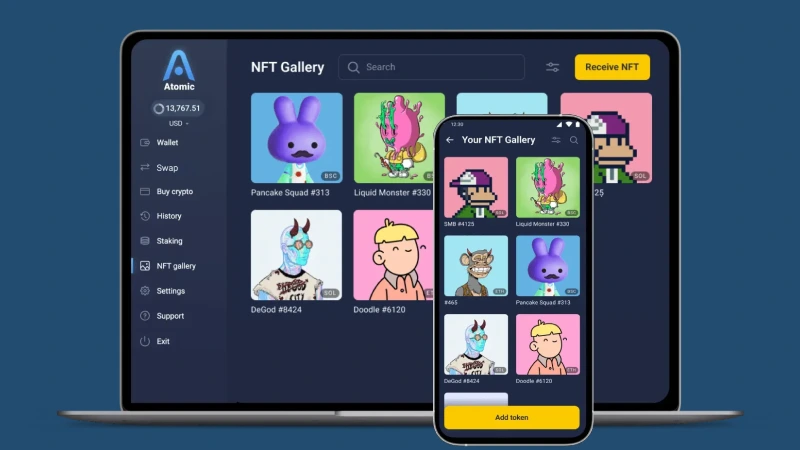
Ready to mint or explore NFTs onchain? Atomic Wallet gives you self-custody access to Web3 apps while keeping control of your private keys.