Is XRP a Good Investment? Price, News, and Outlook
XRP has re-entered mainstream conversation in 2025 as one of the most searched digital assets globally. After years of regulatory uncertainty, the market finally has clearer guidance around XRP’s legal status in the U.S., revitalizing institutional interest. Meanwhile, Ripple’s enterprise payment products continue expanding across LATAM and APAC, bringing new relevance to XRP’s core utility as a liquidity asset.
This guide aims to deliver a balanced, data-driven evaluation of XRP as an investment today — without hype, without fear, and with full transparency.
What Is XRP? (Simple Explanation for New Investors)
XRP is the native digital asset used within the Ripple ecosystem — a network built to move value across borders quickly and cheaply. Unlike smart-contract platforms such as Ethereum or Solana, XRP is purpose-built for payments and liquidity routing. It’s already integrated into Ripple Payments (formerly ODL), enabling financial institutions to source instant liquidity without pre-funded accounts.
Key characteristics:
- Fast settlement: ~3–5 seconds
- Low transaction cost: fractions of a cent
- Used for liquidity bridging in Ripple’s enterprise payment rails
- Not a smart-contract chain, meaning a different role in the crypto stack
- Often viewed as a “regulated-friendly” asset due to its legal clarity in the U.S.
Is XRP a Good Investment? Key Factors to Consider
Whether XRP is a “good investment” depends entirely on an investor’s risk profile, time horizon, and expectations. XRP occupies a unique position in the crypto market: it is not a high-growth smart-contract ecosystem, but it is one of the few large-cap assets with regulatory clarity and real enterprise adoption. That makes it attractive to conservative crypto investors — but it also limits its upside compared to high-beta altcoins.
Pros
- Regulatory clarity in the U.S. — one of the few major assets legally defined not to be a security.
- Institutional-friendly — used in enterprise payment systems.
- Lower volatility compared to typical altcoins.
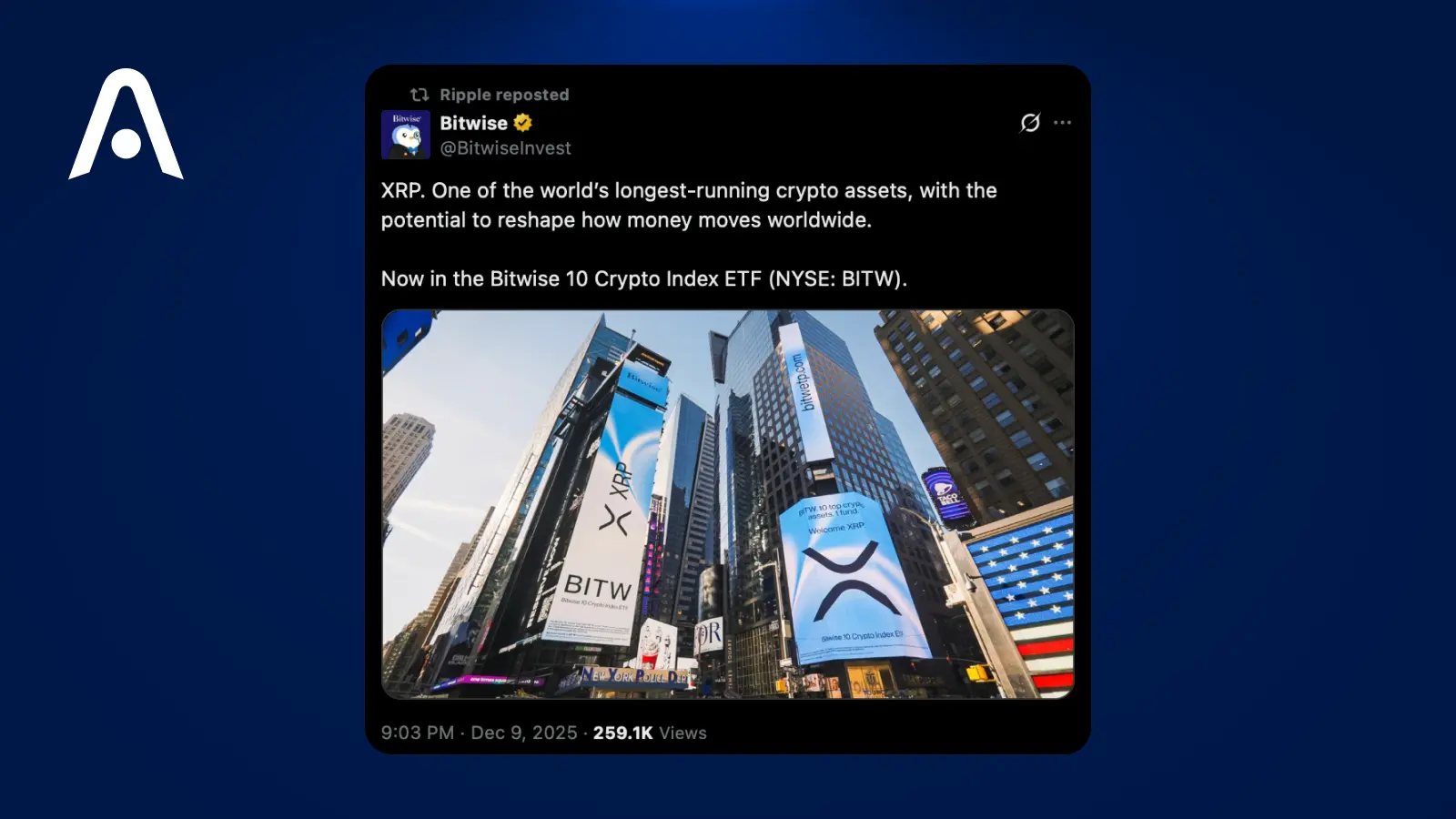
- Included in major crypto indices and ETPs (e.g., BITW), increasing passive inflows.
Cons
- Limited on-chain innovation: XRP Ledger does not compete with Ethereum/Solana in DeFi or smart contracts.
- Escrow unlocks create structural sell pressure.
- Strong dependence on Ripple’s business performance.
- Lower upside potential compared to high-growth L1s.
Why Is XRP Going Up? (2024–2025 Drivers)
XRP’s momentum in 2024–2025 is driven by a combination of regulatory clarity, institutional re-entry, and renewed corporate focus from Ripple. Unlike previous cycles driven mostly by community sentiment, recent price movements reflect improvements in fundamentals and market positioning.
Key drivers:
- Regulatory wins and reduced legal risks in the U.S.
- Ripple Payments expansion across LATAM, APAC, and the Middle East.
- Index inclusion: exposure via BITW and European ETPs brings passive inflows.
- Return of institutional liquidity to large-cap assets with clear legal status.
- Market rotation: investors seeking lower-volatility alternatives during uncertain macro conditions.
XRP Price Today & Recent Performance (2024–2025)
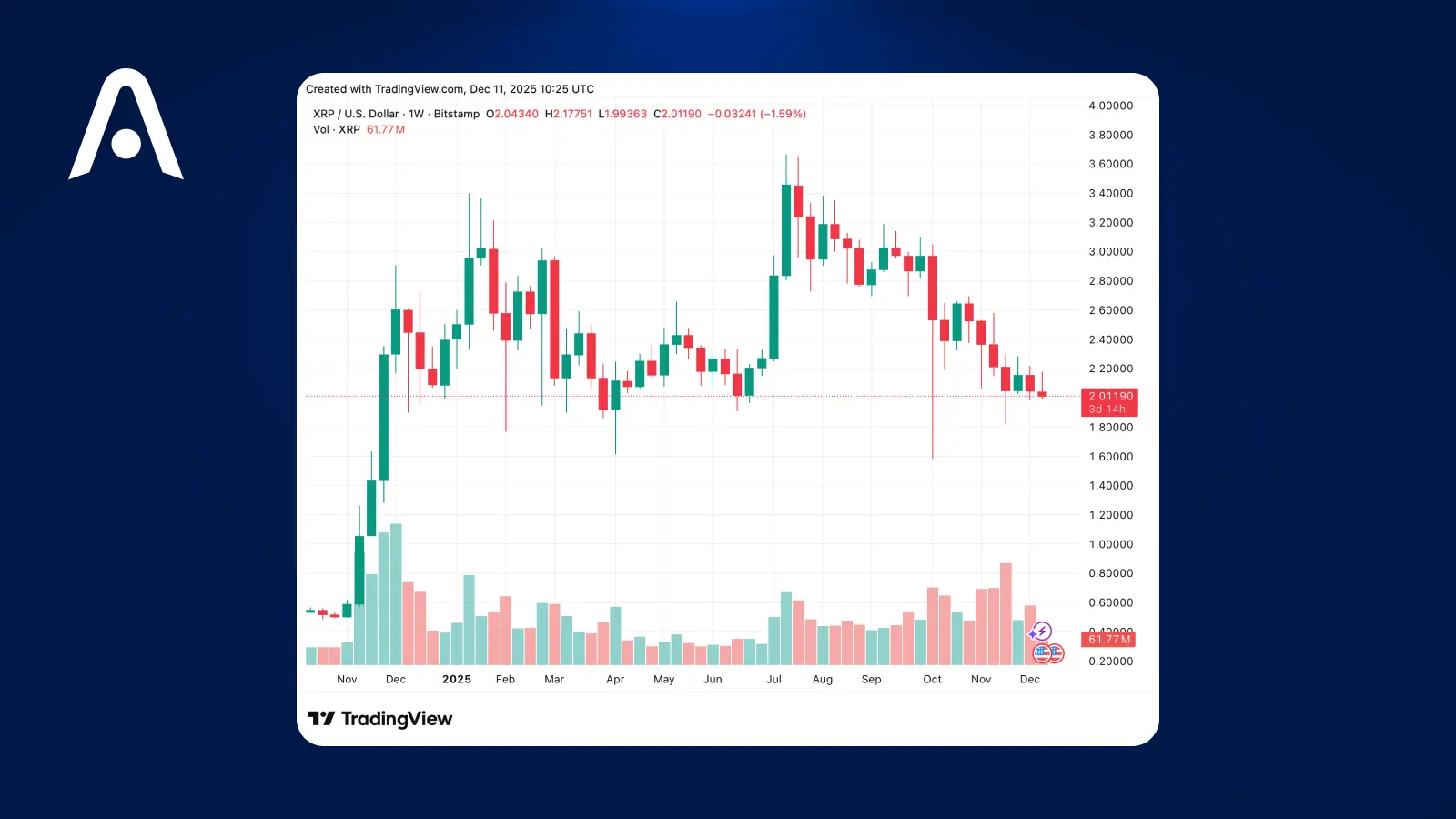
Over the past 12–18 months, XRP has traded in a wide but steady range, reflecting its role as a lower-volatility large-cap asset. Its price movements have been driven less by speculation and more by regulatory developments, institutional flows, and major Ripple ecosystem updates.
Key points:
- 52-week range: typically tighter than high-beta altcoins, but still reactive to macro cycles.
- Major catalysts: SEC case updates, Ripple partnerships, global payment corridors.
- Volume spikes: often coincide with legal announcements or index-related flows.
- Correlation: XRP tends to lag Bitcoin in rallies but remains more stable in corrections.
Ripple vs SEC — What’s the Latest?
The multi-year SEC battle shaped XRP’s market narrative. As of 2025, the core ruling stands: XRP sold on exchanges is not considered a security, giving it rare regulatory clarity in the U.S. While some remedies and procedural elements are still being finalized, the existential risk has largely faded.
This legal certainty is a major reason why institutions are revisiting XRP exposure, and why many investors view it as a comparatively “safer” long-term large-cap asset.
Utility Case — How XRP Is Actually Used
Despite years of hype, XRP’s real utility comes from a focused and fairly narrow domain: enterprise cross-border payments. Ripple uses XRP within its Ripple Payments (formerly ODL) framework to provide instant liquidity for international transfers. This makes XRP structurally different from smart-contract platforms like Ethereum or Solana.
Where XRP is used today:
- Ripple Payments liquidity rails for banks and fintech companies
- Tranglo-powered corridors across Southeast Asia
- SBI Japan integrations and remittance flows
- Liquidity bridging for select institutional partners
XRP remains one of the few assets with a tangible, enterprise-facing use case — though that use case is not high-growth in the same way as L1 smart-contract ecosystems.
XRP Tokenomics — Supply, Escrow, and Sell Pressure
XRP’s tokenomics are one of the most controversial aspects of the asset. With a total supply of 100B XRP, much of it originally controlled by Ripple Labs, token unlocks and escrow releases have historically influenced investor sentiment.
Key elements of XRP tokenomics:
- Escrow model: Ripple releases up to 1B XRP per month, with unsold amounts returning to escrow.
- Institutional program sales: historically contributed to perceived sell pressure (now more regulated and transparent).
- No mining: the entire supply existed from inception.
- Inflation dynamics: while escrow returns mitigate some pressure, supply unlocks remain a structural factor.
For long-term investors, understanding XRP’s supply schedule is essential — it shapes both upward potential and resistance levels during rallies.
How High Can XRP Go? (Realistic Scenarios)
XRP price discussions often swing between extreme bullish predictions and equally pessimistic takes. A balanced, realistic framework focuses on fundamentals: utility growth, regulatory clarity, enterprise adoption, and overall crypto market conditions. XRP is not a high-beta altcoin anymore — its behavior resembles a mature, lower-volatility asset.
Here are three grounded scenarios:
1. Base Case — Gradual Appreciation
- Moderate growth in Ripple Payments volume
- Clear but unchanged regulatory status
- XRP continues trading as a “safer altcoin” with muted volatility
- Outcome: steady but conservative upside; XRP tracks broader market cycles.
2. Bull Case — Strong Institutional & Payment Adoption
- Full closure of SEC matters
- Expansion of Ripple partnerships across LATAM, MENA, APAC
- Inclusion in more institutional indices and ETPs
- Outcome: significant re-rating as XRP becomes a default institutional payments asset.
3. Low Case — Limited Utility Growth
- Payment corridors stagnate
- Escrow sell pressure remains dominant
- Market rotates toward higher-growth L1 ecosystems
- Outcome: XRP underperforms the market and behaves like a defensive altcoin.
These scenarios illustrate that XRP’s upside exists — but is bounded by utility, regulation, and supply structure.
XRP Future — What Could Shape the Next Cycle
Several catalysts could redefine XRP’s position in the crypto landscape over 2025–2027. While XRP is no longer competing with L1 smart-contract platforms, it can strengthen its role as an institutional settlement asset.
Key drivers for the next cycle:
- Final closure of the Ripple vs SEC case
- Expansion of Ripple Payments volume with banks and fintechs
- Potential CBDC collaborations and pilot programs
- Increased inclusion in crypto indices and ETPs (BITW, European products)
- Broader adoption of tokenization and institutional settlement solutions
XRP’s future depends less on hype and more on institutional infrastructure — making it a unique asset within the crypto market.
Risks of Investing in XRP
Even though XRP has regulatory clarity and a long operational history, it carries several structural risks that every investor should understand before allocating capital. Many of these risks are fundamental, not just market-driven.
Key risks include:
- Limited on-chain innovation: XRP Ledger is not a general-purpose smart-contract ecosystem like Solana or Ethereum, which restricts organic developer growth.
- Dependence on Ripple Labs: Despite decentralization improvements, Ripple remains the primary driver of enterprise adoption. This introduces single-actor reliance.
- Escrow supply & sell pressure: Ripple continues releasing XRP from escrow. Even if managed conservatively, it creates long-term structural sell pressure.
- Regulatory overhang (partially resolved, not fully): While XRP is not a security in secondary sales, parts of the case remain open, and future regulatory developments could impact the ecosystem.
- Narrative risk: XRP’s performance is often tied to headlines, legal outcomes, and payment corridor news — not purely on-chain fundamentals.
- Lower growth ceiling vs. L1 ecosystems: Since XRP isn’t competing in DeFi, NFTs, gaming, AI, or L2 ecosystems, it lacks many upside catalysts other networks have.
Summary
XRP is not inherently a “bad” or “unsafe” asset — but it is a specialized asset with structural limitations. Investors seeking explosive L1-style growth may find XRP too constrained, while conservative investors may appreciate its stability and regulatory clarity.
How to Trade XRP Using Perpetual Futures (Strategic Angle)
Perpetual futures are one of the most popular ways to trade XRP because the asset reacts strongly to news, regulatory updates, and macro sentiment, while maintaining deep liquidity across major markets.
Why XRP Fits Perp Trading Well
- High liquidity → tighter spreads
- Strong reaction to headlines (Ripple, SEC, partnerships)
- Lower downside volatility than high-beta altcoins
- Ideal for both short-term traders and hedgers
Common XRP Perp Strategies
- Directional trades: Trade short- or medium-term trends driven by market catalysts.
- Hedging: Long-term holders can use XRP perps to hedge their spot exposure — helpful during uncertain regulatory periods.
- Event-driven trading: SEC filings, court decisions, and Ripple partnership announcements often create rapid volatility windows.
Trade XRP Perpetual Futures in Atomic Wallet
You can trade XRP perpetual futures directly from Atomic Wallet — with full self-custody and without depositing your assets on centralized exchanges.
Atomic Perps lets you:
- Trade XRP with leverage in a secure, non-custodial environment
- Maintain full control of your private keys
- Access deep liquidity and fast execution
- Hedge your XRP exposure or trade news-driven movements
Start trading XRP perpetual futures in Atomic Wallet — download the app and trade directly from your wallet.