What Is Ethena? How ENA Coin Works and What Drives the ENA USDT Price
Ethena has rapidly become one of the most discussed projects in crypto. At the center of this surge is USDe, a new type of “synthetic dollar” that doesn’t rely on banks or traditional stablecoin collateral. Instead, it’s powered by a derivatives-based engine that uses perpetual futures markets to maintain stability and generate yield — making Ethena the first protocol to turn perps liquidity into a full-scale monetary system.
Meanwhile, ENA, the ecosystem token, is directly tied to real economic activity across perps markets and growing USDe demand — a combination that has made it one of the fastest-moving assets of 2024–2025.
This guide explains how Ethena works, what drives ENA’s price, and why its model has become central to the new DeFi cycle.
What Is Ethena? (USDe, sUSDe, and the ENA Token Explained)
Ethena is a synthetic-dollar protocol built around three core components:
• USDe — a delta-hedged synthetic dollar designed to hold stable value;
• sUSDe — a staked version of USDe that distributes yield from the protocol’s hedging engine;
• ENA — Ethena’s ecosystem and governance token, aligned with growth, liquidity, and risk management.
Unlike traditional stablecoins such as USDC or USDT, USDe isn’t backed by cash, T-bills, or centralized issuers. Instead, it relies on a market-neutral position synthesized from spot assets and perpetual futures, making Ethena the first large-scale stable asset powered directly by derivatives markets.
Together, these components form a self-contained economic system that bridges DeFi, derivatives, and synthetic dollars.
How Ethena Works — Delta-Neutral Model Powered by Perpetual Futures
At the core of Ethena is a delta-neutral hedging engine: the protocol holds long spot exposure (typically ETH or BTC) while simultaneously shorting perpetual futures. This structure neutralizes directional price risk — meaning USDe doesn’t depend on the underlying asset going up or down.
Where the system becomes powerful is in funding rates.
When funding is positive — which has historically been common in crypto perps — short positions earn funding payments. These inflows, combined with basis spreads and staking income, provide the yield that powers sUSDe.
Key mechanics include:
- Long spot + short perps → price-neutral synthetic dollar
- Positive funding → revenue that fuels sUSDe yield
- Deep CEX perps liquidity → stability and scalability
- Hedged positions → reduced exposure to market swings
This model means Ethena’s stability — and part of ENA’s value — is tied directly to the health and liquidity of global perpetual futures markets.
A brief takeaway: Ethena is the first system to turn perps liquidity into a monetary base.
What Is ENA Coin? Utility, Role, and Token Economics
ENA is the native token of the Ethena ecosystem, designed to coordinate growth and governance. Its utility spans several layers:
- Governance: ENA holders shape risk parameters, collateral settings, and future integrations.
- Growth incentives: Liquidity programs, seasons, and user rewards expand USDe adoption.
- Alignment mechanism: As USDe supply scales, ENA becomes the asset that absorbs long-term protocol value.
- Risk buffer: Parts of ENA emissions and treasury allocations serve as protection for protocol operations.
Because USDe demand drives the protocol’s hedging engine — and hedging revenue influences system growth — the ENA price often tracks cycles in funding, sUSDe yield, and perps trading activity.
Put simply: ENA is the coordination token for one of the fastest-expanding synthetic dollar systems in DeFi.
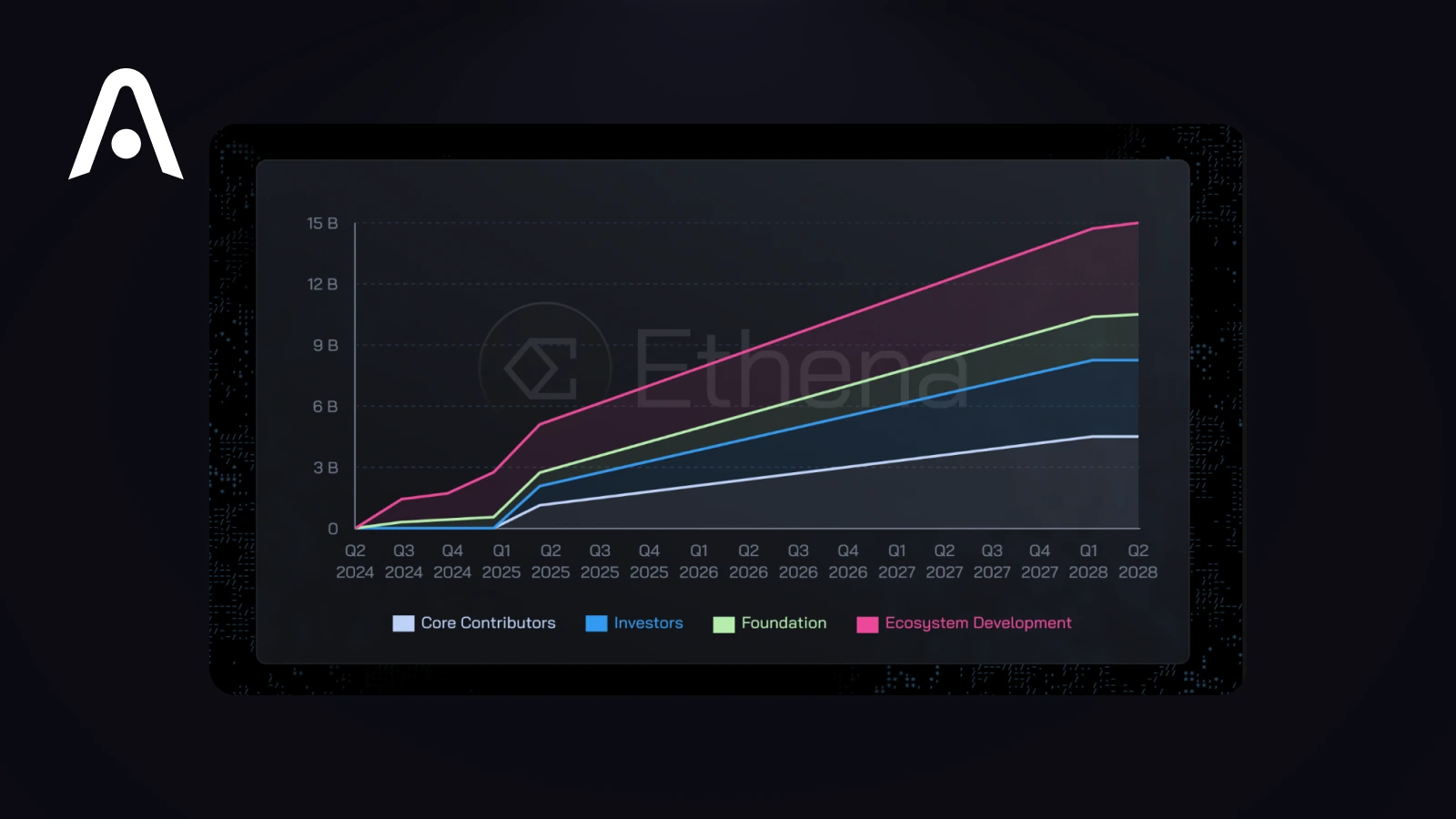
ENA USDT Price — Recent Performance (2024–2025)
Since launch, ENA USDT price has shown the typical behavior of a high-beta DeFi asset: fast repricing during liquidity expansions and equally sharp corrections during funding downturns. The token tends to move in cycles tied to USDe growth, perp funding rates, and broader ETH/BTC volatility.
Key price markers and drivers:
- 52-week range: wide swings as liquidity rotated between LRTs, perps, and synthetic dollar protocols.
- Major catalysts: Season campaigns, CEX listings, and periods of strongly positive funding.
- Correlation: ENA often tracks spikes in perps volume — especially ETH perps — because revenue expectations rise with higher funding.
- High-volume sessions: Typically aligned with USDe reaching new supply milestones.
A short takeaway: ENA’s performance is less about speculation and more about structural demand for delta-neutral yield in crypto.
Why USDe Became One of the Largest Synthetic Dollars
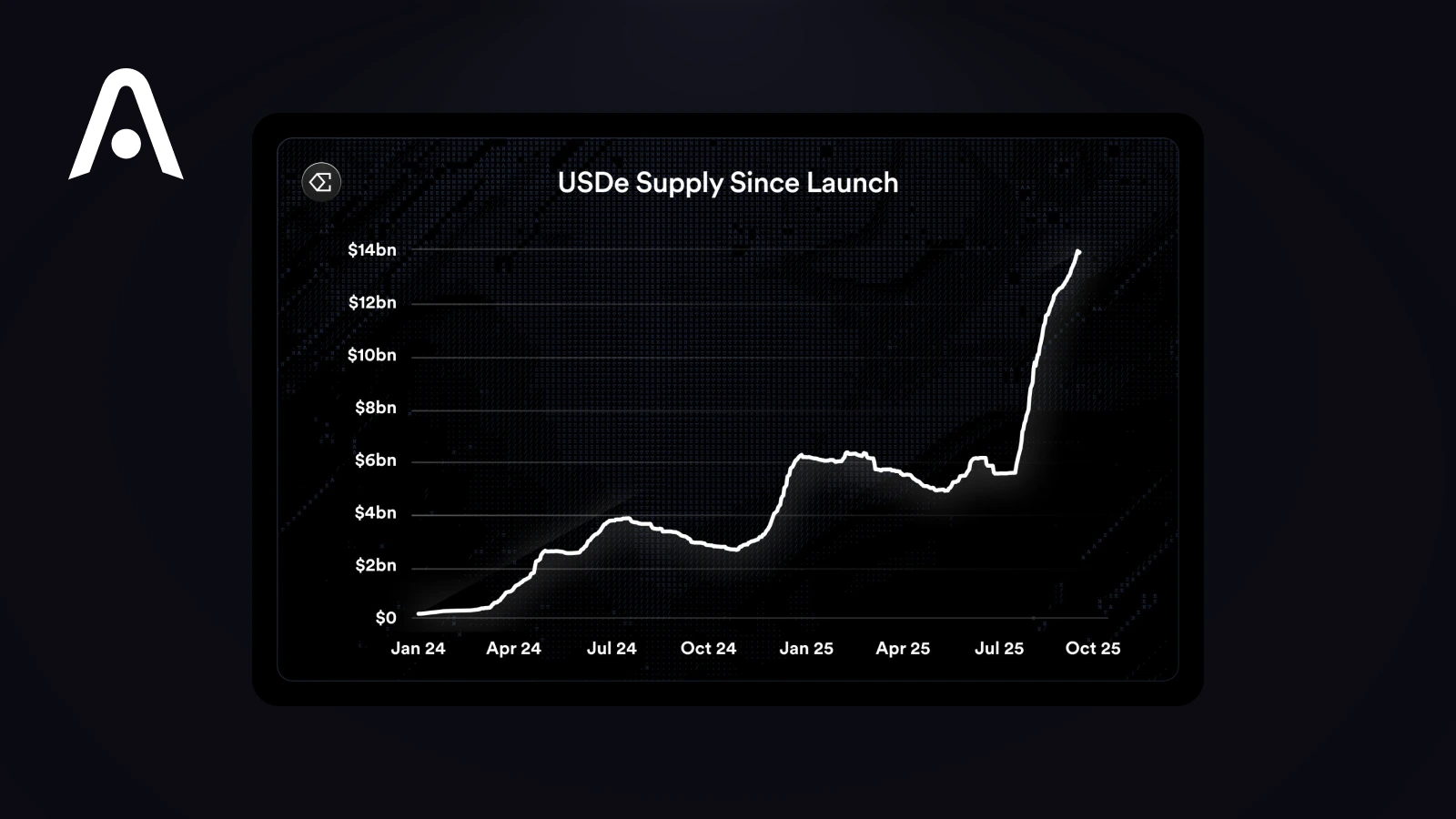
USDe has grown into a multi-billion-dollar synthetic dollar because it solves a problem other stablecoins cannot: a scalable, collateral-efficient asset not dependent on banks or treasuries. Its design makes it attractive to both DeFi protocols and yield-seeking users.
Where USDe is used today:
- Pendle Finance: tokenized yield markets and basis trading.
- Morpho & Gearbox: collateral for leveraged strategies.
- LRT ecosystems: integration with ETH restaking protocols.
- DeFi money markets: predictable, hedged collateral with strong liquidity.
USDe’s appeal comes from combining stability with programmable yield, making it one of the most integrated assets of the new DeFi cycle.
Where the Yield Comes From — Funding, Basis, and Staking
Ethena’s yield engine is powered by a combination of funding markets, basis trades, and staking rewards, all stacked on top of its delta-neutral structure. The system does not rely on mint-and-sell mechanics — it relies on real market flows.
Main yield sources:
- Perpetual futures funding: the core driver. When funding is positive, shorting perps earns predictable income that flows to sUSDe holders.
- Spot–perp basis: during volatile markets, the spread between spot and futures markets can produce additional structured yield.
- ETH staking yield: when part of the collateral is staked, the protocol extracts baseline staking rewards.
A key nuance: none of these sources are guaranteed. Funding can flip negative; basis can compress; staking yield depends on ETH market conditions. This makes Ethena powerful — but sensitive to derivatives liquidity.
Risks of Ethena and ENA
Ethena is one of the most influential protocols of the cycle, but its design introduces meaningful risks every user should understand.
Primary risks:
- Funding risk: prolonged negative funding can reduce or eliminate sUSDe yield.
- Perp liquidity dependence: USDe stability relies on deep, stable perp markets on major CEXs.
- Counterparty exposure: because hedges sit on centralized exchanges, exchange risk cannot be fully removed.
- Regulatory uncertainty: synthetic dollars may face classification or oversight in major jurisdictions.
- Depeg scenarios: although delta-neutral by design, extreme market dislocations or illiquidity could stress the hedge.
Short summary:
Ethena is robust during normal market conditions — but it remains highly tied to the health and liquidity of the global perpetual futures ecosystem.
ENA Price Outlook — What Could Move ENA Next
ENA’s future price action is tightly linked to both market demand for USDe and the broader derivatives environment. As long as USDe supply grows and funding rates remain healthy, ENA tends to behave like a high-beta DeFi token tied to real protocol activity.
Key drivers to watch:
- Funding cycles on ETH/BTC perps: strong positive funding → higher USDe yields → more demand → upward pressure on ENA.
- USDe supply expansion: when institutions, DeFi protocols, or LRT platforms adopt USDe, ENA often rallies.
- New integrations: listings, collateral acceptance, and DeFi partnerships (Pendle, Morpho, Gearbox, etc.).
- Macro market structure: periods of volatility usually strengthen hedged-stablecoin demand.
- Season campaigns: Ethena’s incentive seasons historically produced spikes in ENA volume and volatility.
Overall, ENA behaves like a leveraged bet on the health of perps markets, not just the broader crypto cycle.
Trading Ethena-Related Markets With Perpetual Futures
Perpetual futures play a central role in how Ethena works — and they’re also one of the most efficient ways for traders to gain exposure to ENA-related narratives.
Why traders use perps around Ethena:
- Directional exposure: ENA perps allow traders to long or short the narrative without needing spot liquidity.
- Hedging strategies: users holding USDe or sUSDe sometimes hedge funding-cycle risk with perp positions.
- Funding arbitrage: ENA and perps linked to Ethena often exhibit predictable funding patterns during large inflows/outflows.
- Volatility trading: Ethena news (expansion, seasons, integration) creates high-volume short-term setups ideal for derivatives.
Perps give traders tools that spot markets can’t — especially when ENA liquidity is fragmented or concentrated on a few exchanges.
Trade Perpetual Futures Safely With Atomic Wallet
Ethena is built on top of perpetual futures — which makes perps one of the most efficient ways to trade the ENA narrative. With Atomic Perps, you can access perp markets directly from your self-custody wallet, without depositing funds on a centralized exchange.
Why traders choose Atomic Perps:
- Self-custody trading: your keys, your assets — no exchange custody risks.
- Access to major perp markets, including assets correlated with ENA and broader DeFi narratives.
- Fast execution and transparent fees.
- Mobile + desktop support: trade anywhere with a unified experience.
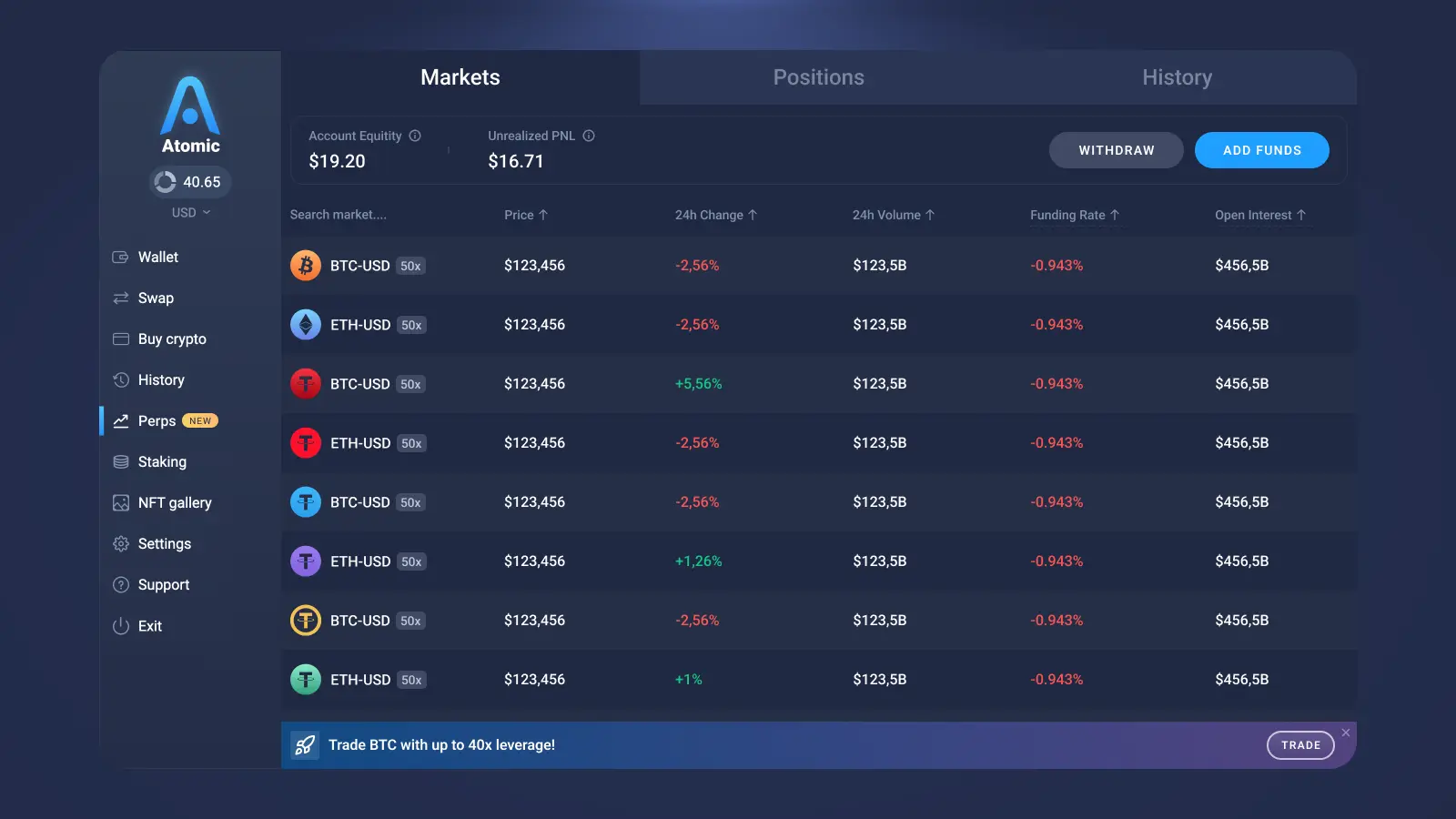
If you want secure exposure to Ethena-related perpetual futures, Atomic Perps is built for you.
Start trading perps in Atomic Wallet — download now.