REKT Meaning: What It Means in Crypto and Trading
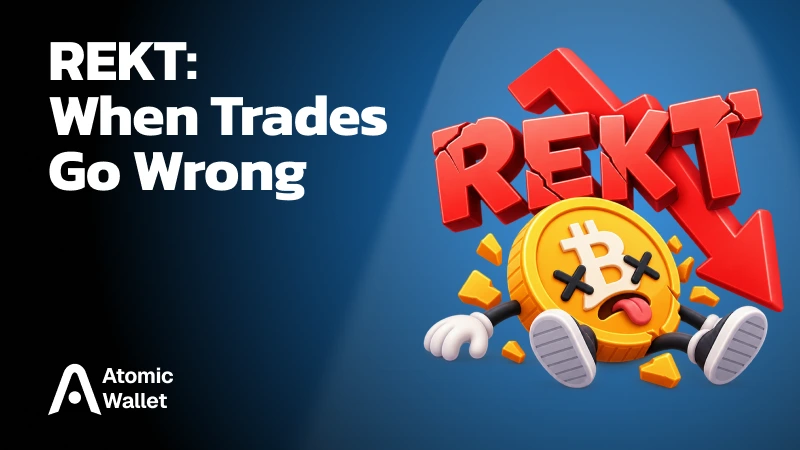
REKT is crypto slang for “wrecked,” used to describe a heavy loss on a trade, investment, or other crypto activity.
You’ll see it after sharp price drops, liquidated positions, and costly mistakes. The expression is casual, sometimes even a joke, but the losses behind it can be serious. Understanding the context helps you tell whether someone is describing a temporary drop in value, a closed trade, or funds that are actually gone.
What Does REKT Mean in Crypto?
Getting REKT means suffering a substantial financial loss, without any fixed percentage or requirement to lose everything.
Someone who buys a token before its price collapses might say, “I got rekt.” A trader whose leveraged position gets liquidated might use exactly the same phrase. The word describes the severity of the outcome rather than identifying what caused it.
REKT can also refer to an asset or market. “This token got rekt” usually means its price fell sharply, while “the market got rekt” describes a broader sell-off.
There is no official threshold separating an ordinary loss from getting REKT. People use the term with different levels of seriousness, from self-deprecating exaggeration to describing a near-total loss. It does not, by itself, confirm that someone was liquidated, sold their holdings, or lost their entire portfolio.
Where Did REKT Come From?
REKT comes from “wrecked,” written the way it sounds, and was used in internet and gaming slang before becoming familiar in crypto.
Outside finance, it can describe someone who was badly defeated, embarrassed, or extremely drunk. In multiplayer games, “get rekt” became a way to taunt an opponent after a one-sided defeat. Crypto communities adopted the expression to describe painful financial outcomes.
Dictionary.com records the term’s early usage in 2010–2015. Its exact first use is difficult to establish, so there is no reliably confirmed single creator or founding post.
REKT is pronounced like “wrecked,” in one syllable. It is not an acronym, and writing it in capital letters simply adds emphasis.
How Do People Use REKT?
People use REKT to describe losses, admit a mistake, warn others, or mock someone’s outcome.
The surrounding words tell you which meaning is intended:
The tone matters as much as the definition. Someone describing their own trade may be joking to cope with frustration. The same language aimed at another person can sound dismissive of a serious loss.
A post saying “shorts got rekt” also needs context before you interpret it as a liquidation report. The phrase alone does not establish how many positions closed, how much traders lost, or whether every affected trader was liquidated.
How Do People Get REKT in Crypto?
Heavy crypto losses can come from price movements, leveraged positions, fraud, or security failures.
The same slang can describe very different situations:
- A spot holding collapses: Someone buys a token outright, then its market value falls sharply. There is no liquidation requirement, but the investment can still lose most of its value
- A leveraged trade moves against the trader: Falling prices hurt a long position; rising prices hurt a short. Losses can consume the available margin and trigger forced closing
- A project turns out to be fraudulent: Insiders may drain liquidity or sell concentrated holdings, leaving other holders with sharply devalued or difficult-to-sell tokens
- Funds are stolen or a protocol is exploited: A compromised recovery phrase, harmful token approval, or vulnerable smart contract can lead to losses without a market sell-off
Liquidity also affects the outcome. A token may show a price on screen while offering very little opportunity to sell a meaningful amount near that price.
These causes require different responses. Reducing trading exposure addresses a different problem from protecting a recovery phrase or reviewing a contract permission. The word REKT alone does not tell you which risk materialized.
Why Leverage Can Turn a Small Move Into a Big Loss
Leverage increases the position controlled by each dollar of margin, making price movements much larger relative to the trader’s initial capital.
Consider two hypothetical long positions, excluding fees and funding:
For the leveraged trader, a 5% market decline produces a loss equal to 50% of the initial margin. The asset itself has moved only 5%.
A short position reverses the direction: an upward price move creates the loss. This is why traders can get REKT during a rally as well as a crash.
The calculation illustrates profit and loss, not an exact liquidation threshold. Liquidation depends on maintenance requirements, available collateral, margin mode, and other positions. On Hyperliquid, it also uses the mark price, which can differ from the latest traded price shown on a chart. A position may be liquidated before its entire initial margin is consumed.
The scale can become enormous. CoinGlass reported more than $19 billion in liquidated positions on October 10, 2025. That figure measures the notional value of positions forcibly closed, not an equivalent amount of traders’ cash lost. Leverage makes those two numbers very different.
REKT vs. Liquidation and Other Crypto Terms
REKT describes a severe loss, while liquidation identifies a specific event: a trading system forcibly reduces or closes a position because its margin requirements are no longer met.
A fully paid spot holding can lose most of its value without being liquidated. Conversely, a liquidation may close only part of a position and leave some collateral remaining.
The amount exposed also depends on the margin arrangement. With isolated margin, collateral is allocated to a particular position. Cross margin shares collateral across positions, allowing losses in one to affect the others. The exact treatment follows the platform’s rules.
Other terms describe different parts of the story:
These situations can overlap. A rug pull can leave someone holding a nearly worthless token, prompting them to say they got REKT. The slang summarizes the outcome without explaining its cause.
A price recovery does not reopen a liquidated position. Once that exposure has been closed, a later rebound cannot reverse the realized loss. If liquidation was partial, only the remaining position continues to participate in subsequent price moves.
How to Reduce the Risk of Getting REKT
Managing exposure, understanding trade mechanics, and protecting wallet access address different sources of crypto losses.
Before committing funds, review the decisions that determine what is at risk:
- Position size: Consider the loss a position could create across your finances, rather than focusing only on its potential return
- Leverage and collateral: Understand the actual market exposure, maintenance requirements, and which funds can support the position
- Exit conditions: Decide what would make you reduce or close the position before a fast market forces the decision
- Liquidity and costs: Account for slippage, trading fees, and funding payments when assessing a trade
- Project and contract risks: Check token ownership, liquidity arrangements, and the permissions requested by applications
- Wallet access: Protect your recovery phrase offline and review addresses, networks, and transaction requests carefully
Protective orders also have limits. A stop-loss market order can execute at a worse price than its trigger during volatility. A stop-loss limit order restricts the execution price but may remain unfilled if the market moves past it.
After a substantial loss, review what happened before increasing exposure. An attempt to win everything back quickly can commit more capital to the same unresolved risk.
Managing Crypto With Atomic Wallet
Atomic Wallet gives you control of your wallet keys and access to tools for managing supported crypto assets.
In our app, you can receive, send, swap, and stake supported assets. Protect your 12-word backup phrase offline so you can restore access if you lose your device. Our support team will never ask you to share it.
For leveraged trading, Atomic Perps provides access to long and short positions through Hyperliquid. Before opening a position, review its size, collateral, leverage, and liquidation estimate. Fees and funding can also affect the outcome over time.
Self-custody and trading risk remain separate responsibilities. Keeping control of your keys does not prevent an asset from losing value or a margined position from being liquidated. Choose your exposure with the same care you use to protect access to your wallet.