What Is a Snapshot in Crypto? Meaning and How It Works
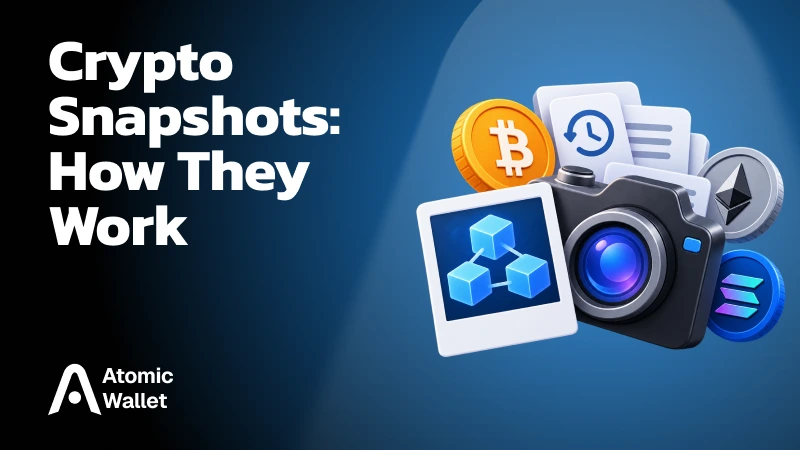
A snapshot in crypto records blockchain data at a specific block, giving projects a reference point for airdrops, voting, and other events.
That reference point matters when balances change. You might hold a token today but have held none when a project took its snapshot. You could also qualify based on an earlier balance, even though you have since moved the funds. Understanding which data counts — and when it was recorded — helps explain who can participate and what happens next.
What Is a Snapshot in Crypto?
A crypto snapshot is a record of selected blockchain data at a particular block height.
Depending on its purpose, it may capture:
- Token balances: How much of an asset each address held
- NFT ownership: Which addresses owned items from a specific collection
- Staking positions: How much was staked or delegated under the project’s rules
You’ll often see two related terms. The snapshot date describes the relevant date and time, usually with a specified time zone. The snapshot block identifies the block used as the reference on the chosen network. For example, Snapshot’s voting platform uses a block number to calculate voting power from the state at that point.
Taking a snapshot does not freeze your tokens or move them to another wallet. The network continues operating while the recorded data provides a fixed reference. The project’s rules determine how that information affects eligibility, voting power, or an allocation.
How Does a Crypto Snapshot Work?
A project selects a reference block, reads the relevant blockchain data, and applies its rules to that historical record.
For a simple token-holder snapshot, the process looks like this:
- Choose the network and block: Specify which blockchain and block height will serve as the reference
- Retrieve the relevant data: Read token balances, NFT ownership, or other qualifying positions at that block
- Apply the event’s rules: Check minimum balances, eligible contracts, exclusions, and any additional requirements
- Calculate the result: Produce the eligible address list, token allocations, or voting power
Suppose address A holds 100 tokens at the selected block. Its owner then transfers all 100 to address B. A balance snapshot for the original block still records those tokens at A. The later transfer changes the current balance without rewriting the earlier state.
The data can also be retrieved after the reference block has passed. Ethereum archive nodes, for example, provide access to historical account balances and contract state.
Some campaigns use several snapshots or calculate average holdings over a period. Others evaluate transaction history up to a cutoff. The published rules tell you whether one balance at one block is enough.
What Are Crypto Snapshots Used For?
Projects use snapshots to establish a consistent reference for rewards, governance, migrations, and network operations.
These uses involve different kinds of records. An airdrop team might need only a list of qualifying addresses and amounts. A node operator needs enough application state to synchronize with the network. CometBFT’s state sync supports the latter approach, reducing the work required to join a running chain.
A snapshot can support a token distribution or migration, but its existence alone does not mean holders will receive a new asset.
Bitcoin Core also uses snapshots through its AssumeUTXO feature. A node can load a snapshot of unspent transaction outputs and synchronize toward the current chain while validating earlier history in the background. Here, the snapshot helps a node get started; it does not determine a token reward.
Snapshot vs. Airdrop Eligibility vs. Claim
A snapshot supplies reference data, eligibility rules determine who qualifies, and a claim or distribution is how recipients receive their tokens.
These stages can happen on different dates:
- Snapshot: The project establishes which balances, positions, or activity will count
- Eligibility: It applies requirements such as minimum holdings, qualifying transactions, and exclusions
- Claim or distribution: Eligible recipients collect their allocation or receive it automatically, depending on the event
Holding a token at the reference block may satisfy one requirement without satisfying all of them. Some airdrops reward earlier activity, apply filters against coordinated wallet farming, or distribute allocations gradually.
The historical Arbitrum airdrop illustrates the distinction. Its snapshot corresponded to Arbitrum One block 58,642,080 on February 6, 2023. Eligibility depended on a points system based on network activity and additional screening. Claiming opened on March 23 and closed on September 24, 2023.
Those dates describe a completed event. Finding an eligible historical address today does not reopen its expired claim period.
Uniswap’s 2020 UNI distribution included an unusual detail: roughly 12,000 addresses qualified for 400 UNI each despite having submitted only failed transactions. Eligibility recognized historical attempts to use the protocol. A failed transaction recorded on-chain can therefore count under a campaign’s rules, even when the intended swap never completed.
What Happens If You Move Tokens Before or After a Snapshot?
A transfer changes your current balance, but it cannot change the balance recorded at an earlier reference block.
For a campaign using a single balance snapshot, timing generally works like this:
Submitting a transaction before an announced time is therefore different from having it included by the required block. Check the project’s official network, block reference, and cutoff rules.
Moving tokens after a snapshot may preserve eligibility when the campaign relies solely on that historical balance. However, some events use multiple snapshots, average holdings, or continued participation requirements. Confirm those conditions before assuming the first snapshot completes every requirement.
Do Staked Tokens and Exchange Balances Count?
Staked tokens count when the snapshot rules include those positions. Exchange balances depend on the event’s requirements and the exchange’s participation policy.
The total shown in your wallet or exchange account may differ from the balance a project measures. Check how the event treats each type of holding:
- Staked or delegated tokens: The project may read staking records or include specific staking contracts
- Liquidity pool deposits: Your position may be represented by an LP token or NFT rather than a balance of the deposited assets at your address
- Wrapped or bridged tokens: The event must recognize the relevant token contract and network
- Exchange holdings: The provider controls the on-chain addresses, so customer allocations depend on its published support and accounting rules
For example, the completed FlareDrops program included both wrapped FLR holdings and eligible staked FLR in its calculations. Those were specific program rules, rather than a general rule for every snapshot.
Before moving or unstaking anything, read the official eligibility criteria. A different wallet app cannot make an excluded network, contract, or position qualify.
Is Snapshot the Same as the Snapshot Voting Platform?
A snapshot is a record of blockchain data. Snapshot is also the name of a governance platform that uses such records to calculate voting power.
DAOs and other communities use Snapshot to publish proposals and collect votes. Each proposal has rules for determining who can participate and how much voting power they receive. These may use token balances, NFT ownership, delegation, or other qualifying data.
A reference block keeps that calculation consistent throughout a vote. Without a fixed reference, someone could vote with tokens, transfer them to another address, and attempt to use the same balance again. Tokens acquired after the selected block generally do not add voting power to that proposal.
In the classic platform, voters sign messages off-chain, so casting a ballot does not require an on-chain transaction or a gas fee. The result’s implementation depends on the community’s governance arrangements.
Snapshot X is a separate, fully on-chain governance protocol. Its voting and execution mechanisms differ, so “Snapshot is always off-chain and gas-free” is too broad. When reading an announcement, check whether it refers to a snapshot event, the classic voting platform, or Snapshot X.
What Should You Check Before a Crypto Snapshot?
Check the official rules for the network, reference block, qualifying positions, and any steps required after the snapshot.
A short announcement may leave out details that determine whether your address qualifies:
- Verify the source: Find the announcement through the project’s official website or documentation
- Confirm the network and asset: Check the blockchain, token contract, or NFT collection being measured
- Read the timing details: Note the block number, date, time zone, and whether the campaign uses one snapshot or several
- Review the eligibility rules: Look for minimum balances, qualifying activity, staking treatment, and exchange support
- Check what happens afterward: Confirm whether distribution is automatic, whether a claim is required, and whether a deadline applies
If a transfer is necessary, allow time for its inclusion in the blockchain. A pending transaction may miss the reference block even if you submitted it before the announced time.
Reading public blockchain data does not require your recovery phrase or permission to spend your tokens. Connecting a wallet, signing a message, and claiming an allocation are separate actions. Review each request rather than treating it as a routine part of “being snapshotted.”
How Do Snapshots Work With Atomic Wallet?
A snapshot can read qualifying holdings at your Atomic Wallet address from the blockchain, even when the app is closed.
In our app, open the relevant asset to check its receiving address and network. You can use that address to review transactions in the appropriate block explorer and compare your activity with the project’s published requirements. Your current balance may differ from the balance recorded at an earlier block.
Holding assets in Atomic Wallet does not automatically qualify you for every event. The project decides which addresses and positions count. Separately, confirm that we support the distribution’s network and asset, and check whether receiving the allocation requires a claim procedure.
Keep your 12-word backup phrase private throughout the process. Our support team will never ask for it, and a website requesting it to “register for a snapshot” is attempting to obtain control of your wallet.