What Is an IOU? How It Works in Finance and Crypto
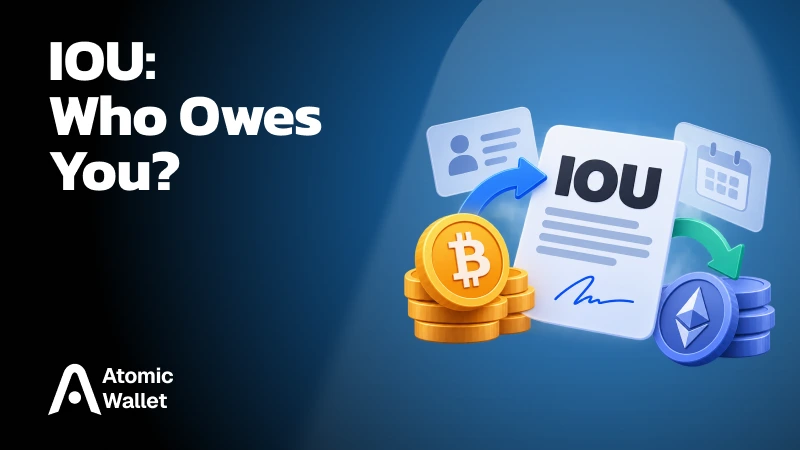
IOU stands for “I owe you.” It is an acknowledgment that one person or organization owes something to another, usually money. A handwritten note recording a $100 debt is a simple example.
In crypto, IOUs can represent obligations to deliver tokens or other assets. Some exist as balances inside an exchange; others can move between blockchain addresses. What you can do with an IOU depends on who issued it and the terms attached to it.
IOU predates digital messaging by centuries: Merriam-Webster dates its first known use to 1795.
How Does an IOU Work?
An IOU records who owes a debt, who is owed, and the amount or asset involved. It gives the parties a written reference for an obligation that remains unpaid.
Suppose Alex borrows $100 from Jordan. Alex writes, “I owe Jordan $100,” then dates and signs the note. Jordan keeps the IOU as a record of the debt.
A more detailed version might include:
- The names of the borrower and lender
- The amount owed and the currency
- The date the debt was recorded
- Any agreed repayment date or schedule
The details matter when the parties remember an arrangement differently. If Jordan expects repayment next Friday while Alex expects to pay next month, a note stating only the amount leaves that question unresolved.
An IOU does not automatically include interest, collateral, or a repayment schedule. Those terms must come from the arrangement between the parties. A document that also sets out an explicit promise to repay may function more like a promissory note.
IOUs have also appeared in government finance. During its 2009 cash crisis, California issued roughly 449,000 registered warrants, commonly called IOUs, covering $2.6 billion in payments. They became redeemable on September 4, 2009, with interest at a 3.75% annual rate, according to the California Legislative Analyst’s Office.
IOU vs Promissory Note: What’s the Difference?
An IOU acknowledges that a debt exists, while a promissory note contains an explicit promise to repay it and usually provides more detailed payment terms.
Both can document money owed between people or businesses. The distinction lies in what the document actually says.
For example, “I owe Jordan $100” acknowledges the debt. “I promise to pay Jordan $100 on November 15” adds an express undertaking to repay on a stated date.
The U.S. Uniform Commercial Code distinguishes an acknowledgment of an obligation from an undertaking to pay it. However, calling a document an IOU does not automatically make it unenforceable. Its wording, the evidence surrounding the transaction, and applicable law determine its legal effect.
How Are IOUs Used in Crypto?
In crypto, an IOU generally represents a claim on an asset that an issuer, platform, or counterparty is expected to deliver under specified terms.
The arrangement can serve different purposes. A platform might enable trading before tokens become available for withdrawal, while an issuer might create transferable tokens representing assets held elsewhere.
Two implementations help explain the difference:
- Exchange-based IOUs: A platform records an entitlement in its own system and may allow users to trade it before delivery. External transfers depend on the platform’s rules and whether withdrawals are available
- On-chain issued assets: An issuer creates tokens that users can hold and transfer on a blockchain. Any right to receive an underlying asset depends on the issuer’s redemption terms
The XRP Ledger provides an established example of the second model. Its learning glossary identifies IOU as an older name for issued currencies. A dollar-denominated token from one issuer can have different backing and redemption conditions from a token using the same currency code issued by someone else.
The blockchain can record balances and transfers, but that record does not establish whether an issuer holds sufficient reserves or will fulfill an obligation. Understanding a crypto IOU therefore requires checking both the asset itself and the arrangement behind it.
Crypto IOUs vs Native Crypto Assets
A crypto IOU represents an obligation involving an underlying asset. Holding native BTC or ETH directly means you already hold that asset, without needing an issuer to deliver it later.
The distinction matters when you want to transfer or use what you have.
An on-chain IOU can itself be a transferable token. However, transferring that token does not necessarily deliver the asset it represents. A token redeemable for BTC remains distinct from native BTC on the Bitcoin network.
Self-custody also has a specific role here. Holding an issuer-backed token in your own wallet gives you control over your keys and the transfers they authorize. The issuer’s backing, redemption conditions, and any token restrictions still matter.
How Do You Redeem a Crypto IOU?
A crypto IOU is redeemed when its issuer or platform settles the claim under the agreed terms, typically by delivering the underlying asset. The process may be automatic or require a request.
For an exchange-based IOU, the platform may announce a conversion date and replace eligible IOU balances with actual tokens. Whether you can then withdraw those tokens depends on withdrawal availability, account eligibility, and the supported network.
For an on-chain claim, redemption may require submitting a request to the issuer and returning the tokens through its designated process. Sending tokens to an issuing address without checking those instructions does not establish that you will receive a payout.
Selling an IOU is a different transaction. Another buyer pays you for the claim, which continues to exist under its terms. A sale lets you exit at an available market price; redemption fulfills the obligation itself.
Why Can an IOU’s Price Differ From the Underlying Asset?
An IOU’s price reflects both the expected value of the underlying asset and the conditions involved in receiving it. Delays, limited liquidity, and uncertainty about delivery can affect what buyers will pay.
A claim redeemable immediately under clear conditions can trade differently from one whose settlement date remains uncertain. Fees and restrictions on who can redeem may also affect its market price.
Pre-launch trading adds another variable: the underlying token may not yet have an established market price. Traders are buying and selling based on expectations about future demand and supply.
Consider this hypothetical example:
- You pay $200 for IOUs representing 100 future tokens
- The platform successfully converts them into 100 tokens at a 1:1 ratio
- Those tokens begin trading at $1 each, making your holdings worth $100 before fees
The promised quantity was delivered, but the position lost value. A 1:1 conversion specifies how many tokens you receive, not their dollar price.
Restrictions can also allow price differences between venues to persist. When deposits and withdrawals are unavailable, traders cannot freely move assets between markets to take advantage of those differences.
What Are the Risks of IOUs?
The central risk of an IOU is that the issuer or counterparty fails to fulfill the obligation. Even when delivery succeeds, restrictions, costs, or market conditions can affect the outcome.
The risks depend on how the arrangement works:
- Counterparty failure: The party responsible for delivery may lack the assets or funds needed to settle
- Settlement delays or conditions: Delivery may depend on a token distribution, account verification, or another requirement that remains incomplete
- Limited liquidity: You may struggle to sell the IOU, particularly if few buyers are available or the gap between buying and selling prices is wide
- Platform or token restrictions: Withdrawals may be suspended, or an on-chain issuer may have powers to restrict transfers, depending on the token’s design
Backing and collateral deserve separate attention. A statement that an IOU is “backed” does not establish what assets are held, who controls them, or which holders can access them.
Before acquiring an IOU, establish who owes the asset, when you can receive it, what conditions apply, and what happens if delivery fails. Those details reveal more about the arrangement than its ticker or displayed balance.
Manage Your Crypto With Atomic Wallet
Atomic Wallet lets you receive, send, and exchange supported crypto assets while keeping control of your private keys.
When an IOU is settled, check which asset you receive and whether withdrawals are available on a network your wallet supports. Once the asset reaches your wallet, you can manage it directly through our app.
Keep the distinction between access and redemption in mind. Controlling your private keys gives you control over the transactions they authorize. Any issuer obligations attached to a token still depend on that token’s terms.
Download Atomic Wallet to manage your supported crypto assets in one place.