What is Monero?
Monero is a cryptocurrency built for privacy. On most blockchains anyone can look up an address and see its balance and every payment it made. On Monero the sender, the receiver and the amount of every transaction are hidden by default, so the history of your coins stays private.
Because of this, every XMR is interchangeable with any other, and no coin can carry a tainted history. Monero (XMR) is used for private payments and by people who do not want their finances to be public.
How does Monero keep transactions private?
Monero combines three tools. Ring signatures mix your payment with decoys taken from the blockchain, so observers cannot tell which output is really being spent. Stealth addresses create a new one-time address for every payment, so your public address never appears on the chain. RingCT, added in 2017, hides the amount.
Bulletproofs, added in 2018, made these proofs much smaller and cut fees sharply. You can still prove a payment when you need to by sharing a view key or a transaction proof with the person you choose.
Mining and RandomX
Monero uses proof of work, like Bitcoin, but its RandomX algorithm, used since November 2019, is designed to run best on ordinary computer processors. That keeps specialized mining chips at a disadvantage and lets anyone with a regular computer take part in mining. A new block is added about every 2 minutes.
XMR supply
Monero has no hard cap. The main emission ended in 2022, after about 18.1 million XMR had been created. Since then the network releases a fixed 0.6 XMR per block forever. This tail emission keeps miners paid and keeps yearly inflation below 1%. Around 18.83 million XMR are in circulation today.
A short history of Monero
Monero launched on April 18, 2014 as a fork of Bytecoin, built on the CryptoNote protocol. It was first called BitMonero; monero means coin in Esperanto. The original developer left within weeks, and a community of volunteer developers has run the project ever since. The network upgrades on a regular schedule, which is how RingCT, Bulletproofs and RandomX were added.
What moves the price of XMR?
XMR follows the wider crypto market, but privacy rules matter more for it than for most coins. When large exchanges delist privacy coins under regulatory pressure, XMR becomes harder to buy and its price can drop. Growing interest in financial privacy and a small, steady supply growth support demand.
How to store Monero safely
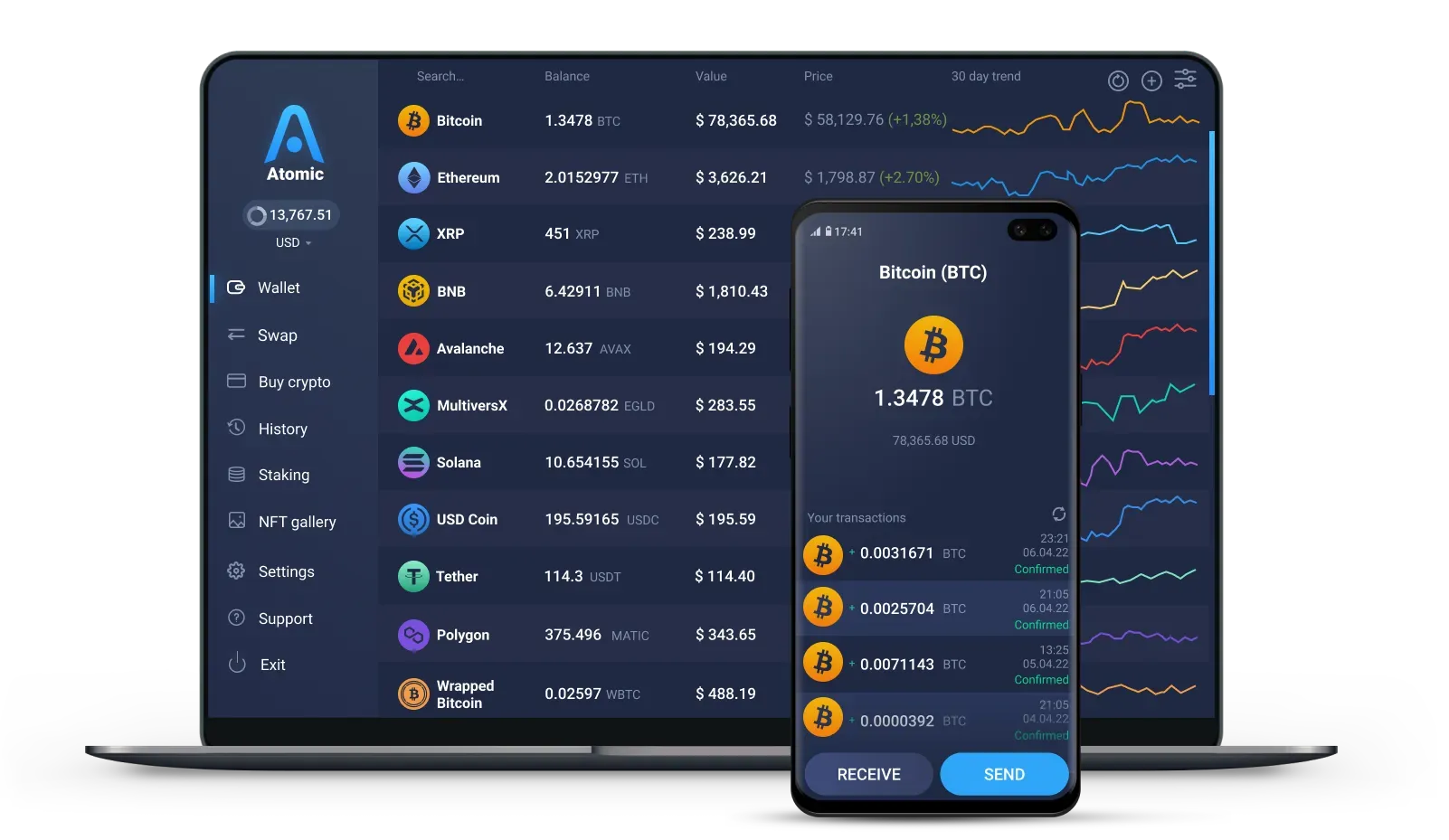
The safest way to hold XMR is a self-custody wallet, where only you control the private keys. In Atomic Wallet your keys are encrypted and never leave your device, and a 12-word backup phrase lets you restore your wallet on any device. You can buy XMR with a card, swap it for BTC, USDT and other coins, and keep it next to the rest of your crypto in one app.