What is Tether?
Tether (USDT) is a stablecoin: a token designed to be worth one US dollar. Each USDT is pegged 1:1 to the dollar and, according to Tether, can be redeemed for dollars under its terms of service. That lets you hold dollars on a blockchain and send them at any hour, without a bank in the middle.
Traders use USDT to park funds between trades without cashing out, and people use it to send dollars across borders. Tether Limited, a company registered in the British Virgin Islands, issues the token.
What backs USDT?
Tether says every USDT is fully backed by its reserves. The reserves hold cash and cash equivalents, mostly US Treasury bills, plus other assets that include loans Tether has made to third parties. Tether publishes a reserves report every quarter, prepared by the independent accounting firm BDO Italia, and updates the number of tokens in circulation on its transparency page.
Which networks does USDT run on?
USDT is issued natively on several blockchains, among them Tron, Ethereum, Solana, TON, Algorand, Celo, Tezos and the Liquid Network. USDT on one network is a separate token from USDT on another. When you send it, the sender and the receiver have to use the same network, otherwise the transfer may not arrive.
USDT supply
USDT has no fixed supply. Tether creates new tokens when customers deposit dollars and takes tokens out of circulation when they redeem them, so the supply follows demand for the stablecoin. Around 174.8 billion USDT are in circulation today.
A short history of Tether
Tether launched in 2014 as one of the first stablecoins. Its first tokens were issued on the Omni Layer, a protocol built on top of the Bitcoin blockchain. The project was co-founded by Brock Pierce, Reeve Collins and Craig Sellars. USDT later spread to Ethereum, Tron and many other networks, and Paolo Ardoino has led Tether as CEO since October 2023.
Why does USDT stay near $1?
USDT is not meant to rise or fall in value. Its price stays close to one dollar because Tether issues and redeems tokens at that rate and holds reserves against them. During sharp market stress the price on exchanges can drift slightly above or below $1 for a short time. For a USDT holder the questions that matter are the quality of the reserves and the network you use, not the chart.
How to store USDT safely
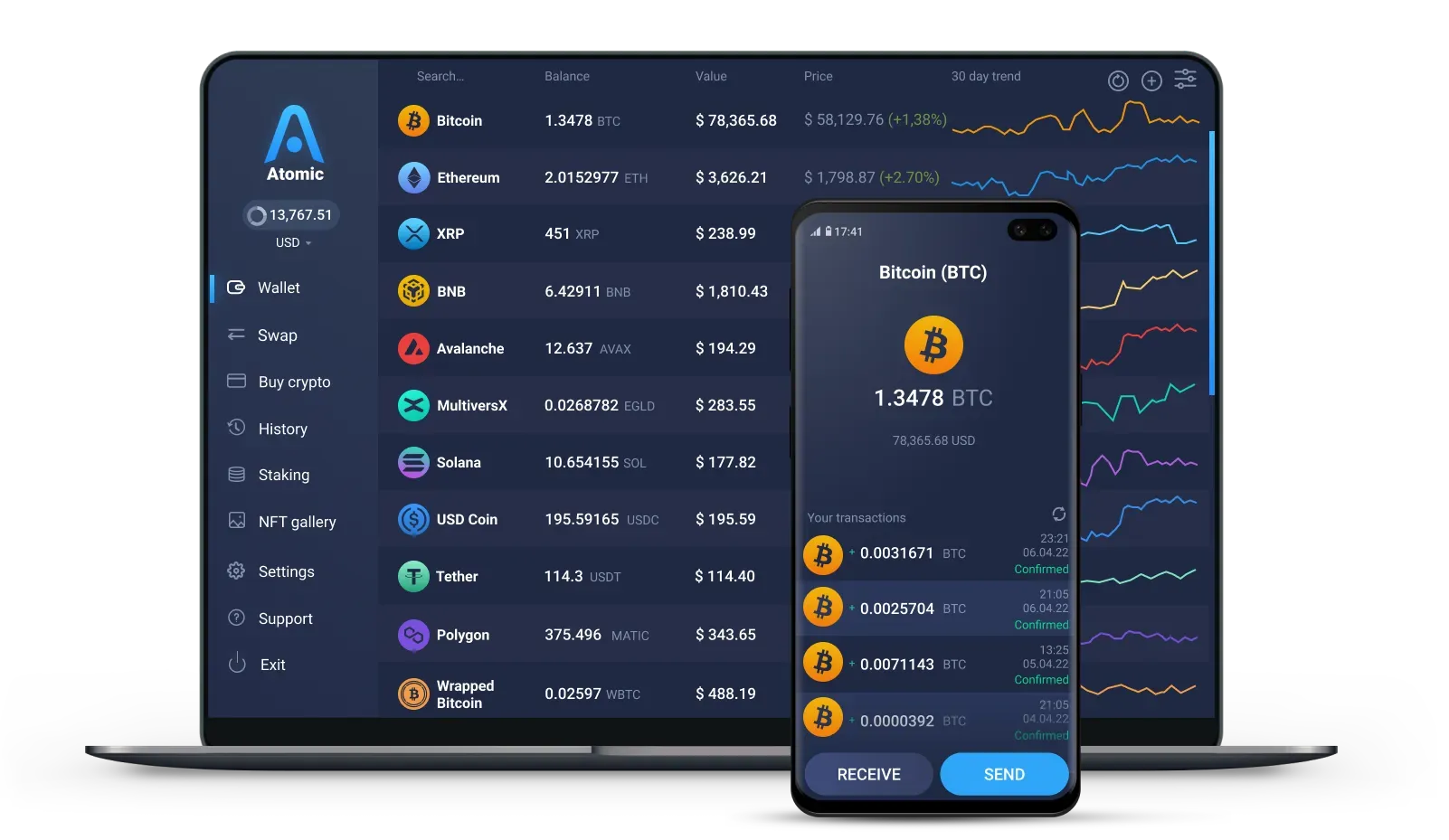
The safest way to hold USDT is a self-custody wallet, where only you control the private keys. In Atomic Wallet your keys are encrypted and never leave your device, and a 12-word backup phrase lets you restore your wallet on any device. To send USDT, keep a little of the network's own coin, such as TRX on Tron or ETH on Ethereum, to pay the network fee.