What is Cardano?
Cardano is a blockchain platform for smart contracts, decentralized apps and tokens. It is built on peer-reviewed research: new features are described in academic papers and checked before they go live. Cardano is known for its careful, step-by-step approach and for letting ADA holders take part in running and governing the network.
ADA is the native coin of Cardano. It pays for transactions, is staked to secure the network and gives holders a vote on how the protocol changes and how the treasury is spent.
How does Cardano work?
Cardano uses Ouroboros, a proof-of-stake protocol. Time is split into epochs of five days, and stake pools take turns producing blocks; the more ADA is delegated to a pool, the more often it is chosen. Smart contracts have run on Cardano since the Alonzo upgrade in September 2021.
Tokens on Cardano are native: they live on the blockchain itself, not inside a smart contract, so sending them is as simple and cheap as sending ADA.
Staking ADA
You can delegate your ADA to a stake pool and earn rewards every epoch. Your coins never leave your wallet and are not locked, so you can spend or move them at any time. In Atomic Wallet you can stake ADA in a few taps and earn about 3.06% a year.
ADA supply
There will never be more than 45 billion ADA. New ADA comes from a reserve that pays staking rewards and funds the treasury, and the amount released falls over time. Around 36.82 billion ADA are in circulation today.
A short history of Cardano
Cardano was founded by Charles Hoskinson, a co-founder of Ethereum, and is developed by Input Output together with the Cardano Foundation and Emurgo. The network launched on September 29, 2017. Its development is split into eras: Byron launched the coin, Shelley added staking in 2020, Goguen brought smart contracts in 2021, and the Chang upgrade in 2024 started Voltaire, which hands governance to ADA holders. The platform is named after the mathematician Gerolamo Cardano and the coin after Ada Lovelace.
What moves the price of ADA?
ADA follows the wider crypto market. Its price also reacts to big network upgrades, to how many apps and how much money are on Cardano, and to the share of ADA that is staked.
How to store Cardano safely
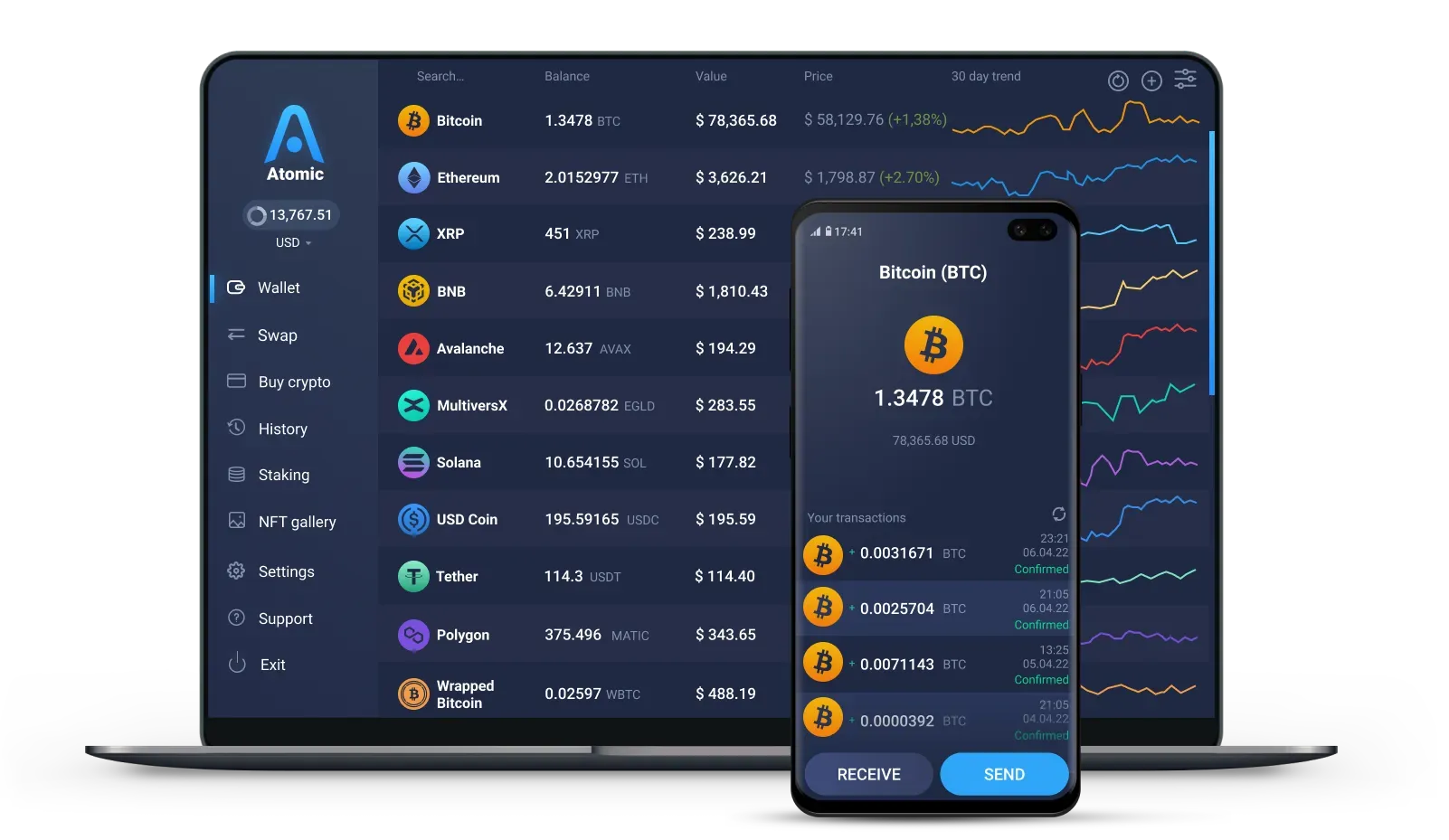
The safest way to hold ADA is a self-custody wallet, where only you control the private keys. In Atomic Wallet your keys are encrypted and never leave your device, and a 12-word backup phrase lets you restore your wallet on any device. You can buy, swap, stake and hold ADA next to 1000+ other coins in one app.