What is Monad?
Monad is a layer-1 blockchain that runs the Ethereum Virtual Machine much faster. It uses the same address format and RPC as Ethereum, so Ethereum contracts, MetaMask and explorers like Etherscan work with it, but blocks come every 300 milliseconds and transactions are final in 600 milliseconds. The network is built for up to 10,000 transactions per second.
MON is the native coin of Monad. It pays transaction fees and is staked to secure the network.
How does Monad work?
Most of the speed comes from parallel execution: Monad runs many transactions at the same time, yet the result is always the same as if they had run one by one. Consensus and execution are also separated and pipelined, so the network agrees on the order of transactions while executing earlier ones. Other parts include the MonadBFT consensus, RaptorCast for spreading blocks, a JIT compiler and MonadDb, a database built for Ethereum state.
Staking MON
Monad uses proof of stake. To be an active validator, an operator needs at least 100,000 MON of its own, 10 million MON of total stake and a place in the top 200 by stake. Holders can delegate MON to a validator and share the new MON minted for each block, minus the validator's commission. Priority fees from the block go to the validator alone.
MON supply
Monad launched with 100 billion MON. There is no hard cap: block rewards add new MON, while the base part of every transaction fee is burned. About 49.4% of the supply was unlocked on day one. Tokens held by investors, the team and the Category Labs treasury stay locked for at least a year and unlock fully by the end of 2029. Around 25.81 billion MON are in circulation today.
A short history of Monad
The first Monad client was written from scratch in C++ and Rust by Category Labs, and the token is issued by the Monad Foundation. From October 14 to November 3, 2025, 289,000 accounts could claim 4.73 billion MON in an airdrop. The Foundation published the tokenomics on November 10, 2025, and the Monad public mainnet launched on November 24, 2025.
What moves the price of MON?
MON is a young coin, so its price is driven by activity on the network, the apps launched there and the unlock schedule. The large block of tokens locked until 2029 will reach the market step by step. Fee burns and the share of MON staked work in the other direction, and the wider crypto market moves MON as well.
How to store Monad safely
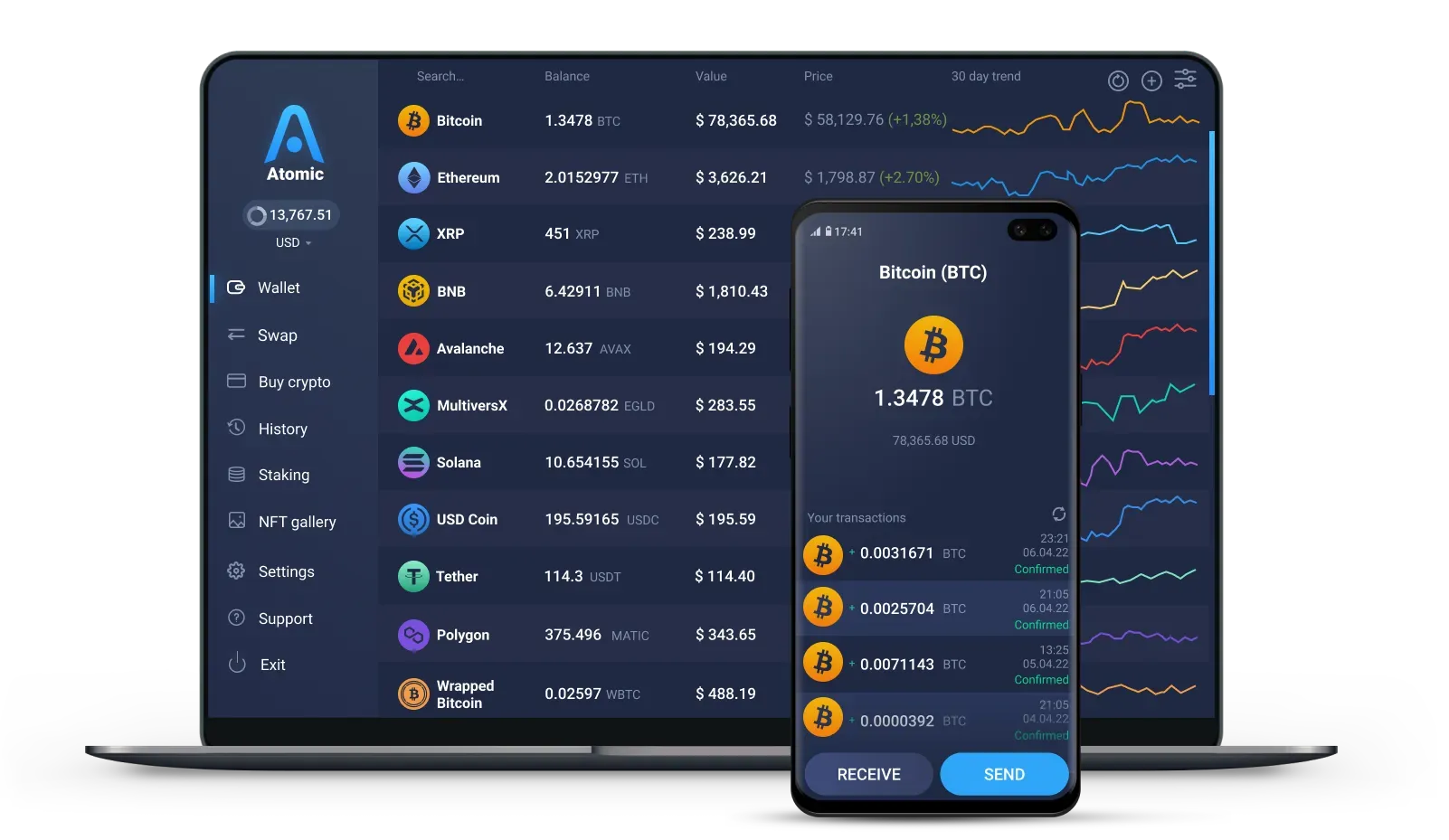
The safest way to hold MON is a self-custody wallet, where only you control the private keys. In Atomic Wallet your keys are encrypted and never leave your device, and a 12-word backup phrase lets you restore your wallet on any device. You can swap MON for USDT and other coins and keep it next to the rest of your crypto in one app.