What is Starknet?
Starknet is a permissionless layer-2 network on top of Ethereum. It is a validity rollup: thousands of transactions are executed off the main chain, and a single cryptographic proof that they were executed correctly is checked on Ethereum. Users get lower fees while the result is secured by Ethereum.
STRK is the native token of Starknet. Since September 2025 all transaction fees on the network are paid in STRK.
How does Starknet work?
A sequencer collects transactions and orders them into blocks. A prover called SHARP then generates STARK proofs that the new state of the network is correct, and Ethereum verifies them. Compressed state changes are published on Ethereum, so anyone can rebuild the state. Smart contracts are written in Cairo, a language created by StarkWare.
Every Starknet account is a smart contract. That makes multisig, session keys and passkey logins native features rather than add-ons.
Staking STRK
STRK holders can stake to help secure sequencing and block validation and earn rewards in STRK. Running a validator takes at least 20,000 STRK and a full node; delegators can stake any amount. Withdrawing staked tokens takes 7 days. Since 2025 tokenized BTC can also be staked, with rewards paid in STRK. STRK also gives votes on governance proposals.
STRK supply
StarkWare created 10 billion STRK, and they were minted on chain on November 30, 2022. There is no hard cap: the protocol issues new STRK as staking rewards, so the total supply grows slowly above 10 billion. Around 7.83 billion STRK are in circulation today.
A short history of Starknet
Starknet was built by StarkWare, the company that developed STARK proofs and the Cairo language. Starknet Alpha went live on Ethereum mainnet on November 29, 2021. STRK became claimable on February 20, 2024 through the Starknet Provisions program. Staking launched in November 2024, making Starknet the first major rollup with staking on layer 2. In January 2026 STRK became available on Solana through NEAR Intents.
What moves the price of STRK?
STRK follows the wider crypto market and Ethereum in particular. Activity on Starknet matters directly, because every transaction now pays its fee in STRK. The share of STRK locked in staking and new staking emissions, which slowly add to the supply, also affect it.
How to store Starknet safely
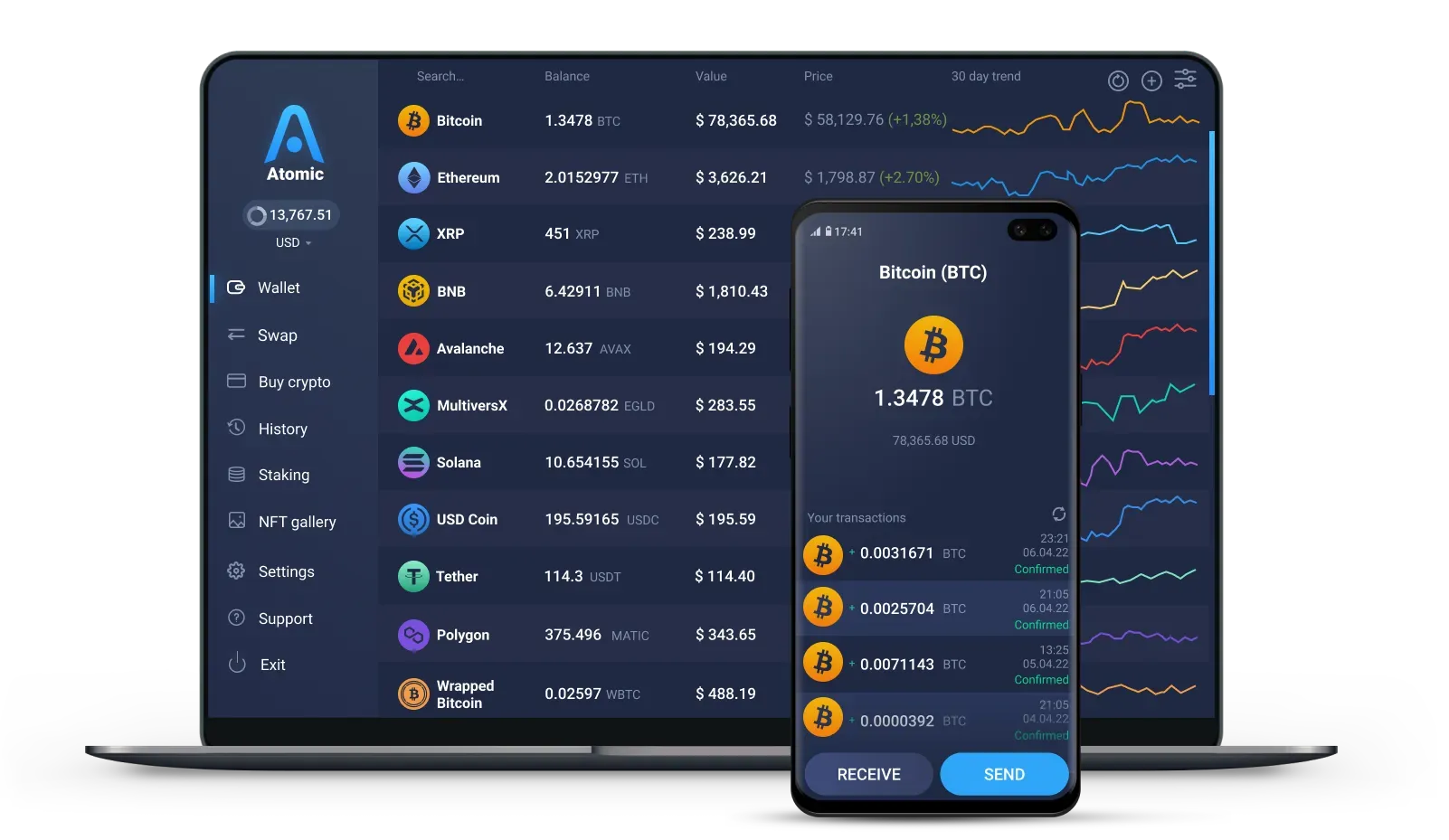
The safest way to hold STRK is a self-custody wallet, where only you control the private keys. In Atomic Wallet your keys are encrypted and never leave your device, and a 12-word backup phrase lets you restore your wallet on any device. You can buy STRK with a card and keep it next to ETH and the rest of your crypto in one app.